
The Kiss (Lovers)
1908
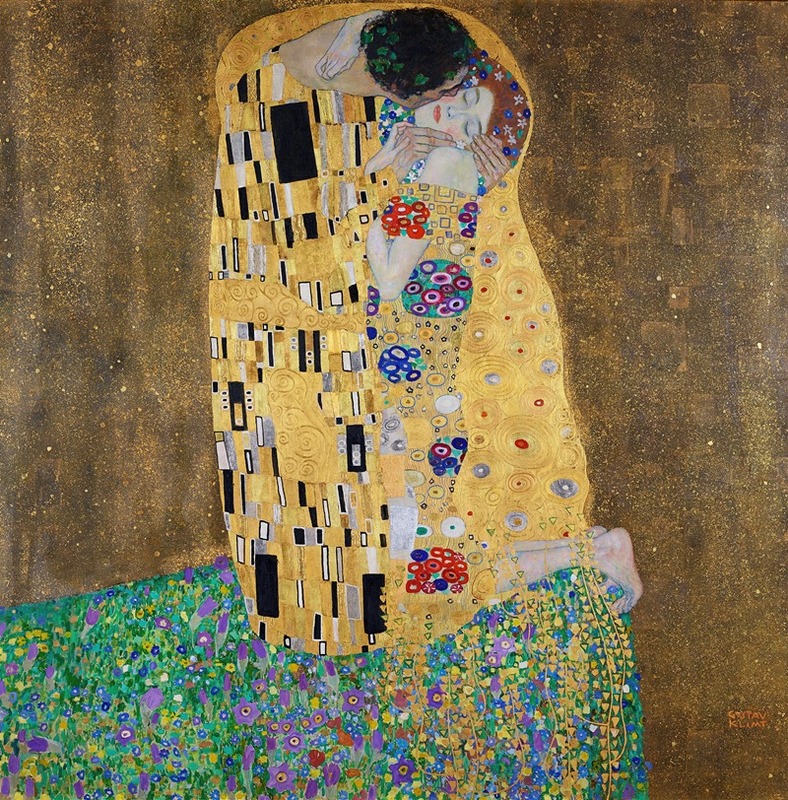
- Dimensions
- 180 × 180 cm
- Medium
- Oil, resin oil paint, gold leaf, silver leaf, platinum leaf, brass leaf on zinc white ground, canvas
- Collection
- Belvedere Museum, Vienna
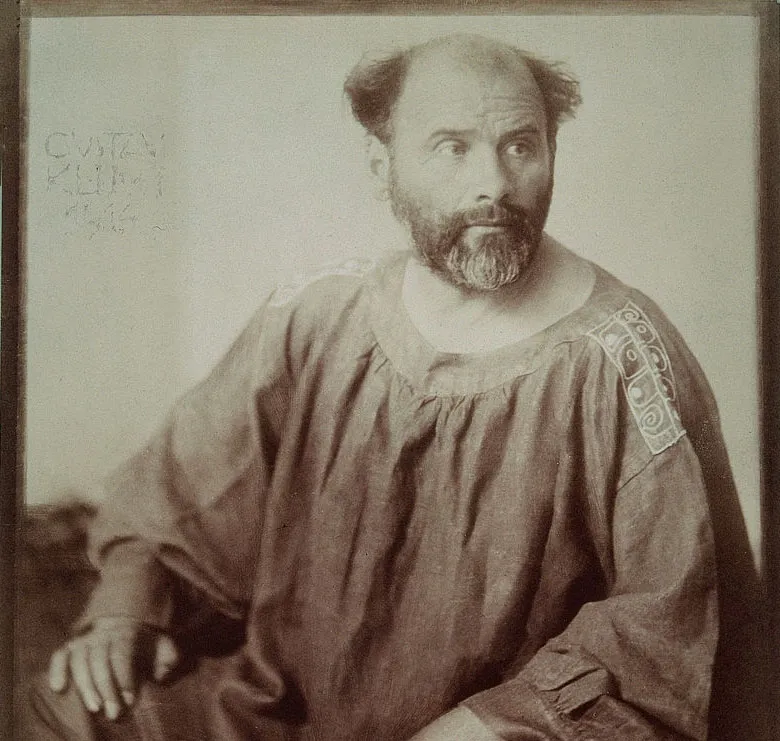
One of Vienna's foremost Symbolist painters active from the late 19th to early 2…
A testament to complete artistic freedom in the face of state oppression and fierce criticism. By entrusting a universal vision of love—belonging to no one in particular—to dazzling gold and cellular patterns, the artist achieved a quiet victory.
✦ Highlights (technique & color)
The golden radiance that dominates the canvas is achieved through the skillful use of not only pure gold, but also silver, platinum, and brass leaf. Irregularly crushed gold leaf was scattered across the background to create a starry shimmer. In contrast, no metal leaf was used for the faces and limbs, which were painted directly in oils on the canvas with delicate gradations. Two-dimensional ornamentation and three-dimensional realism merge seamlessly.
✦ The setting of this painting
The setting depicted is not a specific, real-world location, but an entirely fictional, timeless space. In the meadow beneath the figures' feet, flowers reminiscent of buttercups and violets are meticulously rendered. This decorative vision of nature arose from a synthesis of the Alpine flora Klimt observed during his summers by Lake Attersee and the compositional methods of the Japanese botanical prints he collected.
✦ Historical context
When this painting was first unveiled in 1908, the Austro-Hungarian Empire was flaunting its superficial splendor on the occasion of Emperor Franz Joseph I's 60th anniversary on the throne. At the same time, advances in microscopy were revealing microscopic realms such as cellular structures and early embryos, knowledge that was beginning to reach the general public. It was an era when cutting-edge scientific discoveries were elevated into artistic motifs.
At the edge of a sheer cliff carpeted with vivid wildflowers,
a man and a woman wrapped in golden robes share a deep embrace.
Cradling the kneeling woman's face in both hands, the man tenderly presses his lips to her right cheek.
Her eyes are closed, her face radiant with serene ecstasy.
It is often believed that the models were the artist himself and his companion, Emilie Flöge.
Others recount that the painting sparked a scandal with its daring sensuality.
Yet in truth, no evidence exists that it depicts any specific individuals.
And far from facing condemnation, the unfinished work was purchased by the state for a record-breaking sum.
Vienna in the early 1900s.
Entering his forties, Gustav Klimt found himself swept into a storm of fierce backlash.
Commissioned to paint the ceiling murals for the Great Hall of the University of Vienna,
he saw his work denounced as decadent.
Conservative professors and parliamentarians unleashed venomous criticism.
He resolved to refuse all public commissions.
With the support of private patrons, he even returned the advance payments he had received from the state.
Free from state pressure,
Klimt gained total artistic freedom through private patronage.
Bound by no client's request,
driven solely by his own will, he stood before a monumental canvas measuring 180 centimeters square.
In his Vienna studio in 1907,
he deftly orchestrated not only pure gold, but also silver, platinum, and brass leaf.
Directly on the canvas, he rendered their flesh in oils, crafting delicate, nuanced shadows.
What he painted was no specific pair,
but a universal vision of two lovers.
The concentric circles and ovals adorning the woman's dress
evoke the forms of early embryos and fertilized eggs seen through a microscope.
Drawing on cutting-edge biology learned from an anatomist friend, he entrusted the mystery of life to these motifs.
The blossoms at their feet reflect the landscape of Lake Attersee, where he spent his summers,
blended with the delicate compositions of Japanese botanical prints.
About 230 more words
Read stories of masterpieces for free
Stories featuring this painting
Your Note
Write down what this painting made you feel in your art notebook.
Please sign up to write notes.
Sign up for freeRecommended Artworks
Sources & references
More artists
If you find an error in this content, please let us know here
This site is protected by reCAPTCHA, and the Google Privacy Policy and Terms of Service apply.