
 日本語 (JA)
 English (EN)
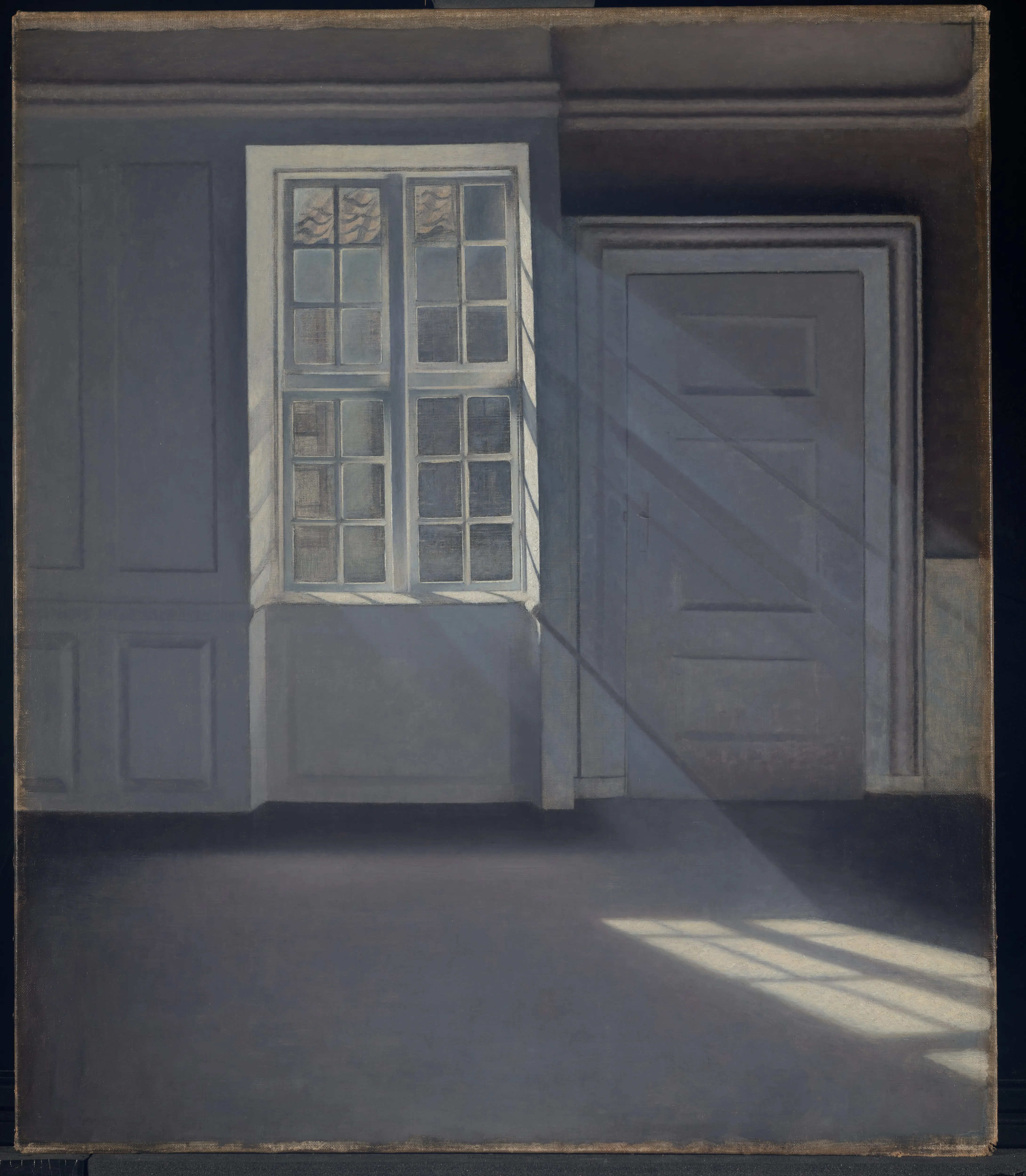
- Dimensions
- 縦 70.0 cm × 横 59.0 cm
- Medium
- Oil on canvas
- Collection
- Ordrupgaard
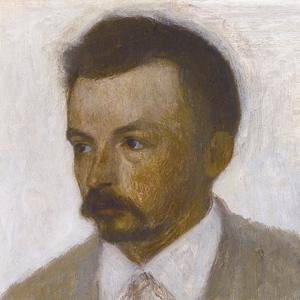
A quiet rebellion against the plein-air painters who exalted outdoor light. A consummate pursuit capturing the pure stillness of light and space, revealing a beauty found only in an empty room.
✦ Highlights (technique & color)
Though appearing at first glance as a cold monochrome of gray, the painting actually possesses a sophisticated structure, with varied grays layered over a reddish-brown and pinkish underpainting. This produces a warm luminosity that seems to emanate from within. By smoothly blending tonal transitions with a dry brush and softening contours, Hammershøi gives the canvas a tactile presence, as though the air itself were subtly vibrating.
✦ The setting of this painting
The setting is an apartment at Strandgade 30 in the Christianshavn district of Copenhagen, Denmark. A historic merchant house built in the early 17th century, it was the rented home where the artist and his wife, Ida, lived for eleven years. Although the surrounding area at the time was a bustling harbor quarter lined with shipyards and factories, the painter shut out the clamor of the outside world, using the room as an aesthetic laboratory to fashion a space of consummate abstraction.
✦ Historical context
Between the late 19th and early 20th centuries, advances in photography profoundly reshaped painters' visual sensibilities. While plein-air painting celebrating outdoor light dominated the Danish art scene, Hammershøi adopted a symbolist approach, confining light within interior spaces. Furthermore, contemporary philosophies—the notion that purposeless contemplation nourishes the soul, along with reflections on existential solitude—inform the aesthetic of silence underlying this work.
A low winter sun casts a rectangle of light onto the cold floor, accompanied by the shadow of the window frame. Within this sharp shaft of light, countless fine motes of dust dance quietly. There is no one in the room. There is no furniture, no painting adorning the walls, nothing that suggests the presence of everyday life. There is only a closed white door and the sunlight streaming through the window. This scene, painted by the Danish artist Vilhelm Hammershøi, draws the viewer instantly into a profound stillness. Why did he continue to paint such completely empty rooms?
An Artist Who Found Beauty in Empty Rooms
In 1900, at the age of thirty-six, Hammershøi was entering a period of complete maturity in his artistic style. With a stable financial foundation supported by patrons, he had the freedom to immerse himself in his own artistic exploration, untroubled by market trends or the demands of clients.
This painting was not a commission, but entirely self-directed work. In the Danish art world of the time, plein-air painting was dominant—exemplified by the Skagen Painters, who captured outdoor nature and dazzling light—making the depiction of an empty, enclosed room extraordinarily unconventional.
Yet Hammershøi's gaze was always drawn inward, toward the quiet domestic interiors around him.
He later reflected on his work:
"I have always thought there was such beauty about a room like that, even when there's nobody in it, perhaps especially when there's nobody in it."
To him, human figures and lavish furnishings may have seemed like nothing more than noise that obscured the innate, pure beauty of the space itself. It is precisely in an empty space that unseen truths—the shift of light, the gentle tremor of the air—dwell. Hammershøi dedicated his life to capturing these quiet truths on canvas.
A Stillness Forged in the Heart of a Bustling City
Encountering the overwhelming quietude conveyed by this painting, one might imagine an old manor in a remote, rural landscape. Yet the setting was no peaceful countryside; it was an apartment in a noisy harbor and industrial district, alive with the smoke and whistles of steamships.
Hammershøi and his wife, Ida, lived at Strandgade 30 in the Christianshavn district of Copenhagen, the Danish capital. While it was a historic merchant house built in the seventeenth century, the surrounding area at the time was crowded with shipyards, factories, and warehouses, humming with the busy movement of dockworkers. Outside the window lay the hurried reality of a modernizing city.
Yet no hint of this external noise ever reaches Hammershøi's canvas. He treated this rented home not merely as a living space, but as a laboratory for exploring the dialogue between light and space. He routinely rearranged or entirely removed the furniture, transforming his everyday domestic quarters into a cloistered, monastic sanctuary for his art.
No matter how loudly or rapidly the outer world changed, he created within his rooms an absolute stillness in which to confront his own inner vision. The closed doors and opaque windowpanes, which obscure any view of the exterior, bear witness to his deliberate decision to shut out the outside world and invite in only the purest light.
Setback in London: The Painter He Could Not Meet
A bitter experience may have cast its shadow over Hammershøi's deepening pursuit of silence. In the autumn of 1897, a few years before this piece was painted, he traveled to London with his wife, Ida. While he was drawn to the distinctive light of the mist-shrouded city, he carried another purpose close to his heart.
The artist visited the London studio of James McNeill Whistler, whom he deeply admired, hoping to meet him, but the meeting never took place. Known for his muted palettes and aesthetics of harmonious arrangement, Whistler was an artist with whom Hammershøi resonated profoundly, even referencing his compositions in his own work. Encouraged by acquaintances, Hammershøi mustered the courage to knock on the studio door, but Whistler was either away or preoccupied, and they never met.
A deeply introverted man, Hammershøi was profoundly disappointed and never attempted to arrange a meeting again. One can only wonder what effect this had on his spirit. The door that was meant to open him to the wider world through dialogue with a revered master remained shut, prompting him to retreat even deeper into his own interior realm. During his stay in London, he frequently visited the British Museum, wandering alone through its hushed galleries and down fog-veiled streets. His decision to forgo social connections and instead gaze into light and shadow in solitude may have only reinforced the sense of enclosure in his interiors.
Removing the Figure to Let Light and Dust Take Center Stage
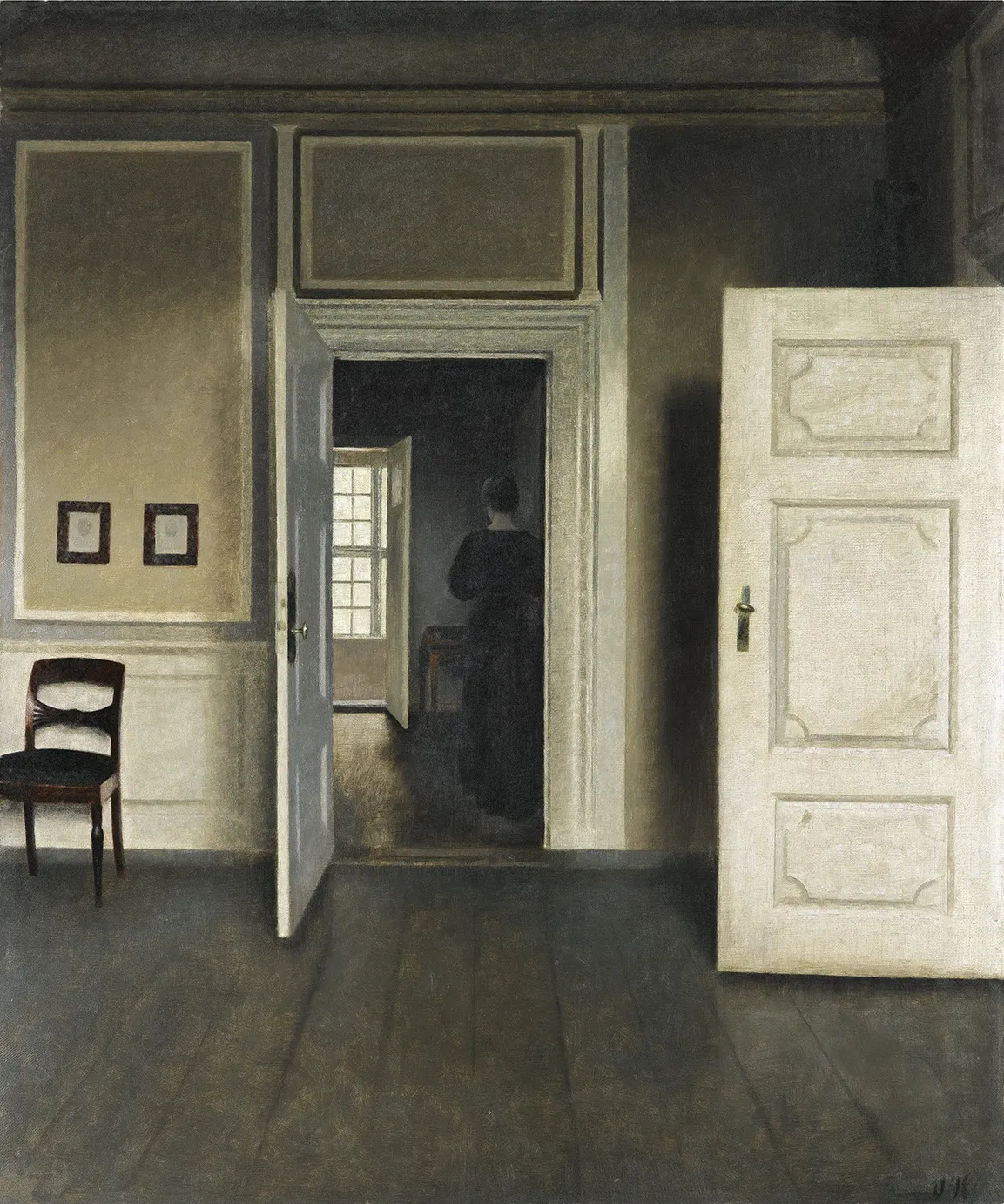
In the apartment on Strandgade, Hammershøi painted the same rooms again and again. In many of his works, his wife, Ida, appears seen from behind, placed almost like part of a still life. In fact, a painting from the following year with nearly the same composition features Ida, but in this canvas, the human figure is entirely absent.
When the human figure—the element that draws the viewer's eye most powerfully—is erased, what remains? Only a sharp beam of sunlight streaming through the window and the countless motes of dust gently suspended within it. He discovered an eternal beauty in the moment when ordinary, insignificant flecks of dust caught the light and shimmered.
When first exhibited, the artist gave the work simple titles such as "Sunshine" or "Sunbeams." The poetic name widely known today was bestowed later by those who understood him deeply. It is widely believed that his patron and friend, the dentist Alfred Bramsen, along with others compiling his catalogue raisonné, gave it the title "Dust Motes Dancing in Sunbeams."
The void left by the absence of figures is by no means sorrowful. Rather, precisely because no one is there, the trajectory of the light and the quiet dance of the dust unfold before us like a sacred ritual.
About 611 more words
Read the rest of this commentary —
and step into a secret gallery
opened just for you
An "art letter" delivered to you every Saturday morning
Works, music and words chosen for your sensibility, from your artist-type result and the paintings you love
A library of masterpieces and music you can enjoy "in your own words", not just look at
A "digital art notebook" (unlimited) where your impressions build into your own taste
Unlimited likes and notes
¥980 / month¥0 today
¥980/month (tax incl.) from day 8. Cancel anytime.
Already have an account? Log in
Your Note
Write down what this painting made you feel in your art notebook.
Please sign up to write notes.
Sign up for freeRecommended Artworks
Sources & references
More art movements
Pre-Baroque
1 artworks
Victorian era
10 artworks
Impressionism
48 artworks
Late Pre-Raphaelite
10 artworks
Baroque
2 artworks
American Impressionism
5 artworks
Realism
4 artworks
Pre-Raphaelite
3 artworks
Barbizon School
5 artworks
Academic art
5 artworks
Luminism
3 artworks
Rococo
2 artworks
Symbolism
22 artworks
Neo-Impressionism
3 artworks

Ukiyo-e
1 artworks
Japonism
4 artworks
Edo period
1 artworks
Fauvism
1 artworks
Naturalism
9 artworks
Russian Realism
1 artworks
Post-Impressionism
13 artworks
Genre painting
9 artworks
Neoclassicism
3 artworks
ウィーン分離派
7 artworks
自然主義
1 artworks
ナショナル・ロマンティシズム
1 artworks
未来派
1 artworks
More artists
If you find an error in this content, please let us know here
This site is protected by reCAPTCHA, and the Google Privacy Policy and Terms of Service apply.