
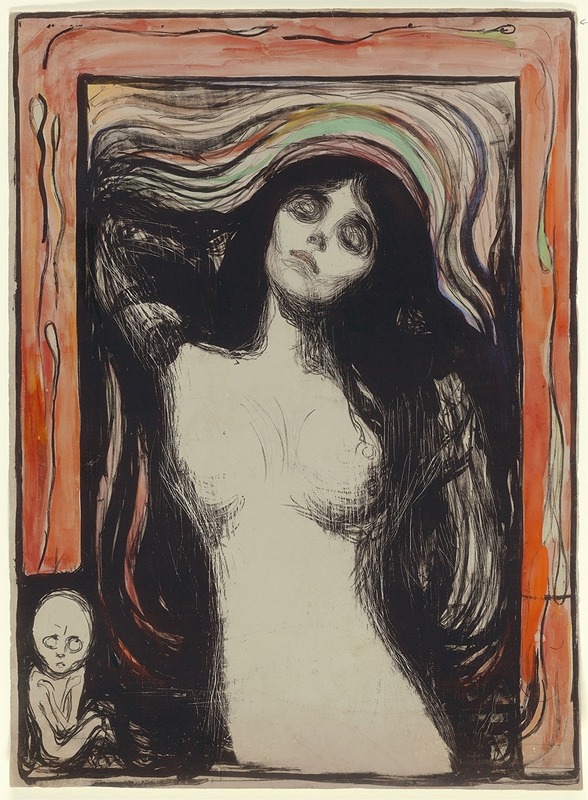
Madonna
1895
- Dimensions
- イメージ:60.5 × 44.5 cm / シート:85.6 × 59.3 cm
- Medium
- Lithograph, occasionally printed in color combined with a jigsaw-cut woodcut block for the background, on Japanese paper or cream laid paper
- Collection
- The Museum of Modern Art (MoMA), the National Museum of Norway, the Munch Museum, and others

A celebrated Norwegian painter active from the late nineteenth century to the fi…
✦ Highlights (technique & color)
A highlight of the technique is the delicate interplay between the expressive, rough strokes of lithographic crayon and flat washes of liquid ink. Its most distinctive feature is the border depicting swimming sperm and a fetus framing the nude figure. Originally hand-carved into the frame of the oil painting version, this motif was innovatively integrated directly into the print itself. The deep red halo glowing above the woman's head serves as a striking accent against the nearly monochromatic composition.
✦ The setting of this painting
The setting of this work is not an actual geographical location. Instead, it depicts a weightless, oceanic cosmic realm reached by a woman's psyche in the ecstatic moment of conception. The undulating curves flowing around her evoke both the spiritual energy radiating from her body and the gentle drift of amniotic fluid carrying germ cells. It is an extraordinary space visualizing a transcendent dimension where life and death intertwine.
✦ Historical context
In 1895, European society was embroiled in intense debates surrounding women's societal advancement and sexual self-determination. Munch was at the heart of an avant-garde circle centered at the Berlin tavern The Black Piglet (Zum schwarzen Ferkel), where daily discussions revolved around psychoanalysis, Nietzschean philosophy, and the duality of woman as both life-giver and femme fatale. This work was born as a vivid reflection of these shifting fin-de-siècle perspectives on gender and intellect.
A naked woman, eyes closed, head thrown back, wears an ecstatic expression.
Above her head, a red halo glows, and a sinuous border encircles the edges of the image.
In the lower left, a small, crouching figure.
This work, titled Madonna.
It stands as a pinnacle of late 19th-century Symbolist art and is one of Munch's most controversial works.
Created in 1895, this lithograph is characterized by its flowing curves and sophisticated design.
It has long been celebrated as a masterpiece that perfectly captures the mysterious essence of womanhood.
It appears as if this complete vision existed in the artist's mind from the outset,
and was then directly translated and fixed into the print.
However, in reality, this perfect composition did not take this form from the very beginning.
Recent scientific investigations have revealed a certain fact:
traces of the artist's hesitation and trial-and-error were discovered, hidden beneath this painting.
Recently, at the National Museum of Norway,
restorers Thierry Ford and his team conducted an investigation,
joined by curator Vibeke Waallann Hansen.
They examined the oil painting version of Madonna held by the museum using an infrared camera.
Unexpectedly, something was found beneath the paint surface:
an early sketch with a completely different composition, showing the arms hanging loosely.
The oil painting completed in 1894 was part of the very initial process of creation.
Munch was experimenting with the composition there.
In 1895, Munch was in Berlin,
at the center of an avant-garde group based at the 'Black Piglet' café.
At that time, European society was experiencing intense debates surrounding women's social advancement,
as well as their right to self-determination regarding sexuality.
Within this circle, discussions took place daily:
psychoanalysis and Nietzschean philosophy,
and the duality of women as both 'reproductive beings and femmes fatales'.
Munch sought to connect the Catholic Church's veneration of the Virgin Mary with raw eroticism.
He attempted to reinterpret modern female sexuality through the lenses of 'the sacred' and 'the premonition of death'.
In 1894,
the Polish novelist Stanisław Przybyszewski published a text,
inspired by Munch's pioneering oil study, The Face of Madonna.
He extolled the 'oceanic beauty' that women display in the ecstasy of conception and love.
Munch was deeply influenced by this analysis.
Through compositional experimentation in the oil painting,
he then perfectly refined the design for this lithograph in 1895.
About 159 more words

Unlock this story's ending, and every article on MusicStory
- 42
Stories1–2 new every week
An archive of paintings paired with great music, made for a weekend night and a cup of coffee
- 282
Paintings with commentarygrowing daily
From simply looking to truly reading — the brushwork and the obsession of the masters
- 10
Music Librarygrowing daily
Know it first, and what reaches your ear changes — background music becomes art you keep for life
My Notes, unlimited
Every reading adds to a digital art notebook that is yours alone
Already have an account? Log in
Your Note
Write down what this painting made you feel in your art notebook.
Please sign up to write notes.
Sign up for freeRecommended Artworks
.webp)


Sources & references
More artists







If you find an error in this content, please let us know here
This site is protected by reCAPTCHA, and the Google Privacy Policy and Terms of Service apply.