
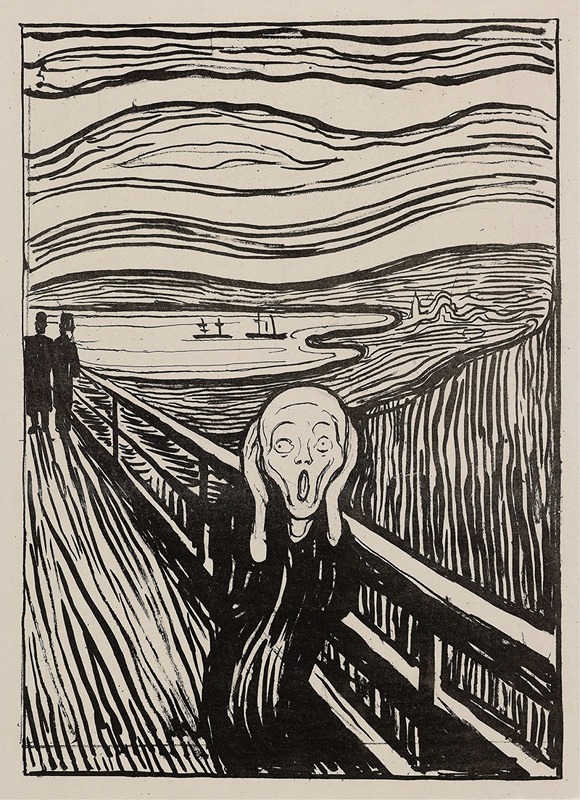
The Scream
1895
- Dimensions
- イメージ:35.7 × 23.6 cm / シート:51.4 × 39.7 cm
- Medium
- Color lithograph on paper / wove paper
- Collection
- The Metropolitan Museum of Art, MoMA, Munch Museum, The British Museum, among others
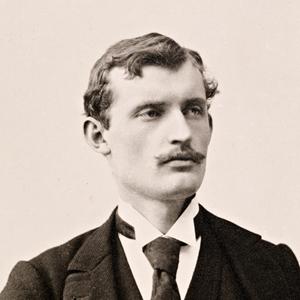
A celebrated Norwegian painter active from the late nineteenth century to the fi…
✦ Highlights (technique & color)
This work is a lithograph rendered in black ink. By deliberately stripping away the vivid colors of the painted version, Munch reconstructs existential dread through the stark, intense clash of light and shadow. To ensure the composition was not inverted in the final print, he employed meticulous craftsmanship, drawing the image directly onto the lithographic stone in reverse. Inscribed at the bottom of the image in German are the title The Scream and a poem of his own.
✦ The setting of this painting
A path on Ekeberg Hill on the outskirts of Oslo, overlooking the Oslofjord below. At the time, this area was notorious as a suicide spot. Furthermore, beneath the cliff lay the Gaustad psychiatric hospital, where Munch's sister Laura was institutionalized, adjacent to a massive municipal slaughterhouse. It was a site of unique and tragic topography, where the shrieks of psychiatric patients and the cries of butchered livestock rose and mingled together.
✦ Historical context
In Europe during the mid-1890s, rapid urbanization and technological innovation surged, while an invisible spiritual desolation and anxiety spread among the people. The backdrop was the psychology of modern urban crowds—freed from traditional social norms, yet suffering from acute isolation and alienation. It was also the peak of the printmaking revival movement; having encountered advanced printing techniques in Paris and Berlin, Munch elevated printmaking from a mere means of reproduction to an independent medium of artistic expression.
On a bridge, a skeletal-faced figure covers their ears with both hands.
A wide-open mouth.
In the background, a swirling landscape and two receding figures are visible.
This imagery, one of the most famous in the world.
It is often assumed that the depicted figure is 'screaming' out of terror.
It is also frequently said that this work was impulsively created, driven by intense emotion.
But in fact, that's not the case.
This figure is not screaming, but rather covering their ears from a 'scream' they hear.
And this print, far from being impulsive, was created with extremely meticulous calculation.
The path on Ekeberg Hill, a suburb of Oslo, which serves as the setting, was known at the time as a place where people frequently took their own lives.
Furthermore, below the cliff was Gaustad Psychiatric Hospital, where Munch's sister Laura was institutionalized.
Munch himself was constantly tormented by the fear of hereditary illness running in his family.
Right next to the hospital was a massive municipal slaughterhouse.
The screams of psychiatric patients.
And the death throes of slaughtered livestock.
These sounds intertwined, creating a unique environment where they seemed to rise up to the top of the hill.
It was around late 1891 to 1892.
As Munch was walking along this path with two friends, the setting sun suddenly dyed the clouds blood-red.
His friends continued walking straight ahead, as if nothing had happened.
Munch was left behind.
He was overcome by an exhaustion and anxiety so profound it felt like death, and he leaned against the railing.
At that moment, he physically experienced a 'vast, infinite scream piercing through nature.'
About 225 more words
Read stories of masterpieces for free
Your Note
Write down what this painting made you feel in your art notebook.
Please sign up to write notes.
Sign up for freeRecommended Artworks
.webp)
Sources & references
More artists
If you find an error in this content, please let us know here
This site is protected by reCAPTCHA, and the Google Privacy Policy and Terms of Service apply.