
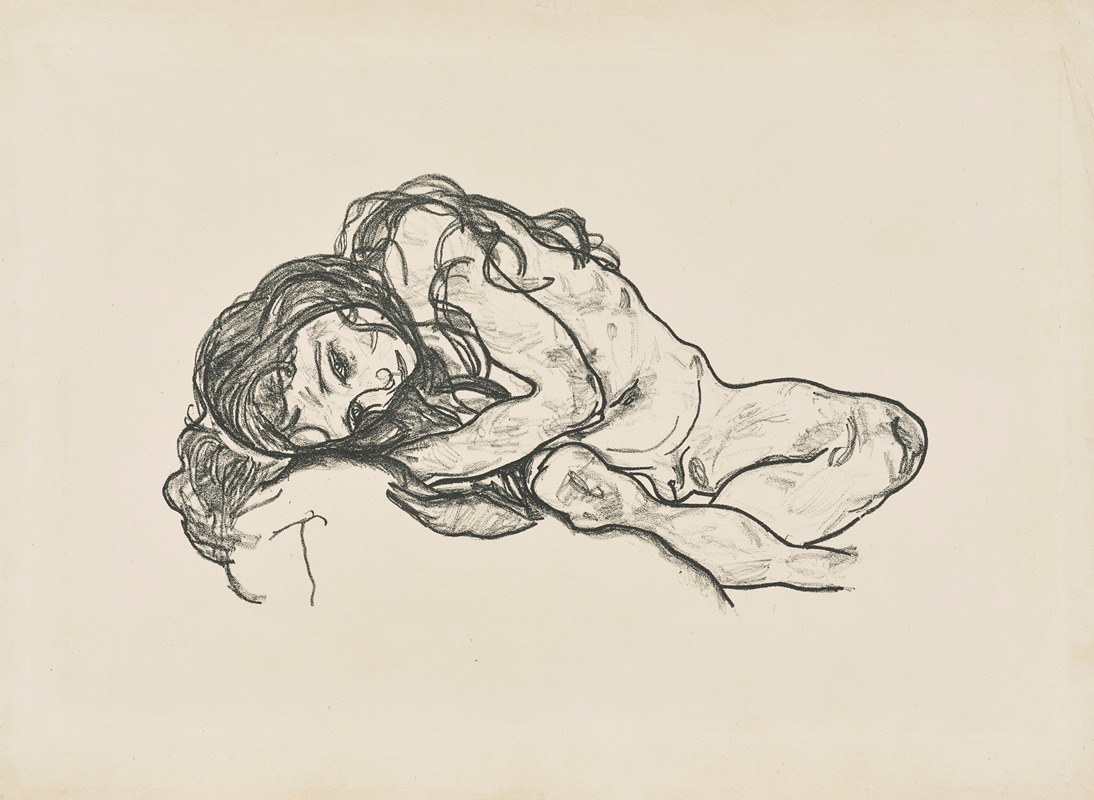
Girl
1918
- Dimensions
- 構図サイズ: 21.2 × 37.2 cm
- Medium
- Lithograph on paper (transfer lithograph, black ink)
- Collection
- The Museum of Modern Art (MoMA) / The Metropolitan Museum of Art
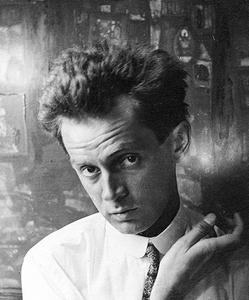
A leading figure of Austrian Expressionism, this early 20th-century painter laid…
✦ Highlights (technique & color)
This work was produced using the transfer lithography technique. Instead of drawing directly on the lithographic stone, the lines were drawn on specially prepared paper and transferred using a press, preserving Schiele's characteristically sharp and sinuous linework. Eschewing tonal gradations, he expresses physicality and emotion solely through crisp hatching and dynamic, varied contours.
✦ The setting of this painting
This work was created in Schiele's final studio in Hietzing, Vienna's 13th district. The background contains no furnishings or defining boundary lines, left entirely as empty white space. This void accentuates the sinuous contours of the girl's body and her palpable psychological tension.
✦ Historical context
The year 1918 was catastrophic, marked by the defeat and collapse of the Austro-Hungarian Empire and the devastation of the Spanish flu. For Schiele, however, it brought great acclaim; his major success at the Vienna Secession exhibition in March placed him at the pinnacle of the avant-garde as the successor to his late mentor, Gustav Klimt. It was a moment where the zenith and the end of his life and career intertwined.
In a stark white space, a young girl lies curled on the ground. Her head is bowed, her body contorted.
There is no background—nothing at all. Only the girl’s figure is captured, raw and vivid, in bold black lines.
At first glance, it might look like a private sketch born of the artist’s personal fascination. In reality, however, it was something else entirely.
Though originally commissioned by a patron, the finished work was flatly rejected upon completion. The reason: the raw, sexual adolescence of the young girl had been emphasized far too starkly.
The year was 1918, in Vienna—a year of catastrophe as the Austro-Hungarian Empire spiraled toward defeat and collapse.
Yet for Schiele himself, he was reaching a dramatic peak. Following his resounding success at the Vienna Secession exhibition in March, he stood at the zenith of the avant-garde, the undisputed successor to his late mentor, Gustav Klimt.
He invited young models into his Hietzing studio, executing drawing after drawing to forge this singular image. Though spurned by his client, a different path opened up through the art critic and patron Arthur Roessler.
Roessler urged Schiele to embrace printmaking, arguing that prints could be sold in volume within the thriving German market, bringing the painter much-needed financial stability.
Schiele took on the challenge of transfer lithography. Rather than drawing directly on the lithographic stone, he rendered his lines on special transfer paper, using the press to convey his characteristically sharp, twisting strokes onto the stone with unadulterated fidelity.
About 188 more words
Read stories of masterpieces for free
Your Note
Write down what this painting made you feel in your art notebook.
Please sign up to write notes.
Sign up for freeRecommended Artworks
Sources & references
More artists
If you find an error in this content, please let us know here
This site is protected by reCAPTCHA, and the Google Privacy Policy and Terms of Service apply.