
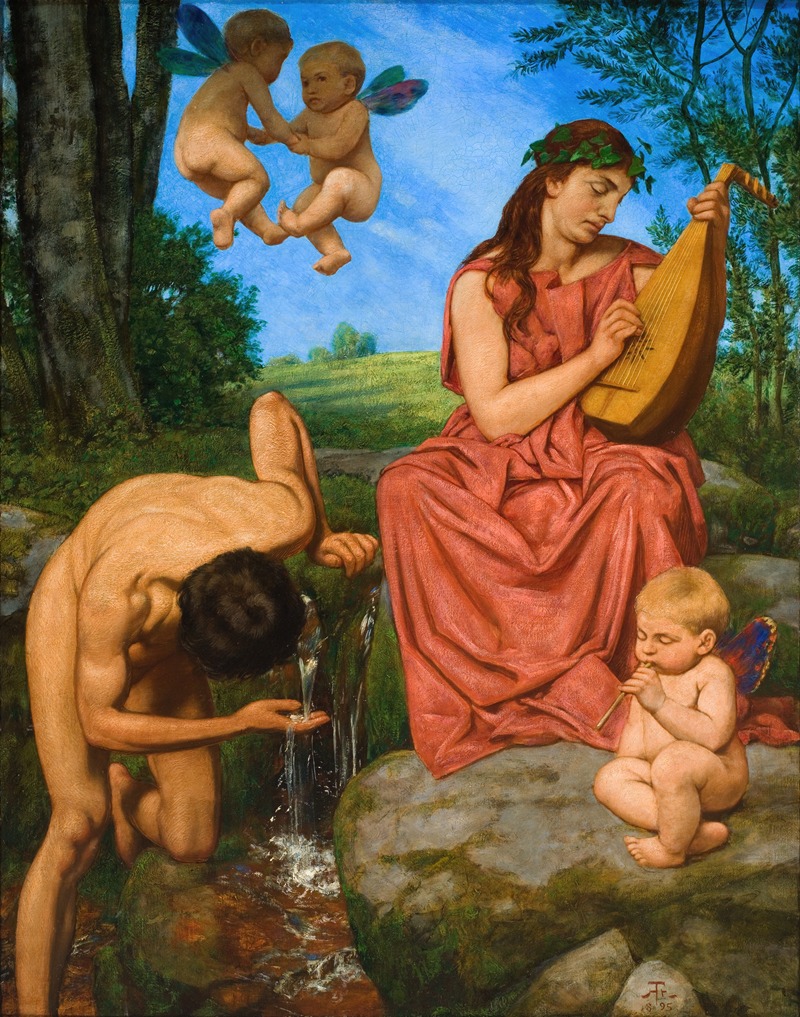
Die Quelle (The Spring)
1895
- Dimensions
- キャンバス: 113.03 cm × 87.63 cm
- Medium
- Oil on canvas
- Collection
- Los Angeles County Museum of Art (California)
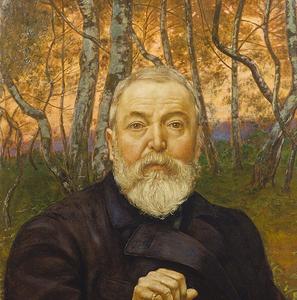
Hans Thoma was a German painter. He was born on 2 October 1839 in Bernau, Grand…
✦ Highlights (technique & color)
Built upon a palette of deep, earthy tones—the rich greens of the Black Forest and the dark browns of the craggy rock face—the garments and the soft skin tones of the putti radiate a festive light. The sculptural contours of the man's body merge organically with the texture of the rocks. Another major highlight is the heavy, original wooden frame, adorned with patterns hand-painted by the artist himself.
✦ The setting of this painting
By a mystical spring where clear water wells up, surrounded by lush forest trees and monumental rock faces. While rooted in the native German nature Thoma observed in the Black Forest and the Upper Rhine, the presence of the figures transforms the scene into an ancient Arcadia that transcends both time and place.
✦ Historical context
In 1890s Germany, there was a growing movement against academic history painting and Impressionist optical approaches. Inheriting the ideals of the German Romans with whom he had associated in Rome, Thoma pursued visionary landscapes imbued with classical thought and spiritual symbolism. This work was painted in 1895, when he was rising to the pinnacle of the German art world.
Deep within the forest, a clear spring bubbles forth from a massive rock face.
A muscular, nude man bends down.
He leans in to drink directly from the fresh water welling up among the rocks.
Beside him, a draped woman plays a stringed instrument.
Next to her, a nude child plays a small pipe.
Looking up at the sky, two winged cherubs hold hands, dancing joyfully through the air.
This painting was created by Hans Thoma.
Dating to 1895, it comes from the period that cemented his reputation among the citizens of Frankfurt.
Later appointed as a museum director, he was steadily ascending to the pinnacle of the German art world.
During the 1870s, Thoma engaged closely with a circle of artists active in Rome,
including Hans von Marées and Arnold Böcklin.
At the time, the art scene was dominated by an academic style producing conventional history paintings,
or by Impressionism, focused purely on retinal optical effects.
Yet, they resisted these trends.
Rather than merely capturing visible reality,
they pursued mythological realms imbued with classical thought and spiritual symbolism.
Thoma closely observed the nature of the Black Forest and the Upper Rhine, lands he had traversed on foot.
The deep greens evoking a moist atmosphere.
The dark browns of the rugged rock surfaces.
The distinctive German nature he so loved
was transformed on canvas into an idealized realm transcending time and place.
About 90 more words

Sign up free and enter Your Museum
Read the stories behind great paintings and music for free, in Your Museum
Your Note
Write down what this painting made you feel in your art notebook.
Please sign up to write notes.
Sign up for freeRecommended Artworks
Sources & references
More artists
If you find an error in this content, please let us know here
This site is protected by reCAPTCHA, and the Google Privacy Policy and Terms of Service apply.