
 日本語 (JA)
 English (EN)
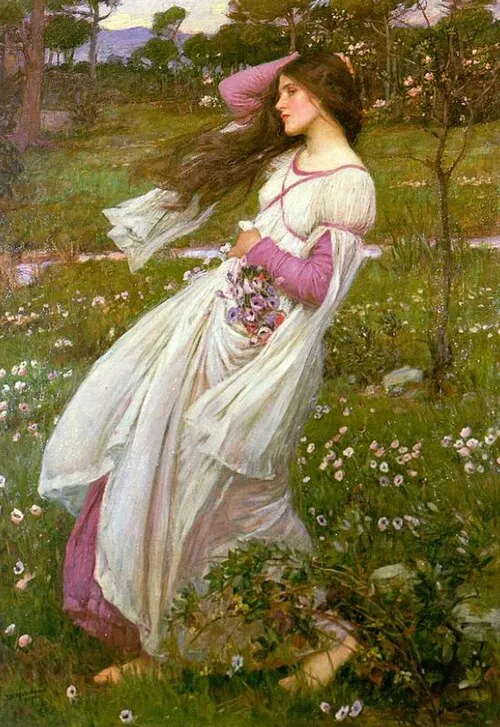
- Dimensions
- 114.3 × 78.7 cm
- Medium
- Oil on canvas
- Collection
- Private collection
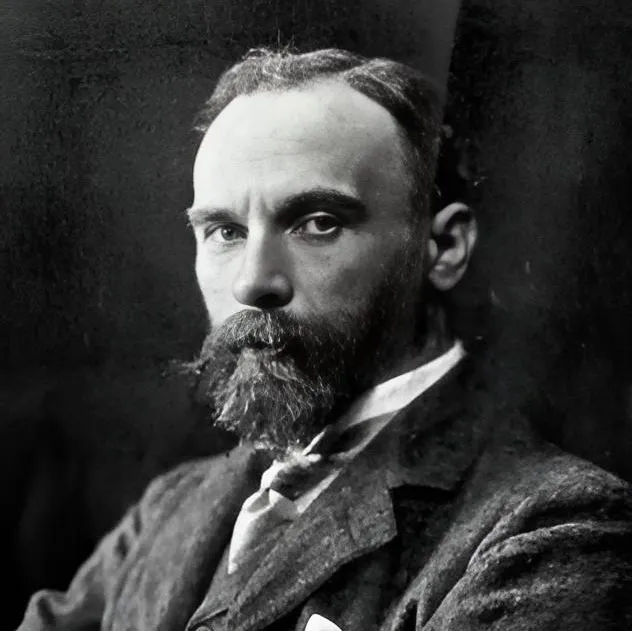
An English painter deeply influenced by the spirit of the Pre-Raphaelite Brother…
To contrast the wind—an unseen, irresistible force of nature—with the fragility of the human figure enduring it, taking on the ambitious formal challenge of rendering the movement of air itself visible on canvas.
✦ Highlights (technique & color)
Notice the strong diagonal lines sweeping across the canvas. Three distinct elements—her billowing hair, the folds of her drapery, and the bending grasses—flow in the same direction, bringing the invisible wind into clear view. Another highlight is the contrast between the smooth, refined brushwork of her face and the swift, textured impasto of her clothing and the background.
✦ The setting of this painting
An English pastoral landscape outdoors during the day, swept by the blustery winds of early spring (around March or April). The semi-imaginary setting blends sketches drawn from life with the artist’s idealized imagination.
✦ Historical context
1902. A transitional period from the Victorian to the Edwardian era, characterized by rapid urbanization and industrialization alongside a growing nostalgia for Britain's traditional pastoral scenery and natural beauty.
A cold, strong wind sweeps across a desolate landscape in early spring. In the midst of this fury, a young woman stands, slightly hunched against the gale. Her long hair whips fiercely through the air, and her thin garments cling to her body, perfectly tracing the shape of the wind. Clasped carefully against her chest is a freshly picked bouquet of delicate anemone flowers. Though "wind" should be invisible, it is undeniably howling across this canvas.
How to Depict the Unseen Fury of Nature
In 1902, John William Waterhouse, who had established an unshakable reputation in the British art world and entered his mature period as a painter, was facing a formidable challenge: "How to paint the invisible."
Britain at the time was at a turning point, marking the end of the long Victorian era and stepping into a new age. In a rapidly urbanizing and industrializing London, Waterhouse, positioned at the heart of a cutting-edge artistic community, enjoyed a life of economic and mental stability. Yet, within him, there was a profound nostalgia for traditional British pastoral landscapes and natural beauty, far removed from the city's hustle and bustle.
He regularly went on sketching trips to rural and coastal areas, feeling the open air on his skin. In the desolate moors of early spring Britain, fierce spring winds howl. The painter deeply desired to capture this inevitable force of nature onto the canvas in his studio. However, one cannot paint the air itself with pigments.
About 388 more words
Read the rest of this commentary —
and step into a secret gallery
opened just for you
An "art letter" delivered to you every Saturday morning
Works, music and words chosen for your sensibility, from your artist-type result and the paintings you love
A library of masterpieces and music you can enjoy "in your own words", not just look at
A "digital art notebook" (unlimited) where your impressions build into your own taste
Unlimited likes and notes
¥980 / month¥0 today
¥980/month (tax incl.) from day 8. Cancel anytime.
Already have an account? Log in
Your Note
Write down what this painting made you feel in your art notebook.
Please sign up to write notes.
Sign up for freeRecommended Artworks
Sources & references
More art movements
Pre-Baroque
1 artworks
Victorian era
10 artworks
Impressionism
48 artworks
Late Pre-Raphaelite
10 artworks
Baroque
2 artworks
American Impressionism
5 artworks
Realism
4 artworks
Pre-Raphaelite
3 artworks
Barbizon School
5 artworks
Academic art
5 artworks
Luminism
3 artworks
Rococo
2 artworks
Symbolism
22 artworks
Neo-Impressionism
3 artworks
Ukiyo-e
1 artworks
Japonism
4 artworks
Edo period
1 artworks
Fauvism
1 artworks
Naturalism
9 artworks
Russian Realism
1 artworks
Post-Impressionism
13 artworks
Genre painting
9 artworks
Neoclassicism
3 artworks
ウィーン分離派
7 artworks
自然主義
1 artworks
ナショナル・ロマンティシズム
1 artworks
未来派
1 artworks
More artists
If you find an error in this content, please let us know here
This site is protected by reCAPTCHA, and the Google Privacy Policy and Terms of Service apply.