
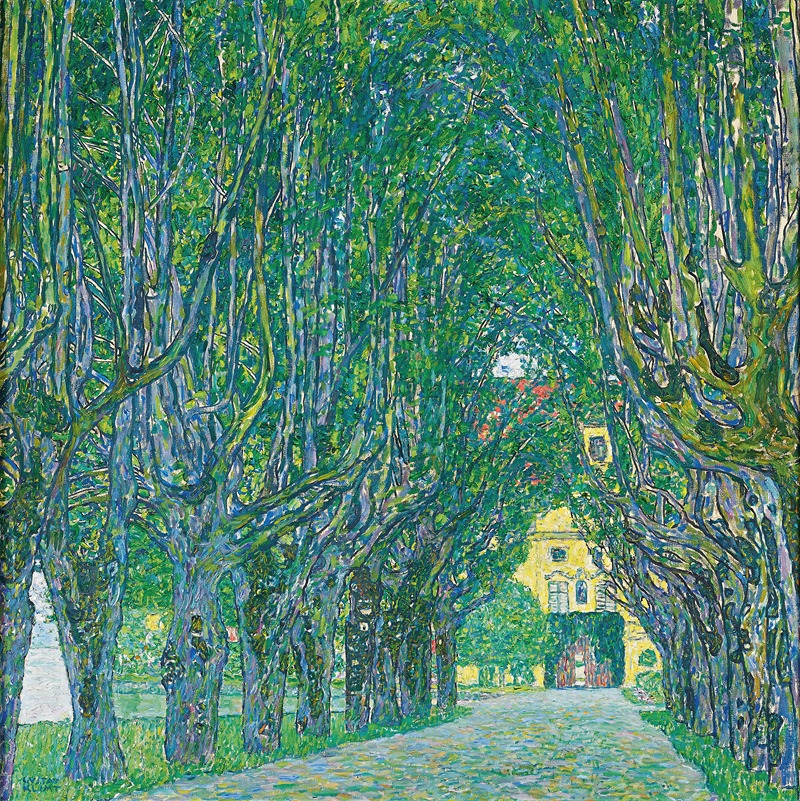
Avenue to the Kammer Castle
1912
- Dimensions
- 110 × 110 cm
- Medium
- Oil on canvas
- Collection
- Belvedere Museum
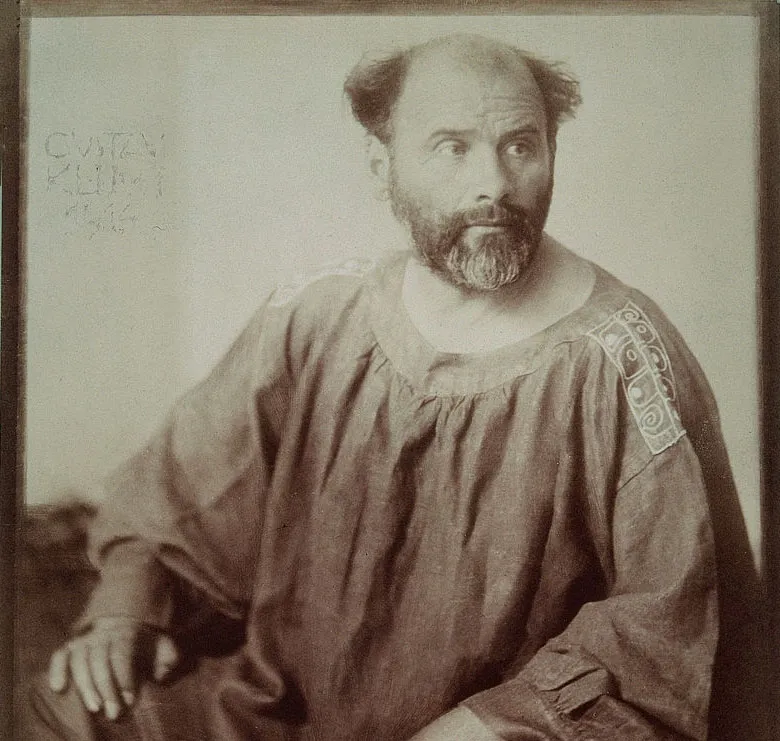
One of Vienna's foremost Symbolist painters active from the late 19th to early 2…
A pursuit of pure spiritual liberation, escaping the social bustle of Vienna and the demands of portrait commissions. The landscape stands as a meditative microcosm for communing with his inner self, inscribed solely with an order of color and form.
✦ Highlights (technique & color)
The square canvas eliminates any narrative sense of time. Klimt viewed the landscape through a telescope and a handheld cardboard frame with a square cutout. The resulting telephoto-like effect compresses depth, flattening the distant castle and foreground trees onto a single plane to create a mosaic-like, two-dimensional composition.
✦ The setting of this painting
The setting is the grounds of Schloss Kammer, situated on the shores of Lake Attersee in the Salzkammergut region of Upper Austria. It depicts a historic avenue of linden trees extending from the lake toward the land. In the early 20th century, this area was a distinguished summer retreat favored by Vienna's affluent citizens and cultural elite.
✦ Historical context
The year 1912 marked a period of mounting political and social tension as the Austro-Hungarian Empire neared its end. In the art world, following the Vienna Secession, Expressionism championed by artists like Egon Schiele was on the rise. Klimt himself was transitioning into his late style, moving away from excessive ornamentation toward a freer, more expressive use of color.
Green trees arch over from both sides of the canvas, forming a verdant canopy.
At the end of the tree-lined avenue stretching into the distance, a small building with yellow walls and a red roof comes into view.
Look closely into the depths of the painting, amid the dappled sunlight and shadows.
"The figure of a maiden in prayer is hidden there."
Such rumors have sometimes circulated persuasively among viewers—
or that this was a romantic view painted from a boat drifting on the lake.
Yet in truth, none of these stories are true.
Recent scientific analyses have confirmed that there are no traces of any human figure in this painting.
Moreover, the vantage point was not from the lake, but from within a park on land.
There was no model.
What is depicted here is purely nature and architecture.
Why did he choose to paint a landscape devoid of people?
In the summer of 1912.
Gustav Klimt was staying on the shores of Lake Attersee in Austria.
It was an exclusive summer resort where wealthy Viennese gathered to escape the heat.
Beginning in 1900, he spent almost every summer by the lake for more than a decade.
He created the vast majority of his landscapes in this region.
At the time, he was at a major turning point.
His opulent "Golden Phase," celebrated for its lavish use of gold leaf, had already come to an end.
In the metropolis of Vienna, endless portrait commissions awaited him.
The social clamor.
The weight of expectations and entangling obligations.
His days at Lake Attersee, far removed from all that,
served as a ground for artistic experimentation—
and above all, a place of spiritual liberation.
This landscape was not a commission from a patron.
It was an independent work, created solely for his own artistic exploration.
About 163 more words
Read stories of masterpieces for free
Your Note
Write down what this painting made you feel in your art notebook.
Please sign up to write notes.
Sign up for freeRecommended Artworks
Sources & references
More artists
If you find an error in this content, please let us know here
This site is protected by reCAPTCHA, and the Google Privacy Policy and Terms of Service apply.