
Judith
1901
- Dimensions
- 84.0 cm × 42.0 cm
- Medium
- Oil and gold leaf on canvas
- Collection
- Belvedere Museum, Vienna
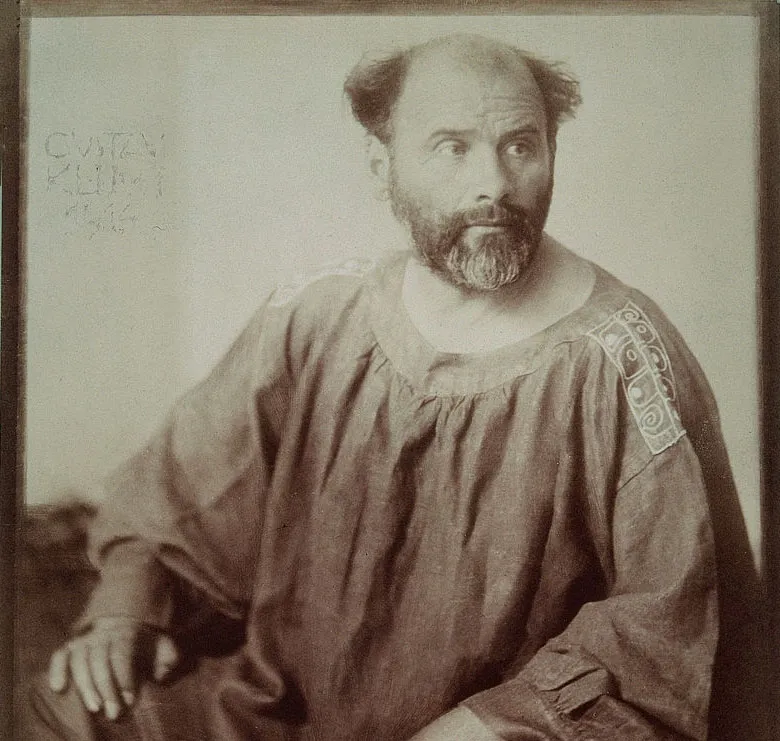
One of Vienna's foremost Symbolist painters active from the late 19th to early 2…
A fierce rebellion by a solitary artist against the harsh condemnation of a conservative society—a golden manifesto etching the absolute triumph of female sexuality and sensuality, unyielding in its aesthetic conviction.
✦ Highlights (technique & color)
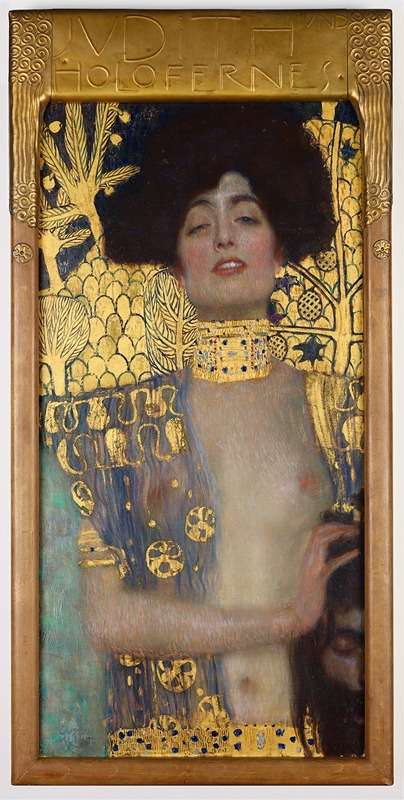
The work employs the technique of oil gilding. High-quality gold leaf was laid over a ground coated with drying oil or varnish, creating a smooth, metallic surface. Onto this, oil paint was layered using delicate blending to render the flesh. The textural clash between the soft, sensitive depiction of the skin and the rigid, flat gold leaf of the background and garments generates an unsettling tension.
✦ The setting of this painting
Rather than the ancient encampment of the Old Testament, the setting is a fantastical, flattened plane incorporating stylized tree motifs inspired by ancient Assyrian palace reliefs. Yet, the atmosphere lingering here is intimately tied to the real interiors of fin-de-siècle Vienna around 1900. The model's hairstyle and sheer black gown evoke the unmistakable presence of a contemporary Viennese society woman appearing in the salons of the day.
✦ Historical context
Around 1900, Vienna was undergoing a profound cultural and psychological shift despite the political stagnation of the Habsburg Empire. This was the era when Sigmund Freud published The Interpretation of Dreams, unveiling the human unconscious and sexual impulses. Moreover, the sensation surrounding Oscar Wilde's play Salome had imprinted on the public a vivid visual archetype: the alluring woman clutching a man's severed head.
Draped in sheer black silk, a woman gazes down with an expression of pure ecstasy.
Cradled in her right hand is the severed head of a man.
This painting must depict Salome, the archetypal femme fatale who sought a man's head.
Critics of the time mistook her for this figure, and the misconception persisted for years.
Yet in truth, she was Judith from the very beginning.
Judith is the Old Testament heroine who saved her homeland by beheading the enemy general, Holofernes.
Look closely at the top of the brass frame enclosing the painting.
There, clearly inscribed, are the words "JUDITH UND HOLOFERNES."
The frame was crafted by the artist's brother, Georg Klimt, based on Gustav's design.
Why, then, was she mistaken for Salome?
Because there is not a single blade depicted anywhere in the painting.
The bloodstained sword, indispensable to traditional depictions of Judith.
The dramatic scene of slaughter.
Klimt eliminated them entirely.
Vienna, 1901.
Gustav Klimt was in the midst of fierce public backlash.
The previous year, in 1900.
He had unveiled Philosophy, the first work for the University of Vienna's Great Hall ceiling.
In March 1901, he followed with Medicine at the Tenth Secession Exhibition.
However, conservative professors and Catholic politicians were incensed.
"Obscene."
"A desecration of art."
Besieged by public condemnation, Klimt retreated into deeper psychological isolation.
Financially, he enjoyed the support of wealthy patrons.
Yet rejection by society weighed heavily upon him.
To confront society with his uncompromising artistic vision.
That was why he embarked on Judith I.
It was not a commissioned work, but a creation born entirely of his own volition.
For his model, he chose Adele Bloch-Bauer.
A modern socialite who presided over a wealthy Viennese salon.
With her sophisticated makeup and fashionable coiffure,
she appeared not as an ancient savior, but as a living woman of contemporary Vienna seen at the theater.
About 167 more words
Unlock this story's ending, and every article on MusicStory
- 42
Stories1–2 new every week
An archive of paintings paired with great music, made for a weekend night and a cup of coffee
- 282
Paintings with commentarygrowing daily
From simply looking to truly reading — the brushwork and the obsession of the masters
- 10
Music Librarygrowing daily
Know it first, and what reaches your ear changes — background music becomes art you keep for life
My Notes, unlimited
Every reading adds to a digital art notebook that is yours alone
Already have an account? Log in
Your Note
Write down what this painting made you feel in your art notebook.
Please sign up to write notes.
Sign up for freeRecommended Artworks
Sources & references
More artists




If you find an error in this content, please let us know here
This site is protected by reCAPTCHA, and the Google Privacy Policy and Terms of Service apply.