
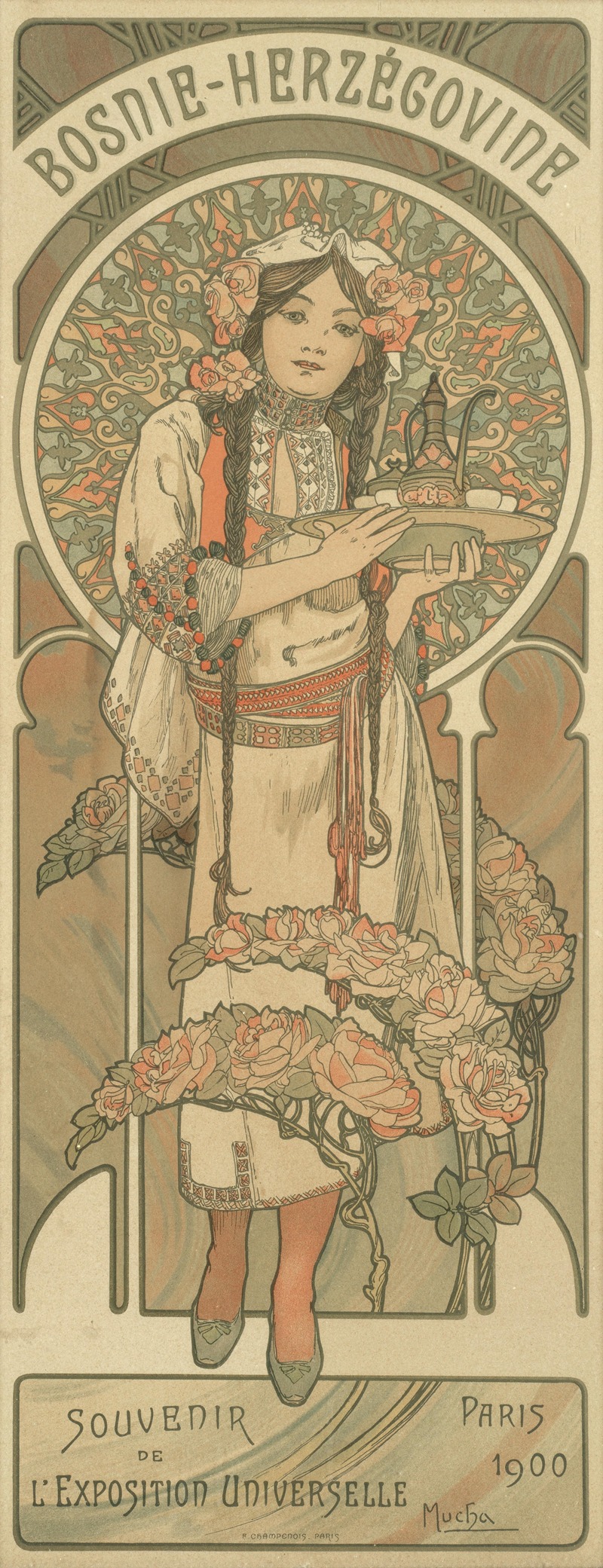
Bosnie-Herzegovine; L’exposition Universelle, Paris
1900
- Dimensions
- 25.5 × 62.5 cm
- Medium
- Color lithograph
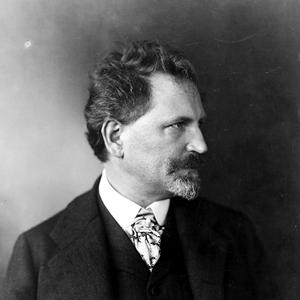
Alfons Maria Mucha, known internationally as Alphonse Mucha, was a Czech painter…
✦ Highlights (technique & color)
This piece features Mucha's characteristic soft pastel palette and ornamental motifs inspired by stylized botanical forms. The sinuous curves framing the composition gracefully accentuate the figure of the woman, who is dressed in traditional Bosnian costume adorned with intricate embroidery.
✦ The setting of this painting
The setting is the Bosnia and Herzegovina Pavilion at the 1900 Paris Exposition, erected along the Quai d'Orsay by the Seine. The poster was designed using preparatory photographs of a model posing in front of the pavilion's completed murals.
✦ Historical context
The 1900 Paris Exposition Universelle was a monumental event celebrating the technological and artistic achievements of the nineteenth century. At the time, Bosnia and Herzegovina was under Austro-Hungarian rule, and the imperial government planned an independent pavilion to showcase the achievements of its administration.
A woman in traditional folk costume gazes quietly toward us, holding a tray with a teapot and cup.
Pink blossoms bloom in profusion around her, with graceful curves framing the composition.
When we think of Alphonse Mucha, we picture the glamorous posters that adorned the streets of Paris.
As the darling of Art Nouveau, he was an artist at the forefront of consumer culture.
This work is also a promotional souvenir poster created for the 1900 Paris Universal Exposition.
With its refined depiction of a beautiful woman and gentle pastel palette,
it appears to be the very essence of Mucha's signature elegance.
Yet in truth, this piece marked the beginning of his farewell to the dazzling world of Paris.
The year was 1900.
The Paris Universal Exposition was a monumental event celebrating the dawn of a new century.
At the time, Bosnia and Herzegovina was under the rule of the Austro-Hungarian Empire.
The imperial government sought to showcase the achievements of its rule to the international community.
To that end, they planned a dedicated Bosnian pavilion and commissioned Mucha to oversee its entire decoration.
Mucha himself was of Slavic descent.
To prepare, Mucha journeyed to the Balkans.
It was a grueling journey of field research, aimed at directly observing the local landscapes and the lives of the people.
There, he witnessed the resilience of the Slavic people, who, despite living under foreign rule, fiercely preserved their language and traditions.
The impact was profound.
Upon returning to Paris, Mucha was overcome by a deep sense of soul-searching.
Had he been squandering his artistic gifts on commercial advertisements for beer and biscuits,
while his oppressed Slavic brethren lived with such noble dignity?
He resolved
to dedicate the rest of his life to creating works centered on the unity and freedom of the Slavic peoples.
About 145 more words
Read stories of masterpieces for free
Your Note
Write down what this painting made you feel in your art notebook.
Please sign up to write notes.
Sign up for freeRecommended Artworks
Sources & references
More artists

If you find an error in this content, please let us know here
This site is protected by reCAPTCHA, and the Google Privacy Policy and Terms of Service apply.