
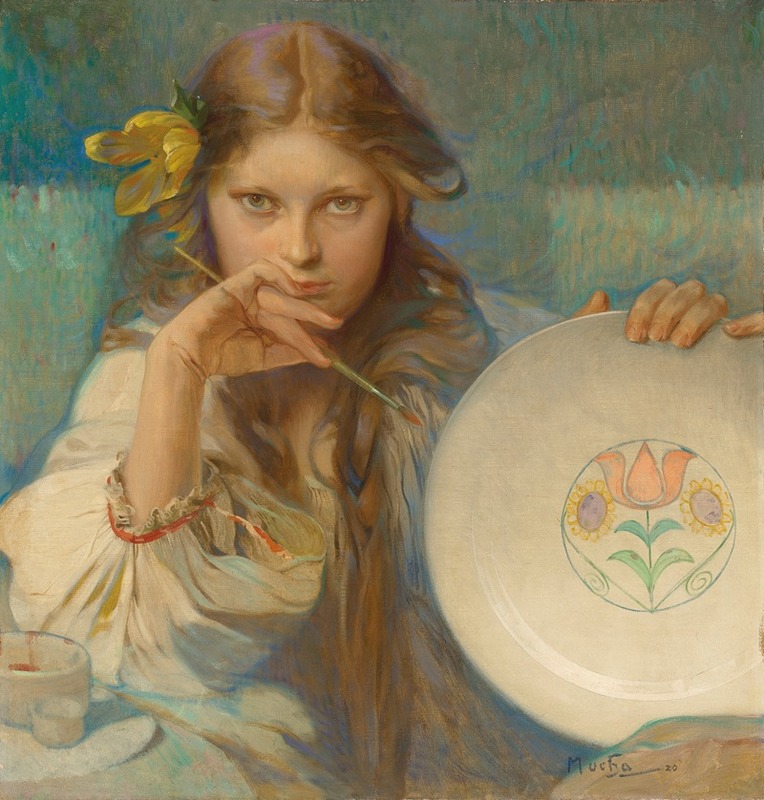
Girl with a Plate with a Folk Motif
1920
- Dimensions
- 57.2 × 54.6 cm
- Medium
- Oil on canvas, mounted on board
- Collection
- Private collection
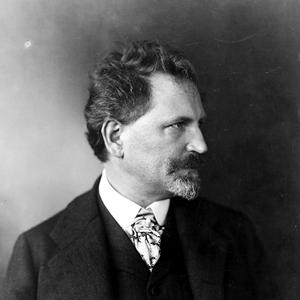
Alfons Maria Mucha, known internationally as Alphonse Mucha, was a Czech painter…
✦ Highlights (technique & color)
Mucha employs the remarkably fluid, light-infused "luminous brushwork" characteristic of his late period. Blues, violets, and cool pastel shades blend in harmony, while delicate touches along the contours of her clothing and skin create a mystical aura, as if the young girl is glowing from within.
✦ The setting of this painting
This painting was created in the grand studio at Zbiroh Castle in Western Bohemia. Detached from real-world space, the background is filled with deep blue and lilac tones, constructed as a symbolist realm steeped in a mystical spiritual world and Slavic folklore.
✦ Historical context
With the end of World War I in 1918 and the fall of the Habsburg Empire, the independence of the Czechoslovak Republic—a long-held dream of Mucha's—was achieved. By 1920, Mucha had stepped away from commercial posters and was devoting himself entirely to The Slav Epic, a monumental cycle depicting the history and spirituality of his homeland.
A young girl emerges from a realm of deep blues and soft purples. Clad in traditional folk attire, she holds a paintbrush and a brightly patterned dish, gazing straight out at us.
Mention Alphonse Mucha, and most people envision the dazzling posters that adorned the street corners of fin-de-siècle Paris—beautiful, ethereal goddesses surrounded by flowers, elegant female figures rendered as icons of consumer culture. This painting, too, might seem like just another of Mucha's charming muses.
In reality, however, she was far more than a mere model. She was a creator in her own right—one who would grasp the brush herself and protect her father’s colossal legacy from the flames of war.
The girl’s name was Jaroslava Muchová, the artist’s beloved daughter. When this portrait was painted in 1920, she was eleven years old. The setting was the vast studio inside Zbiroh Castle in western Bohemia.
In 1918, World War I came to an end, and her homeland of Czechoslovakia achieved its long-sought independence. Mucha had already turned his back on his commercial success in Paris. He was pouring his heart and soul into his epic twenty-canvas masterpiece, The Slav Epic—a grand project designed to carve the history and spirit of his nation into canvas.
Jaroslava had initially studied ballet, yet before long, she followed in her father's footsteps, pursuing the path of art. Far from simply posing, she grew inside the castle studio into her father's indispensable assistant, spending her days mixing pigments. For The Slavs in Their Original Homeland, the first canvas of The Slav Epic, she helped paint the starlit sky. Side by side, father and daughter grasped their brushes to paint the soul of their homeland together.
Yet history proved cruel. The dark shadow of World War II engulfed their homeland—bringing plunder by Nazi Germany and storage under deplorable conditions. The Slav Epic, to which her father had devoted his entire life, suffered severe damage amid the ravages of war.
Her father's death, and the tragically damaged masterpieces... In the face of despair, she stood up.
About 163 more words
Read stories of masterpieces for free
Your Note
Write down what this painting made you feel in your art notebook.
Please sign up to write notes.
Sign up for freeRecommended Artworks
Sources & references
More artists
If you find an error in this content, please let us know here
This site is protected by reCAPTCHA, and the Google Privacy Policy and Terms of Service apply.