
The Primrose
1899
- Dimensions
- 71 × 27.5 cm
- Medium
- Color lithograph
- Collection
- Mucha Foundation, Kunstmuseum Den Haag, and others
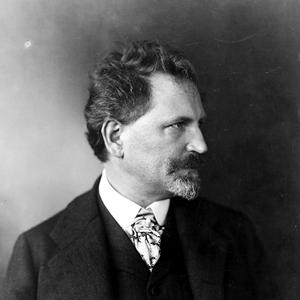
Alfons Maria Mucha, known internationally as Alphonse Mucha, was a Czech painter…
✦ Highlights (technique & color)
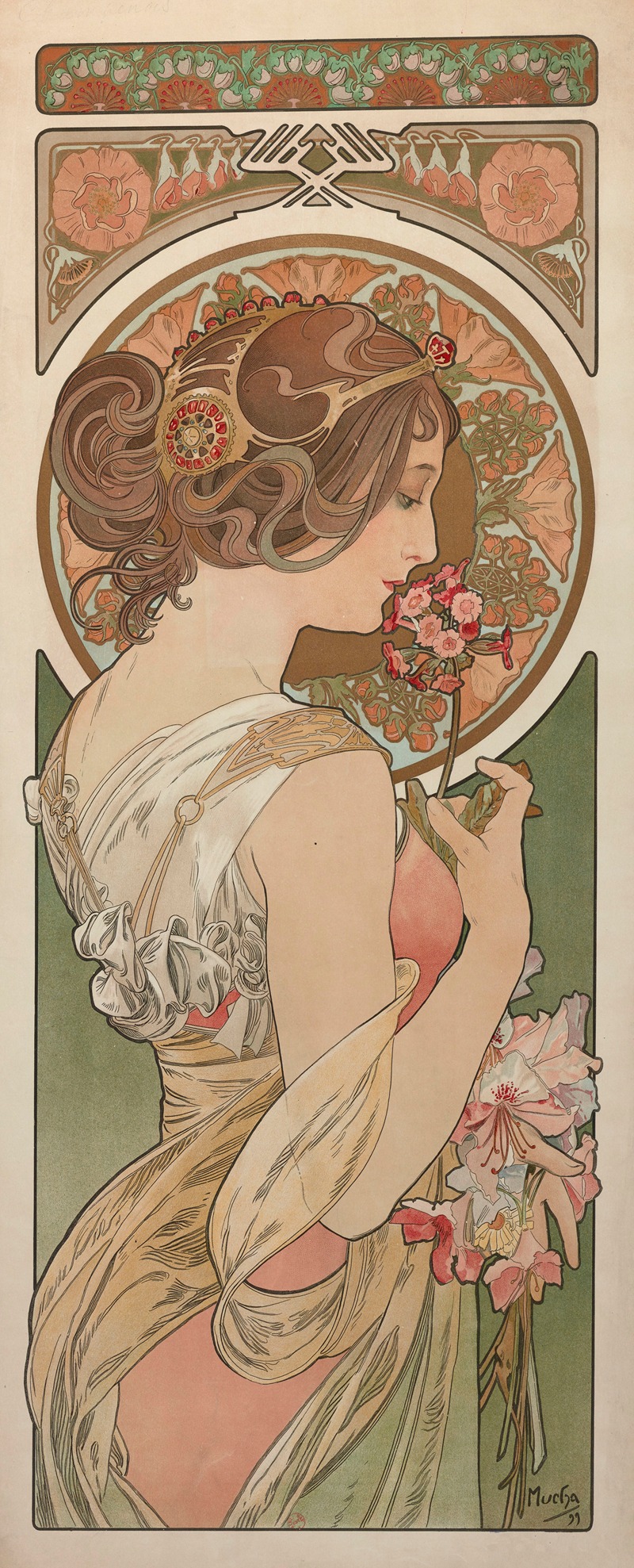
Dominated by gentle, refined pastel tones, this work fully showcases the flowing, curvilinear elegance characteristic of Art Nouveau. A woman draped in a pink robe is depicted in a three-quarter view, leaning closely toward delicate primroses. The organic circular botanical motif, drawn directly from nature, imparts a serene harmony to the entire composition.
✦ The setting of this painting
Rather than depicting a specific real-world setting, this work features an imaginary botanical realm symbolizing the harmony of nature, framed by circular floral motifs in the background. While its companion piece, Feather, employs geometric mosaic patterns, this work highlights the organic beauty of the natural world. It was designed as a decorative art poster to enrich interior spaces.
✦ Historical context
In the late 1890s, as Mucha's posters garnered immense public acclaim, the genre of the "decorative panel"—text-free art intended purely for interior appreciation—was conceived. Rooted in the ideal of the "democratization of beauty," which asserted that art should not be the exclusive privilege of the wealthy but should bring beauty into everyday homes, these works were sold at accessible prices.
A woman wrapped in a pink robe draws her face near a blossom of primroses. Beautiful ornaments gleam in her dark hair as she quietly inhales the flower’s fragrance.
An elegant, passive goddess of beauty, symbolizing Art Nouveau. Many would see in this painting such a graceful, ideal vision.
In reality, however, she was far more than just a beautiful model. The woman behind the image was a "modern woman" fighting for her place in society.
Her name was Marguerite Syamour. Born Marguerite Gagneur on August 10, 1857, in Bletterans in the Jura region, she was the daughter of the famed feminist writer Marie-Louise Gagneur. Marguerite herself carved out an independent path as a sculptor. She was an intellectual woman deeply committed to French republicanism, secularism, and the feminist movement—a woman who fought tirelessly for her beliefs.
In 1899, Alphonse Mucha maintained a vast apartment and studio at 6 Rue du Val-de-Grâce in Paris. Marguerite lived nearby. At the time, Mucha was devising ways to reduce production costs and time demands on his sitters. Instead of hiring professional models, he invited close friends and neighbors into his studio, photographing them to use as direct source material for his sketches.
Marguerite, too, stood before Mucha’s camera. The intellectual presence of the fighting sculptor was reconstructed by Mucha’s brush, transformed into the passive, coveted goddess adored by all.
About 222 more words
Read stories of masterpieces for free
Your Note
Write down what this painting made you feel in your art notebook.
Please sign up to write notes.
Sign up for freeRecommended Artworks
Sources & references
More artists
If you find an error in this content, please let us know here
This site is protected by reCAPTCHA, and the Google Privacy Policy and Terms of Service apply.