
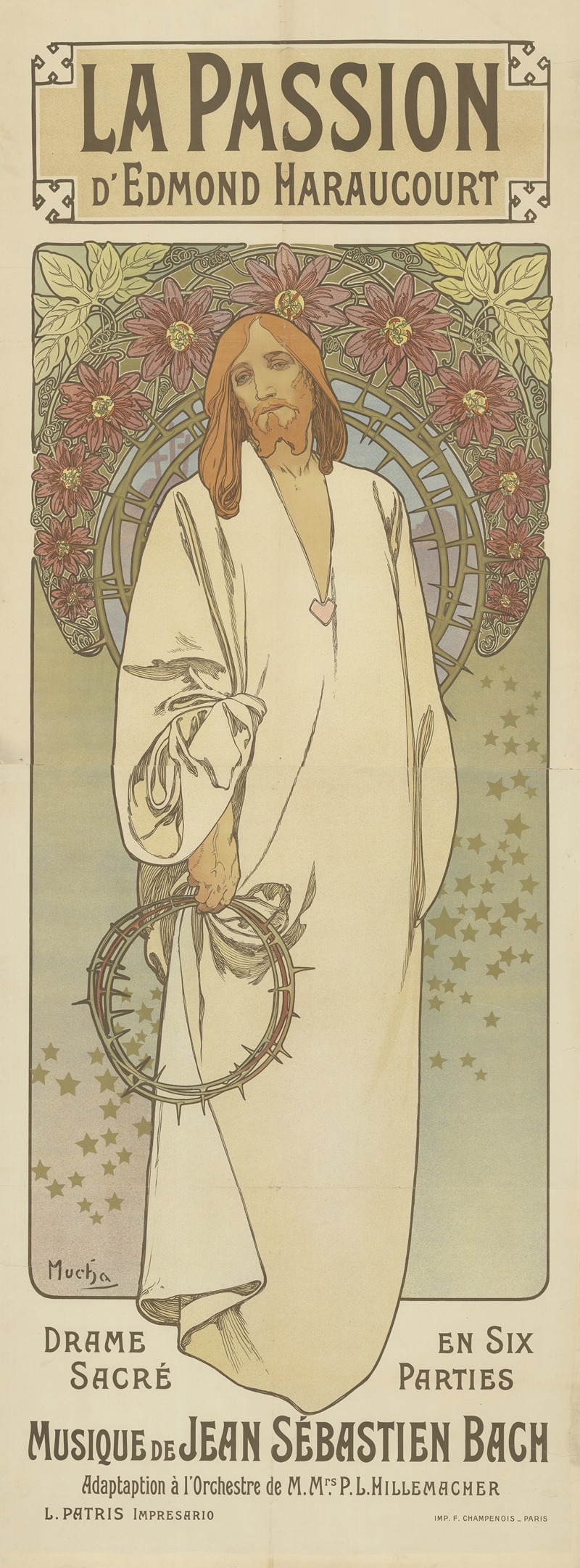
La Passion d’Edmond Haraucourt. Drame sacré en six parties, musique de Jean Sébastien Bach
1904
- Dimensions
- 201 × 72 cm
- Medium
- Color lithograph
- Collection
- Bibliothèque nationale de France (BnF)
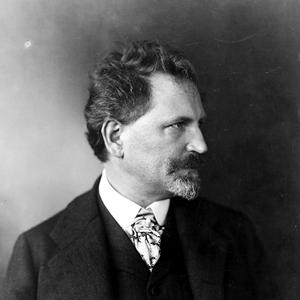
Alfons Maria Mucha, known internationally as Alphonse Mucha, was a Czech painter…
✦ Highlights (technique & color)
The work features a dramatically elongated, monumental composition. The immense circular halo framing Christ's head is adorned with red passionflowers and thorny branches symbolizing the Passion. Rendered in a subdued palette, the lower background displays a mystical band of stars sweeping diagonally across the night sky. Another compelling highlight is the drapery's contrast, setting the simple vertical lines on the right against the rich, heavy folds on the left.
✦ The setting of this painting
This setting was designed as a promotional poster for Edmond Haraucourt's sacred play, La Passion. In the background, three crosses symbolizing Golgotha—the site of Christ's crucifixion—are faintly visible. To the right, a rounded dome evokes the Temple of Jerusalem or a mosque, visually enriching the solemn, theatrical backdrop of the holy city.
✦ Historical context
The year 1904 marked a major turning point for Mucha, as he left Paris—his home for many years—and made his first journey to the United States. While he had achieved fame amid the glamorous commercialism of the 1890s, by around 1900 he had grown weary of commercial advertising work. Longing to dedicate himself to a spiritual art rooted in his ethnic and religious heritage, he created this piece as one of his final large-scale theatrical posters just before leaving Paris.
Jesus Christ, clad in white robes, stands quietly.
In his hands, he clutches a crown of thorns.
Alphonse Mucha.
Hearing his name, one might envision posters depicting glamorous women.
The law on freedom of the press, enacted in France in 1881, transformed the streets of Paris into giant billboards.
Innovations in chromolithography.
A 'street museum' where the public's gaze converged was created.
Mucha, as the darling of Art Nouveau, was at its very heart.
But in truth, he was deeply exhausted by his fame.
This is a reflective, prayerful piece he painted just before leaving Paris.
In 1896, Mucha signed an exclusive contract with the influential printer F. Champenois.
Financial stability through a monthly salary.
He established a vast studio on Rue du Val-de-Grâce and engaged in prolific creative activities.
Amidst the vibrant commercialism of the 1890s, he gained an undeniable reputation.
However, around 1900, a change occurred in his mindset.
Spiritual exhaustion from commercial advertising work, which was merely temporary consumer goods.
What he began to long for was art rooted in his own ethnic and religious heritage.
Dedication to spiritual art.
In his childhood, Mucha grew up in a fervent religious environment.
His experience in the choir.
Church music and Christian themes were a source of deep spiritual solace for him.
1904.
For Mucha, it was a pivotal year, marking his departure from Paris, where he had lived for many years.
He resolved to make his first voyage to the United States.
Just before this, he created this late-period large-format theatrical poster.
The sacred drama La Passion, written by Edmond Haraucourt, depicted the last days of Christ.
Johann Sebastian Bach's church music accompanied the entire production.
This commission was an excellent opportunity for Mucha.
It was a theme where he could directly project his faith and artistic ambitions.
Religious motifs were not merely painting subjects for him.
They were intimately connected to his strong religious experiences from childhood.
About 185 more words
Read stories of masterpieces for free
Your Note
Write down what this painting made you feel in your art notebook.
Please sign up to write notes.
Sign up for freeRecommended Artworks
Sources & references
More artists
If you find an error in this content, please let us know here
This site is protected by reCAPTCHA, and the Google Privacy Policy and Terms of Service apply.