
The Seasons 1
1896
- Dimensions
- 103 × 54 cm
- Medium
- Color lithograph on paper
- Collection
- Mucha Foundation
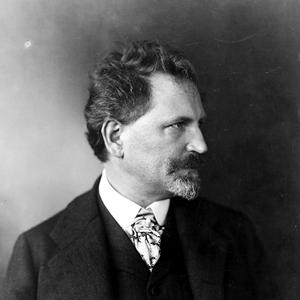
Alfons Maria Mucha, known internationally as Alphonse Mucha, was a Czech painter…
✦ Highlights (technique & color)
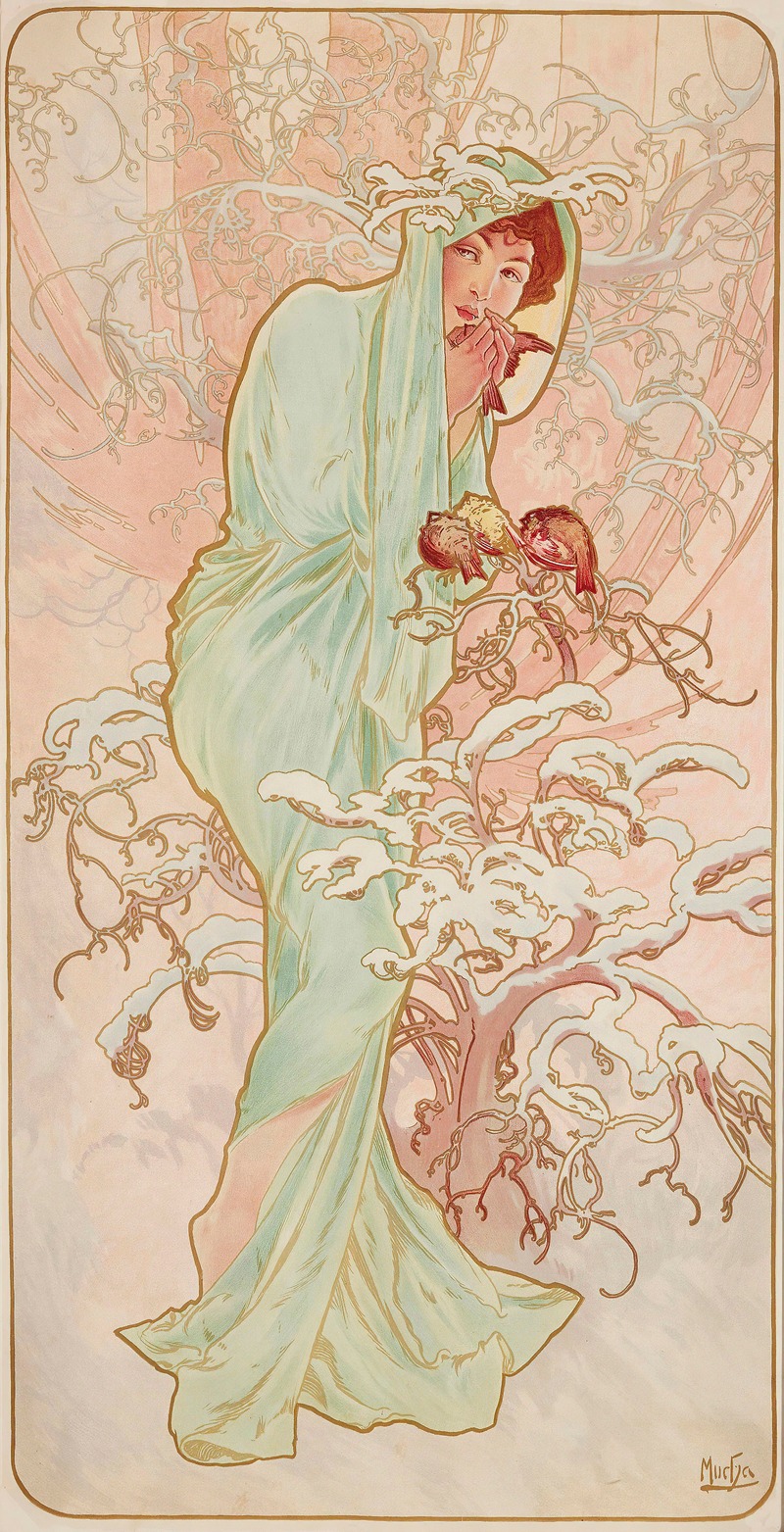
This work employs the technique of color lithography. Surrounded by snow-laden, bare branches, a woman cloaked in an icy blue mantle warms with her breath the small birds clinging to her chest. Expressive, organic curves gracefully delineate the folds of her drapery and the intricate contours of the branches.
✦ The setting of this painting
Rather than depicting a specific real-world location, this imaginative setting conveys the seasonal climate, mood, and cycles of the earth through an allegorical female figure. It portrays a cold, tranquil snowy wilderness where deep snow has fallen and all plant life is blanketed in ice.
✦ Historical context
In 1896, France was swept up in an affinity for Russian and Eastern European culture following the official visit of Tsar Nicholas II, bringing heightened attention to the Czech-born Mucha. It was also a period when the rise of the middle class and advances in lithographic printing spurred a rapid demand for interior decoration, opening up art—once the preserve of the privileged—to the general public.
Amidst bare trees blanketed in snow,
a woman stands with a pale blue cloth draped over her head.
Holding little birds close to her chest to shelter them from the cold, she gently breathes warmth upon them.
At the end of 1894,
Alphonse Mucha designed the poster "Gismonda" for the actress Sarah Bernhardt.
Becoming the sensation of the era overnight,
he set up a new atelier on the Rue du Val-de-Grâce in Paris in 1896.
It was brimming with plants, sculptures, and countless prints.
In this studio, he passionately photographed his models.
At the time, France was buzzing with excitement over the official visit of Russian Tsar Nicholas II.
Amidst this enthusiasm for all things Russian and Eastern European,
interest in the Czech-born Mucha grew with each passing day.
It was in this atmosphere that the printer F. Champenois approached him with a commission:
to create pure decorative art for interiors, entirely free of advertising text.
In those days, fine art was something enjoyed by a privileged few in private salons.
Yet through "The Seasons," a decorative series of four panels depicting Spring, Summer, Autumn, and Winter, Mucha sought to bring art into ordinary homes.
Sold at an affordable price,
these prints captured the hearts of the burgeoning middle class and became an overwhelming success.
Contemporary critics also lauded them as autonomous works of art in their own right, transcending commercial advertisement.
In 1897, a set bearing a handwritten dedication was presented to the art critic Georges Deschamps,
attesting to Mucha's close ties with Parisian intellectuals.
About 54 more words
Read stories of masterpieces for free
Your Note
Write down what this painting made you feel in your art notebook.
Please sign up to write notes.
Sign up for freeRecommended Artworks
Sources & references
More artists
If you find an error in this content, please let us know here
This site is protected by reCAPTCHA, and the Google Privacy Policy and Terms of Service apply.