
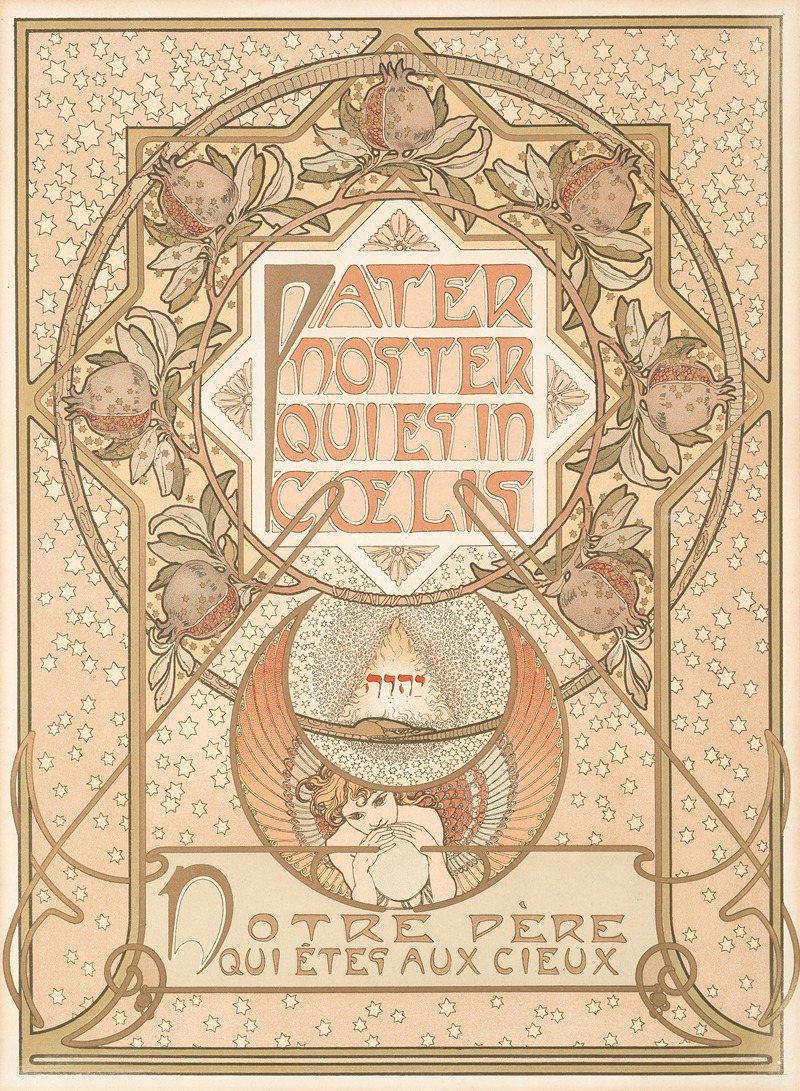
Pater Noster (c.1900)
- Dimensions
- 書籍フォーマット
- Medium
- Illustrated book (color lithograph, monochrome photogravure on paper)
- Collection
- Mucha Foundation
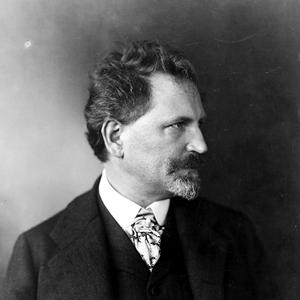
Alfons Maria Mucha, known internationally as Alphonse Mucha, was a Czech painter…
✦ Highlights (technique & color)
The work systematically structures the seven verses of the Lord's Prayer across three distinct page designs for each verse. The opening pages are polychrome lithographs, where the words of the prayer and the artist's philosophical thoughts are beautifully integrated into graceful botanical motifs. In contrast, the subsequent pages feature monochrome intaglio allegorical compositions, employing dramatic chiaroscuro to depict the divine, ethereal spirits, and anguished humanity with profound solemnity and tension.
✦ The setting of this painting
This work offers a universal interpretation of the Lord's Prayer, a foundational Christian prayer, set within a microcosm of the mystical and cosmic realm of the spirit. It creates a dramatic and metaphysical space: amidst mist-shrouded chasms and abysses, struggling humanity prostrates itself and reaches out for salvation toward colossal, luminous spirits and divine shadows floating in the heavens.
✦ Historical context
In late 19th-century Paris, Mucha achieved immense wealth and renown through his commercial posters, yet he struggled deeply with being regarded merely as a decorative designer. Drawn to mysticism, he joined Freemasonry in 1898. Believing that the virtues of Beauty, Truth, and Love would guide humanity's spiritual evolution, he created this work at the turn of the century as a manifesto to transmit his cosmic vision to future generations.
Set against a background dusted with stars, trailing vines and pomegranates form a sweeping circle. At the center rest words written in Latin, while below, a winged figure quietly casts their eyes downward.
Alphonse Mucha. Mention his name, and most people envision the glamorous posters that illuminated fin-de-siècle Paris—beautiful women with flowing tresses set among graceful, pastel botanical motifs. As the darling of Art Nouveau, he amassed immense wealth and fame in the world of commercial advertising. This artwork, too, appears filled with his signature refined, decorative elegance.
In reality, however, Mucha wrestled with intense inner conflict beneath the surface of his dazzling success. He felt a deep despair at being consumed as a mere commercial illustrator and decorative designer.
"I found no true satisfaction in the work I had been doing," Mucha later remarked. "I was convinced that my path lay somewhere else, on a slightly higher plane. I was searching for a way to spread light that could reach even the darkest corners."
In the Paris of the 1890s, he grew deeply absorbed in mysticism. In January 1898, he was initiated into the Parisian Masonic lodge Les Inséparables du Progrès. Beauty, Truth, Love—these three virtues, he came to believe, were the foundation for humanity’s spiritual evolution. Touched by this philosophy, he resolved to create a manifesto to transmit his cosmic vision to the next generation.
At the turn of the century, in late 1899, he completed the illustrated book Le Pater (The Lord’s Prayer), visualizing the traditional Christian prayer through his own mystical interpretation.
He systematically structured the seven verses of the Lord’s Prayer across three distinct page formats: a color lithograph featuring the prayer's text and his personal commentary, followed by a monochrome intaglio plate depicting allegorical imagery. What he rendered there was a profoundly solemn and metaphysical realm—semi-nude figures of humanity writhing in agony within a fog-shrouded abyss, reaching out in desperation for salvation toward a colossal spirit hovering in the sky.
When the original watercolor drawings were displayed in the Austrian Pavilion at the 1900 Paris Exposition Universelle, they created a powerful sensation. Emperor Franz Joseph I of the Austro-Hungarian Empire showed such intense interest that he bestowed upon Mucha the Knight's Cross of the Order of Franz Joseph.
About 158 more words
Read stories of masterpieces for free
Your Note
Write down what this painting made you feel in your art notebook.
Please sign up to write notes.
Sign up for freeRecommended Artworks
Sources & references
More artists
If you find an error in this content, please let us know here
This site is protected by reCAPTCHA, and the Google Privacy Policy and Terms of Service apply.