
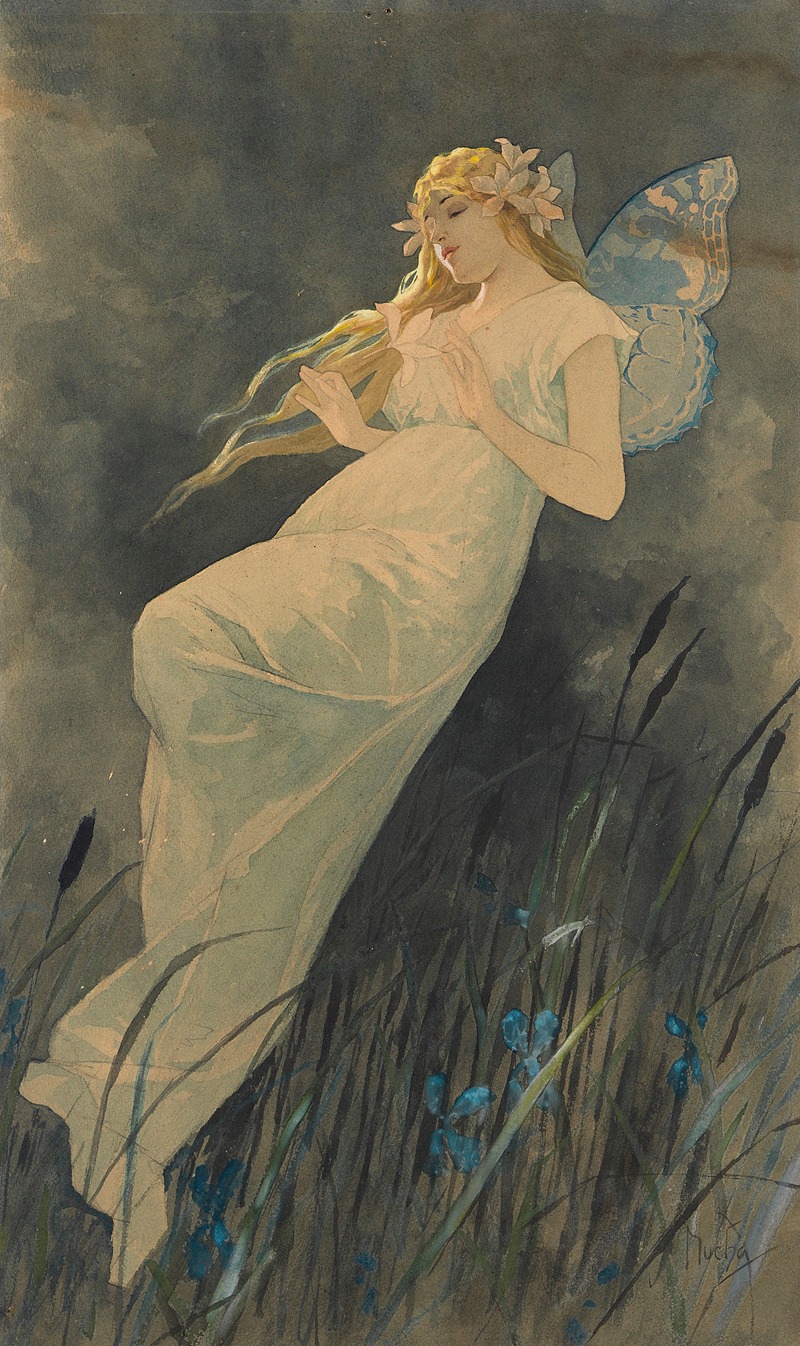
Fairy with Irises (ca. 1885–1890)
- Dimensions
- 41.7 x 24.9 cm
- Medium
- Watercolor and gouache over pencil underdrawing on paper laid down on thin cardboard
- Collection
- Private collection
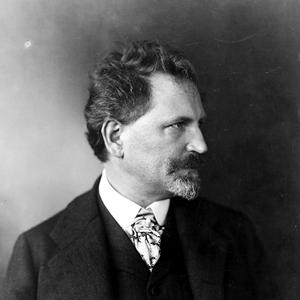
Alfons Maria Mucha, known internationally as Alphonse Mucha, was a Czech painter…
✦ Highlights (technique & color)
Combining transparent watercolor and gouache over a meticulous pencil underdrawing, the restrained palette of white, pale blue, and gray evokes the serene atmosphere of twilight.
✦ The setting of this painting
A mysterious waterside at dusk, lush with dense vegetation. Blue irises and reeds are arranged vertically, gently enclosing the fairy.
✦ Historical context
In the Parisian art world of the late 1880s, history painting and classical depictions of fairies and mythological motifs remained dominant. Moving away from academic training, Mucha was beginning to explore his own decorative style.
A waterside at dusk.
Surrounded by blue irises and reeds, a blonde fairy with blue wings floats quietly.
Clad in a white dress, she rests with her eyes gently closed.
Delicately rendered in watercolor and gouache over a pencil underdrawing.
The late 1880s.
Alphonse Mucha was in the midst of turbulent times.
In 1881, Vienna's Ringtheater was destroyed by fire.
Working as a scenery painter, he suddenly lost his livelihood.
At a loss, he was rescued by Count Karl Khuen-Belasi.
Taking Mucha under his patronage, the Count commissioned him to paint murals for his castle.
One day, a professor from the Academy of Fine Arts saw the castle's decorations and was astonished by his talent.
"This young man must receive formal training immediately."
Upon this strong recommendation, Mucha entered the Munich Academy of Fine Arts in 1885.
By 1887, he had moved to Paris, enjoying days of steady progress.
However, in 1889,
the Count's financial support was abruptly cut off.
Mucha was forced to leave the academy.
He was plunged into severe poverty, scraping by on daily earnings from illustrating children's books and magazines.
About 108 more words
Read stories of masterpieces for free
Your Note
Write down what this painting made you feel in your art notebook.
Please sign up to write notes.
Sign up for freeRecommended Artworks
Sources & references
More artists
If you find an error in this content, please let us know here
This site is protected by reCAPTCHA, and the Google Privacy Policy and Terms of Service apply.