
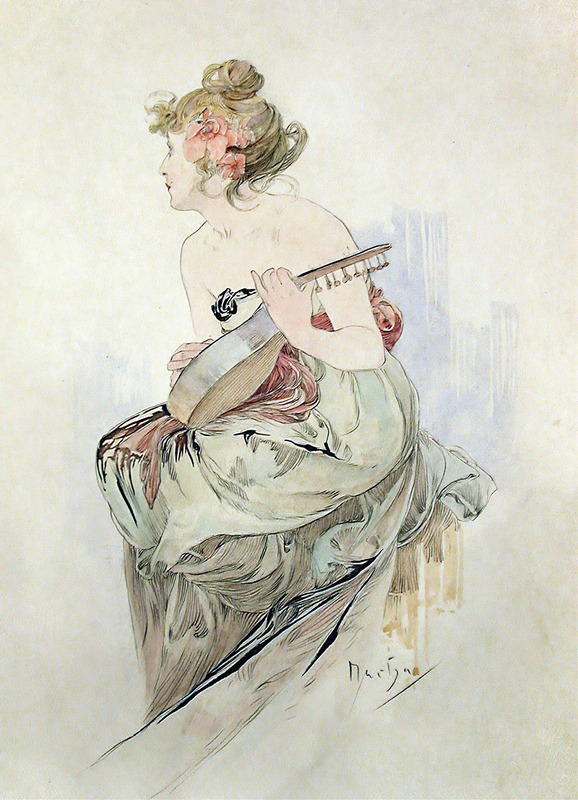
From the Frontispiece of Le Pater
- Dimensions
- 本の全判:39.7 x 30.6 cm、個別プレート:約 19 x 25 cm
- Medium
- Color lithograph and photogravure
- Collection
- Mucha Foundation, Prague
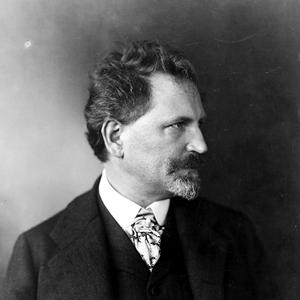
Alfons Maria Mucha, known internationally as Alphonse Mucha, was a Czech painter…
✦ Highlights (technique & color)
This work is a book frontispiece created using color lithography and photogravure. It is composed in a soft palette based on pale pinks, delicate greens, and creamy whites. The flowing lines characteristic of Art Nouveau are beautifully expressed in the woman's drapery and hair.
✦ The setting of this painting
This artwork was created as the frontispiece for Le Pater, a book inspired by the Christian Lord's Prayer. Holding an ancient stringed instrument resembling a lute, the woman offers a prayer to music, poetry, and the cosmic harmony of the divine. Her figure personifies the soul in its devotion to listening for celestial messages.
✦ Historical context
In Paris during the late 1890s, Mucha had reached the height of his success as a commercial artist. Feeling unfulfilled, however, he sought to create art that would contribute to the moral and spiritual elevation of humanity. After joining the Freemasons in 1898, he published this work on the threshold of the new century to illustrate a universal path of spiritual exploration.
A woman adorned with pink blossoms in her hair gazes quietly to the side.
In her arms, she cradles a lute-like stringed instrument.
Flowing hair and the graceful silhouette of a woman.
When one thinks of Alphonse Mucha, such glamorous posters naturally come to mind.
Born in 1860 in Ivančice, southern Moravia, he achieved extraordinary success in Paris.
A poster he produced in late 1894 turned him into an overnight sensation.
In 1896, he signed an exclusive contract with the prominent printer F. Champenois.
With a fixed monthly salary came financial stability.
On Rue du Val-de-Grâce, he established a spacious apartment and studio.
In late 1890s Paris, he stood at the very pinnacle of commercial art.
Yet in truth, he harbored a deep dissatisfaction with this success.
Commercial posters and designs for everyday goods.
He was growing exhausted by the endless stream of commissions.
What Mucha sought was far more than mere decoration.
To contribute to the moral and spiritual elevation of humanity—
he yearned for such a noble mission.
He had harbored an interest in spiritualism since the early 1890s.
Then, in January 1898,
he joined the Parisian Masonic lodge Les Inséparables du Progrès.
"Beauty," "Truth," and "Love."
To spread these ideals to the wider public through visual art—
he was convinced that this was his true calling.
And on December 20, 1899,
as the threshold of a new century approached, a book was published.
It was Le Pater, a visionary work based on the Lord's Prayer.
This sacred text was chosen to illuminate a universal spiritual path transcending sectarian boundaries.
Henri Piazza, a Parisian publisher specializing in fine art editions, stepped forward as co-producer.
The printing was entrusted to none other than F. Champenois.
Master bookbinders including Paul Affolter bound the work in morocco leather.
It was an extraordinary edition, limited to just 510 copies.
About 112 more words
Read stories of masterpieces for free
Your Note
Write down what this painting made you feel in your art notebook.
Please sign up to write notes.
Sign up for freeRecommended Artworks
.webp)
Sources & references
More artists
If you find an error in this content, please let us know here
This site is protected by reCAPTCHA, and the Google Privacy Policy and Terms of Service apply.