
Death and the Maiden
1915
- Dimensions
- 150 × 180 cm
- Medium
- Oil on canvas
- Collection
- Belvedere Museum, Vienna
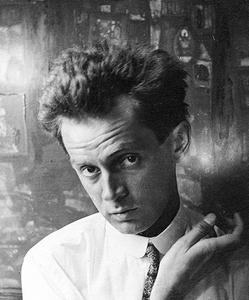
A leading figure of Austrian Expressionism, this early 20th-century painter laid…
A piece that deeply etches into a grave-like space the weight of abandoning his true love for his own convenience and the love he can never regain.
✦ Highlights (technique & color)
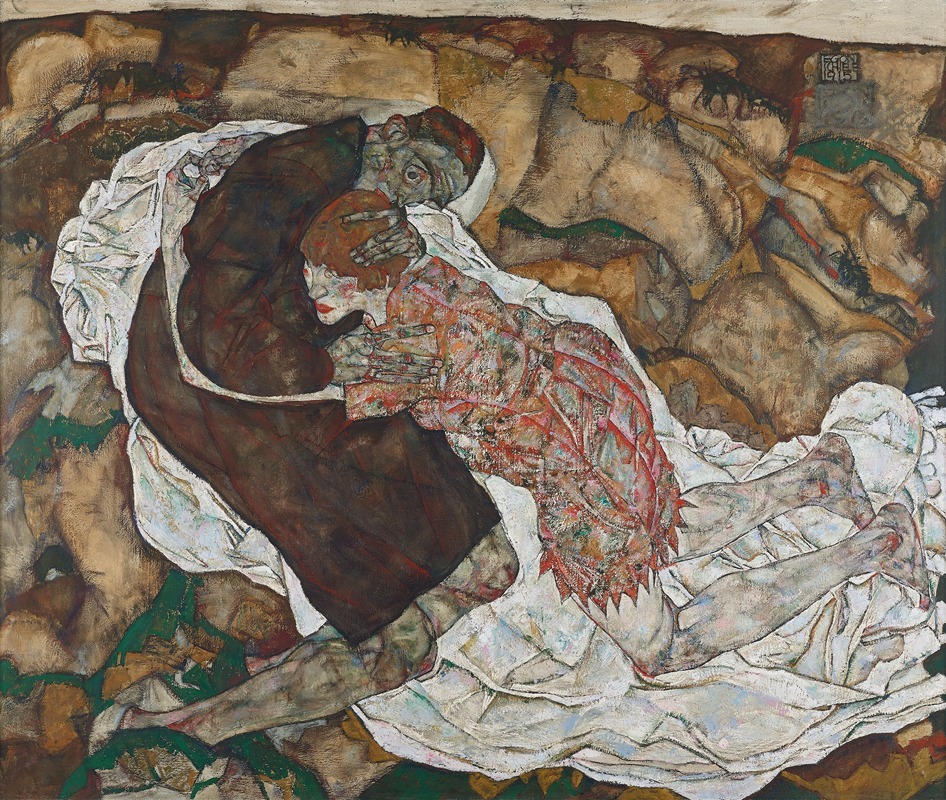
The composition is dominated by a restrained palette of earthy browns, chilling greys, and muted whites. A striking contrast emerges between the dark robe of Death and the pastel specks on the maiden's garment alongside her exposed pale legs. In the background, an abyssal dark void accentuates the absolute solitude that envelops the couple.
✦ The setting of this painting
Created in Schiele's studio in Vienna's 13th district of Hietzing. The irregularly undulating yellow and grey textures beneath the couple suggest sheets and blankets, while simultaneously evoking crumbling geological strata, bare soil, or an open grave—forming a psychological landscape of extreme tension unique to Schiele.
✦ Historical context
In 1915, World War I was intensifying, casting a shadow of death across Europe. Having received his conscription notice for the Austro-Hungarian Army, Schiele was gripped by the existential dread of facing death on the front lines at any moment. It was also a fateful year in which he hastily married Edith, a young woman from the middle class, and parted ways tragically with his longtime lover and muse, Wally.
In the dark void, an emaciated maiden clings fiercely to a man in a dark, monk-like robe.
Beneath their feet, an unsettling ground spreads, resembling either rippling sheets or an open grave.
The title, 'Death and the Maiden,' is a traditional motif depicted in European art since ancient times.
In 1915, as World War I intensified and the shadow of death enveloped Europe,
it is often said that the painter Egon Schiele, having received a conscription order from the Austrian army, depicted the existential fear of not knowing when he might lose his life on the front lines.
However, in reality, this is not merely a religious didactic painting, nor does it solely depict the fear of war.
It is 'the last and greatest farewell' to a single woman, imbued with intense guilt over his own selfish betrayal and the eternal longing for a lost love.
The maiden's model was Valerie 'Wally' Neuzil.
Since 1911, she had been Schiele's beloved companion, who supported him through his most difficult times, when he faced social hardship and was plagued by scandals such as arrest.
Wally served as the model for numerous masterpieces and was also the greatest connoisseur of his art.
However, in 1915, Schiele made a cruel decision.
Seeking social stability as a middle-class citizen and economic benefits, he decided to marry another woman, Edith Harms, who lived across from his studio.
Furthermore, Schiele presented Wally with an unbelievable document.
"I will continue to travel with you alone every year."
A selfish proposal to continue their relationship even after marriage.
Wally rejected it with intense contempt.
And she left Schiele forever.
This painting was created in his studio in the Hietzing district of Vienna immediately after this definitive separation.
Initially, the work was called 'Man and Girl' or 'Entwined Figures'.
The face of Death is Schiele's own self-portrait.
His unfocused, vacant gaze seems to stare into an inescapable fate.
Wally's clothes, clinging to him, are adorned with colorful pastel spots, creating a vivid contrast of light and shadow with the dark robe, along with her exposed white legs.
About 162 more words
Unlock this story's ending, and every article on MusicStory
- 42
Stories1–2 new every week
An archive of paintings paired with great music, made for a weekend night and a cup of coffee
- 282
Paintings with commentarygrowing daily
From simply looking to truly reading — the brushwork and the obsession of the masters
- 10
Music Librarygrowing daily
Know it first, and what reaches your ear changes — background music becomes art you keep for life
My Notes, unlimited
Every reading adds to a digital art notebook that is yours alone
Already have an account? Log in
Stories featuring this painting
Your Note
Write down what this painting made you feel in your art notebook.
Please sign up to write notes.
Sign up for freeRecommended Artworks
Sources & references
More artists
If you find an error in this content, please let us know here
This site is protected by reCAPTCHA, and the Google Privacy Policy and Terms of Service apply.