
Andante (around 1928)

- Dimensions
- 29 x 40 cm / 57 x 80 cm
- Medium
- Gouache on paper
- Collection
- Private collection
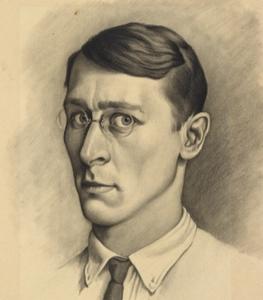
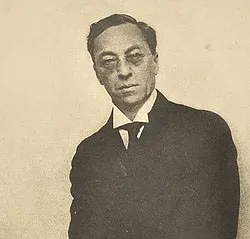
Karl Wiener was an Austrian draftsman , graphic artist and photo montage artist.…
✦ Highlights (technique & color)
Executed in opaque watercolor (gouache), the composition is built from gently undulating horizontal layers of color. The palette transitions systematically from blues and greens to oranges, yellows, and purples, with neighboring bands connecting organically. The evenly spaced black dots arranged atop the purple waves introduce a distinct visual rhythm to the painting.
✦ The setting of this painting
Rather than depicting an actual geographical location, this work is set within the artist's inner spiritual realm. The social enthusiasm of late-1920s Vienna, along with socialist ideals of working-class peace and order, are visualized through musical meter. It can be seen as a harmonious model space for social progress, constructed beyond the turbulence of the real world.
✦ Historical context
In the late 1920s, Vienna was known as "Red Vienna" under the governance of the Social Democratic Workers' Party, which actively promoted public housing construction and welfare policies for the working class. At the same time, armed clashes between the right and left intensified, bringing society to an overheated state on the verge of explosion. As the footsteps of fascism drew near, it was an era defined by a blend of fervor for building a new society and underlying anxiety.
Gently undulating, vibrant layers of color.
Deep-sea blues and greens unfold across the upper section, transitioning rhythmically downward into orange, yellow, and deep purple.
Across the purple wave, black dots are arranged at regular intervals.
On the left side of the composition rises a vertical pillar blending green and yellow.
The title, "Andante," is a musical term meaning "at a walking pace."
In late 1920s European avant-garde art, translating music into painting was a widespread pursuit. Wiener himself was an accomplished pianist who once noted that music was the most direct source of inspiration for his painting.
At first glance, this work appears to be a pure "visualization of music," expressing layered sounds through bands of color and marking a steady beat with black dots.
A beautiful abstract painting.
One might easily wish to simply surrender to its pleasant rhythm.
Yet the rhythm inscribed in this painting is not merely a musical beat.
Within these orderly steps, the painter Karl Wiener subtly encoded the social ideals that Austria was striving toward at the time.
Born in 1901, Wiener grew up the son of a worker at the Social Democratic Workers' Party printing press and became an enthusiastic party member in his youth.
Around 1928, when he painted this piece, Vienna was known as "Red Vienna," a period of rapid progress in large-scale public housing and welfare policies for the working class.
It was an era brimming with fervor, as workers united to build an egalitarian, orderly new society from the devastation of defeat in World War I and severe inflation.
While studying design and composition at the Vienna School of Arts and Crafts, Wiener sought to express this societal energy through abstract painting.
In his contemporary work Allegro, he captured the overheated atmosphere of a society experiencing armed clashes through fiercely swirling colors.
About 256 more words
Read stories of masterpieces for free
Your Note
Write down what this painting made you feel in your art notebook.
Please sign up to write notes.
Sign up for freeRecommended Artworks
Sources & references
More artists

If you find an error in this content, please let us know here
This site is protected by reCAPTCHA, and the Google Privacy Policy and Terms of Service apply.