
Stein on the Danube, Seen from the South
1913
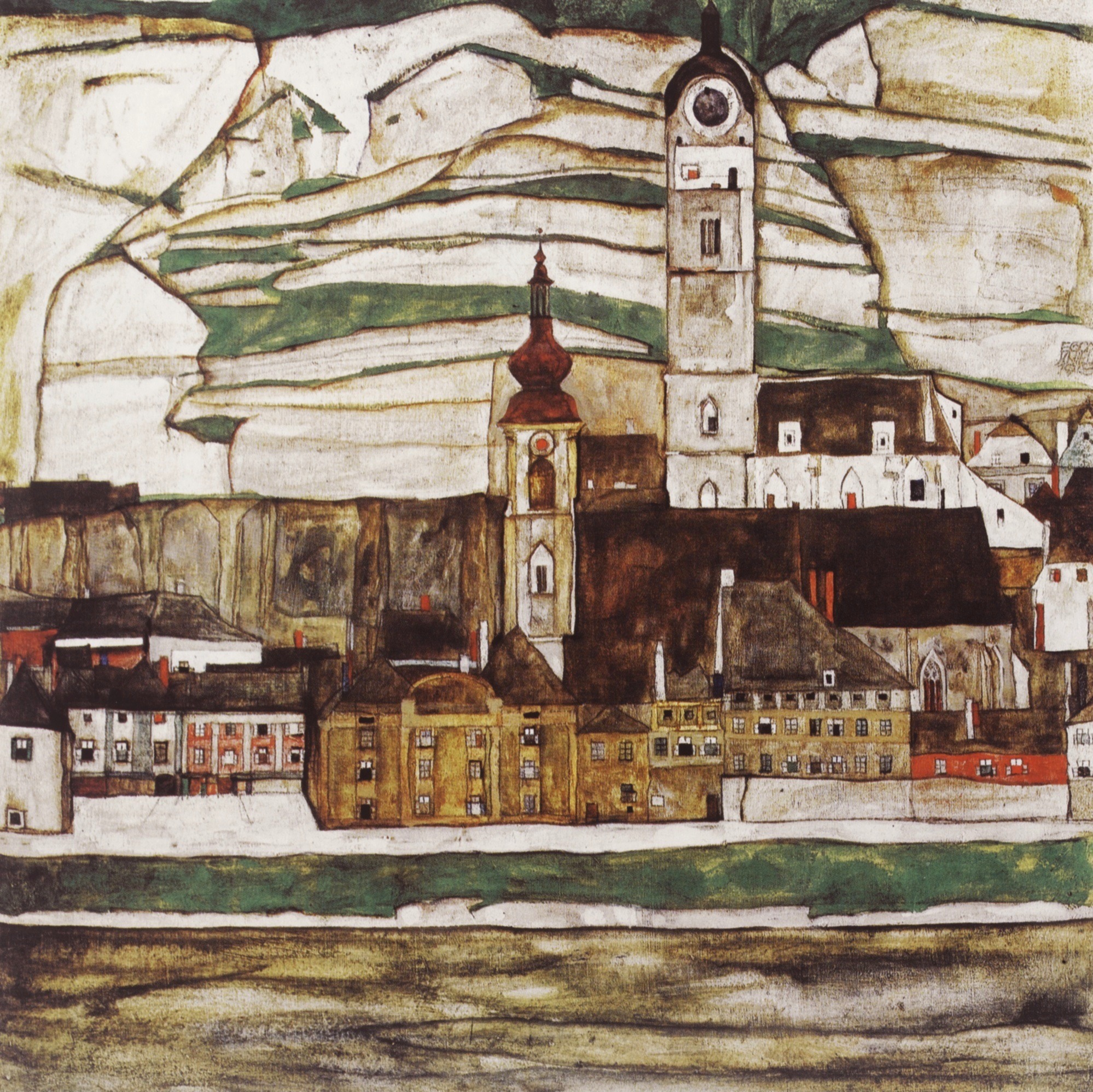
Image: Wikimedia Commons / Public Domain
- Dimensions
- 90.2 × 89.5 cm
- Medium
- Oil on canvas
- Collection
- Neue Galerie
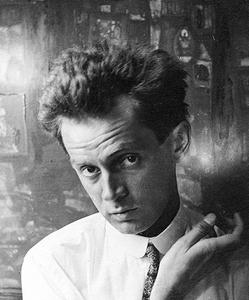
A leading figure of Austrian Expressionism, this early 20th-century painter laid…
Amid the isolation and despair brought on by the absurdities of society, to deconstruct and reconstruct the physical landscape, establishing on canvas an unshakeable order and a psychological sanctuary to safeguard his soul.
✦ Highlights (technique & color)
A geometric composition in which horizontal layers—stretching from the dark, sluggish Danube in the foreground across the rooftops to the terraced vineyards behind—are pierced vertically by the church tower. Amid the muted, earthy browns, vivid flecks of emerald green and vermilion are scattered throughout.
✦ The setting of this painting
Stein an der Donau, a medieval town along the Danube at the eastern edge of the Wachau Valley in Lower Austria. It borders Krems, where Schiele attended school in his youth.
✦ Historical context
1913. A period when Schiele was seeking a resurgence in Vienna after suffering social and financial devastation from his wrongful arrest in the Neulengbach affair the previous year. It was an uneasy time, set against the twilight of the Habsburg Empire and the impending shadows of World War I.
Across the heavy, sluggish waters of the Danube, a deserted medieval town stands in profound silence.
Closed windows, muted earthy brown walls, and the steep slopes of vineyards pressing in from behind.
This is the historic Austrian town of Stein. Yet, this exact scene exists on no real map.
The twenty-three-year-old painter Egon Schiele projected his inner solitude, despair, and prayers for renewal onto this hushed townscape, etching them onto the canvas.
A Silent Town Seen from the Depths of Despair
In 1913, as Schiele held his brush in his Vienna studio, his spirit bore deep and painful wounds.
In the spring of the previous year, during his stay in the village of Neulengbach, he had been suddenly arrested on wrongful accusations of kidnapping a minor and creating immoral drawings.
Twenty-four days spent in a cold cell pushed the young painter to the brink of emotional collapse.
Although the most serious charges were ultimately dropped, his social reputation was utterly ruined, and he was plunged into severe financial distress.
Exposed to the public's cold stares and prejudice, he fled to Vienna with his lover, Wally, the only person who understood him, struggling day by day to find a way to rebuild his life.
As a subject to salvage his wounded soul, he chose Stein—a town along the Danube that he knew intimately from his boyhood school days.
Though the idea was originally suggested by his wealthy patron Carl Reininghaus, Schiele deeply projected his own inner state into the town's scenery.
Schiele did not simply replicate the real landscape spread before him.
In his mind, he dismantled the landmarks—the monasteries and churches—and rearranged them like pieces of a puzzle, guided purely by his aesthetic sensibility and emotion.
He moved the Minorite Church, which stood at a distance in reality, right next to the Frauenberg Church.
Against the horizontal expanse of the dark river and clustered houses, he thrust the church towers vertically into the sky.
It was a solitary effort to hold together his fracturing mind, forging an unshakeable order within the rectangular confines of the canvas that no one could destroy.
The houses, entirely devoid of human presence and with their windows shuttered tight, mirrored Schiele himself—shielding his wounded heart and hiding from the malice of the world.
The dark, murky swell of the Danube seemed to voice the turmoil of his anxiety and his anger at the cruelty of fate.
Through this landscape, he was not merely depicting a town, but crafting a "psychological self-portrait."
Much like his townscape from the previous year titled "The Dead City," this depiction of Stein stood as a symbol of human fragility and the inexorable passage of time.
About 461 more words
- ・Schiele’s painful decision to part with a masterpiece amid deep poverty, and the letters that tell the story
- ・An appeal born of friendship: pleading with an industrialist to save a dear friend rather than himself
- ・The colors of a serene landscape and the indomitable spirit imbued within the tower
Read the rest of this commentary —
and step into a secret gallery
opened just for you
An "art letter" delivered to you every Saturday morning
Works, music and words chosen for your sensibility, from your artist-type result and the paintings you love
A library of masterpieces and music you can enjoy "in your own words", not just look at
A "digital art notebook" (unlimited) where your impressions build into your own taste
Unlimited likes and notes
¥980 / month¥0 today
¥980/month (tax incl.) from day 8. Cancel anytime.
Already have an account? Log in
Your Note
Write down what this painting made you feel in your art notebook.
Please sign up to write notes.
Sign up for freeRecommended Artworks
Sources & references
More artists
If you find an error in this content, please let us know here
This site is protected by reCAPTCHA, and the Google Privacy Policy and Terms of Service apply.