
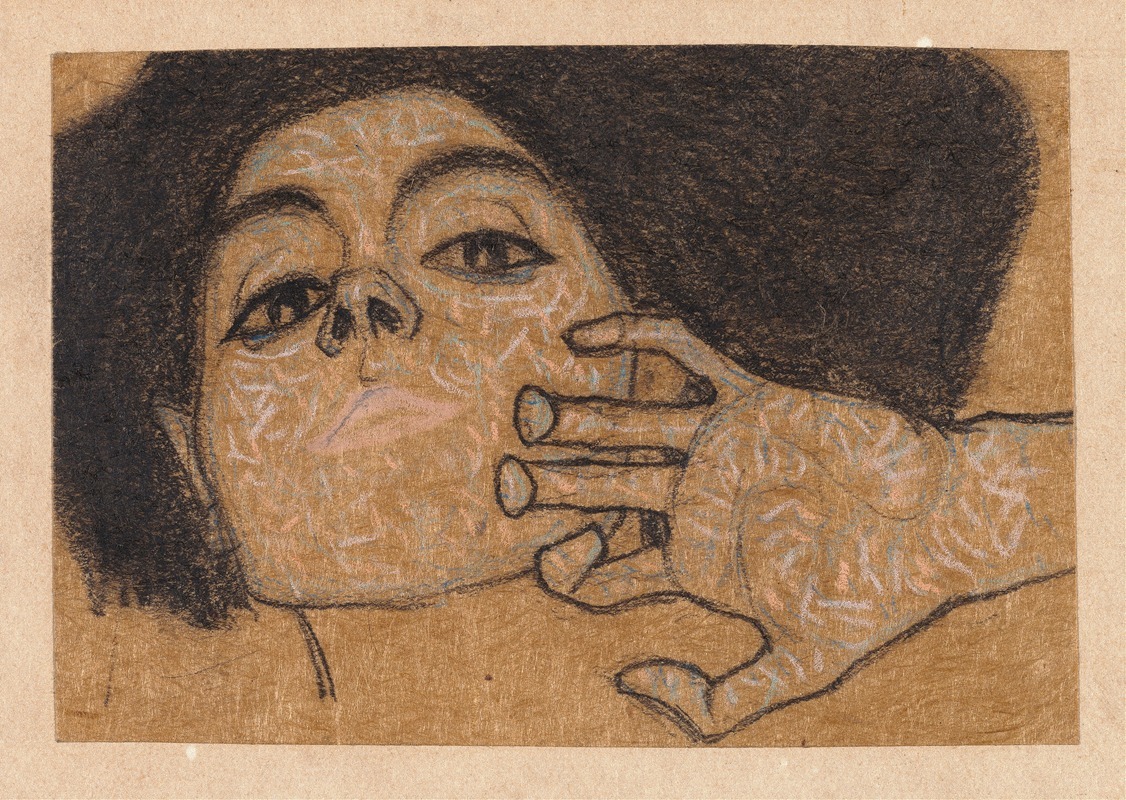
Head of a Woman
1908
- Dimensions
- 6.03 × 8.89 cm
- Medium
- Conté crayon and pastel on buff paper (mounted on board)
- Collection
- National Gallery of Art (Washington, D.C.)
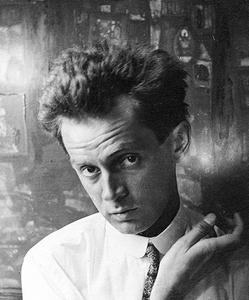
A leading figure of Austrian Expressionism, this early 20th-century painter laid…
✦ Highlights (technique & color)
Executed on an intimate sheet measuring a mere 6 by 9 centimeters, this piece is rendered with bold, vigorous strokes of Conté crayon. By utilizing the rustic texture of the yellowish-brown buff paper as the base tone for the skin, the work reveals the nascent stirrings of Expressionism—departing from realistic rendering to give visual form to the subject's inner psychological state.
✦ The setting of this painting
Vienna, 1908. While enrolled at the Academy of Fine Arts Vienna, Schiele grew increasingly frustrated with its conservative curriculum. Having met the master Gustav Klimt, he was deeply influenced by his decorative eroticism, yet simultaneously began seeking autonomy from academic constraints to forge his own distinct artistic voice.
✦ Historical context
Set against the intellectual ferment of fin-de-siècle Vienna and the dawn of Sigmund Freud's psychoanalysis, this era marked a turning point in Schiele's style. His work rapidly transformed from traditional realism and decorative symbolism into an existential Expressionism that laid bare the human psyche.
A woman’s face emerges from the rustic brown paper. A hand rests against her cheek, fingers splayed, her searching gaze leaving an unforgettable impression.
The year was 1908, and Egon Schiele was just eighteen years old.
At the time, he was a student at the Academy of Fine Arts in Vienna, yet he harbored a growing frustration with his professors' rigid, conservative approach to drawing. It was then that he encountered the master Gustav Klimt. The young Schiele fell deeply under the spell of Klimt’s intense decorative eroticism, the Art Nouveau style, and the sleek design sensibilities of the Wiener Werkstätte.
That same year, Schiele staged his first exhibition in Klosterneuburg, near Vienna, clearly charting a course toward independence from the Academy.
During this pivotal transition toward a style defined by raw physical expression, there was one model he pursued with a passion bordering on obsession: his sister Gertrude, four years his junior.
Schiele’s bond with her was extraordinarily intimate. In 1906, without their guardian’s consent, he took the then twelve-year-old girl away to Trieste, sharing a hotel room with her overnight—a scandalous event often characterized as incestuous.
About 130 more words
Read stories of masterpieces for free
Stories featuring this painting
Your Note
Write down what this painting made you feel in your art notebook.
Please sign up to write notes.
Sign up for freeRecommended Artworks
Sources & references
More artists
If you find an error in this content, please let us know here
This site is protected by reCAPTCHA, and the Google Privacy Policy and Terms of Service apply.