
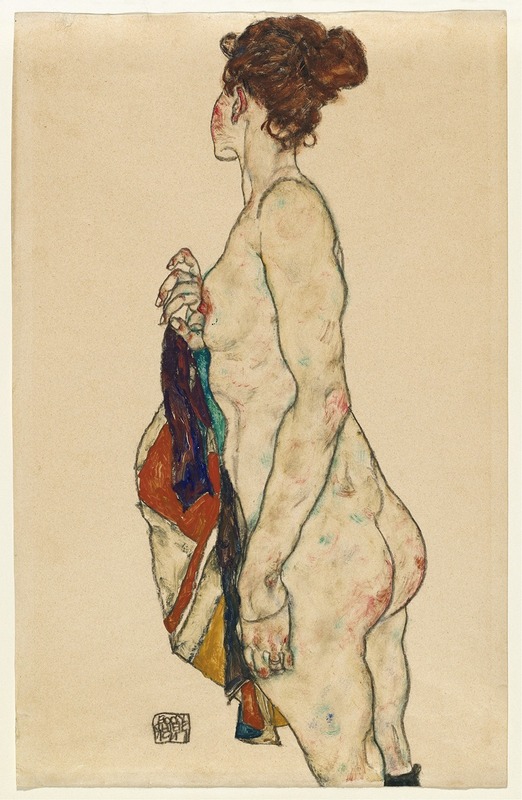
Standing Nude with a Patterned Robe
1917
- Dimensions
- 29.3 × 45.9 cm
- Medium
- Gouache and black crayon (or charcoal) on wove paper
- Collection
- National Gallery of Art, Washington
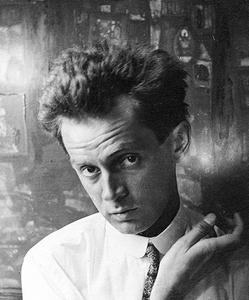
A leading figure of Austrian Expressionism, this early 20th-century painter laid…
✦ Highlights (technique & color)
Note how the soft texture of the paper is utilized to render the skin. Using opaque watercolor, Schiele meticulously applied spots of warm pink alongside cool blue-green tones. The vibrant geometric robe draped over her right arm is more than mere flat decoration; its palpable fabric texture provides a striking contrast to the three-dimensional form of the body.
✦ The setting of this painting
Vienna during World War I. While shortages and exhaustion weighed heavily upon the city, Schiele was permitted to work in his studio through the benevolence of his commanding officer. This work was created in a deeply fulfilling artistic environment, as he regained stability and confidence in his personal life.
✦ Historical context
By 1917, prolonged warfare had plunged Vienna into severe deprivation. For Schiele, however, his marriage in 1915 had brought financial stability. Choosing a middle-class wife over his former mistress steered his art further toward realism. This was a time when his career was ascending to its zenith, just before his triumphant exhibition the following year.
A woman stands, her body tilted to the left, her face turned away.
Over her right arm hangs a robe with vibrant geometric patterns in red, yellow, and green.
The year is 1917.
World War I had dragged on, and the city of Vienna faced severe shortages and exhaustion.
However, Egon Schiele's personal life was calm.
He had married Edith Harms in 1915.
This brought him dramatic stability in both his personal life and financial situation.
His former lover, Wally, who had supported him.
Schiele betrayed her, choosing Edith, who was of a higher social standing.
This choice brought about a change in his art.
A return to middle-class harmony.
And a leaning towards realism.
Even while serving in the military, he was allowed to work in his Vienna studio thanks to the goodwill of his superior officers.
He was filled with complete confidence and devoted himself to his work.
About 153 more words
Read stories of masterpieces for free
Stories featuring this painting
Your Note
Write down what this painting made you feel in your art notebook.
Please sign up to write notes.
Sign up for freeRecommended Artworks
Sources & references
More artists
If you find an error in this content, please let us know here
This site is protected by reCAPTCHA, and the Google Privacy Policy and Terms of Service apply.