
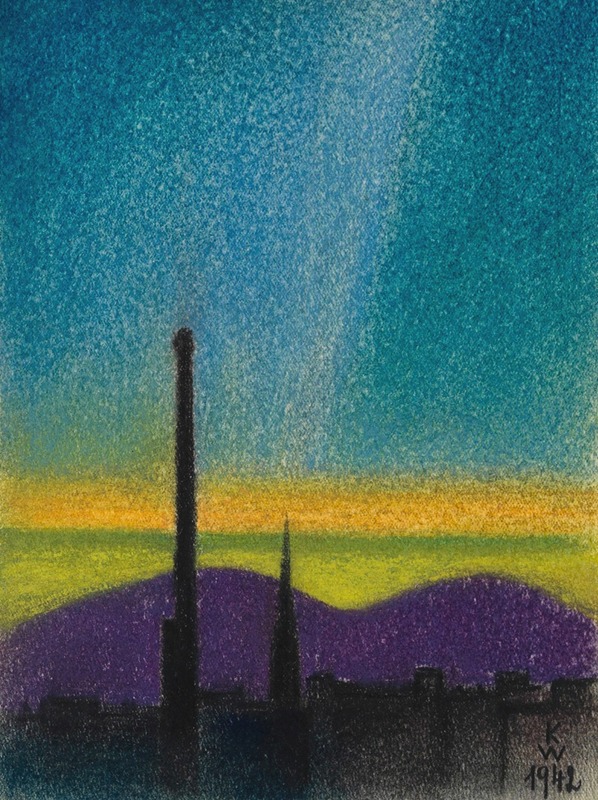
Abendlandschaft Wien
1942
- Dimensions
- 寸法非公表
- Medium
- Oil on canvas, or drawing on paper
- Collection
- Wien Museum
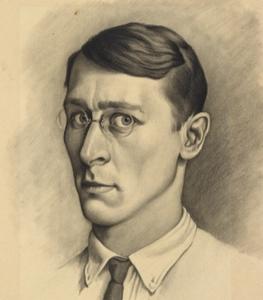
Karl Wiener was an Austrian draftsman , graphic artist and photo montage artist.…
✦ Highlights (technique & color)
Although touches of blue, yellow, and purple are used, the buildings in the foreground are heavily blackened, creating a somber and brooding atmosphere. Streaks of white light reaching into the sky evoke cold moonlight or artificial illumination. The collision of rough Expressionist brushwork with the rigid outlines characteristic of graphic artists heightens the city's stark, cold presence.
✦ The setting of this painting
This work depicts the outskirts of Vienna after sunset in 1942, during the Second World War. Rather than featuring traditional sights, the setting captures an industrial area with gasworks, smokestacks, and desolate construction sites. It reflects the oppressive atmosphere of an era under fascist rule, where male citizens were mobilized to the front lines and a sense of death and silence hung over society.
✦ Historical context
Following the annexation of Austria by Nazi Germany in 1938, Vienna fell under totalitarian control. By 1942, the Eastern Front had deteriorated into a brutal quagmire, and the reign of terror by the Gestapo and the Holocaust had reached its height. Free expression was strictly forbidden, and any dissident artistic activity was a perilous act that meant near-certain death.
Under a sky shifting from blue to yellow lie purple hills.
In the foreground rise a tall chimney and a spire.
The blackened silhouette of the city sinks into shadow.
In the lower right, the year 1942 is inscribed.
It was the height of World War II.
The setting is the outskirts of Vienna after sunset,
an industrial district lined with gasworks and smokestacks.
The painter, Karl Wiener,
taught at the Vienna School of Arts and Crafts.
That was merely his public face.
In 1938, Nazi Germany annexed Austria.
By 1942, Vienna was under fascist rule; male citizens were mobilized one after another to the Eastern Front, and the city was enveloped in death and silence.
Raised in a Social Democratic family,
Wiener harbored a deep fury against the regime’s violence.
On the surface, he was an obedient art teacher.
Yet by night, he secretly continued to produce subversive works.
If discovered, it meant certain death.
The terror was unrelenting,
and his mind fell deeply ill.
About 137 more words
Read stories of masterpieces for free
Your Note
Write down what this painting made you feel in your art notebook.
Please sign up to write notes.
Sign up for freeRecommended Artworks
Sources & references
More artists
If you find an error in this content, please let us know here
This site is protected by reCAPTCHA, and the Google Privacy Policy and Terms of Service apply.