
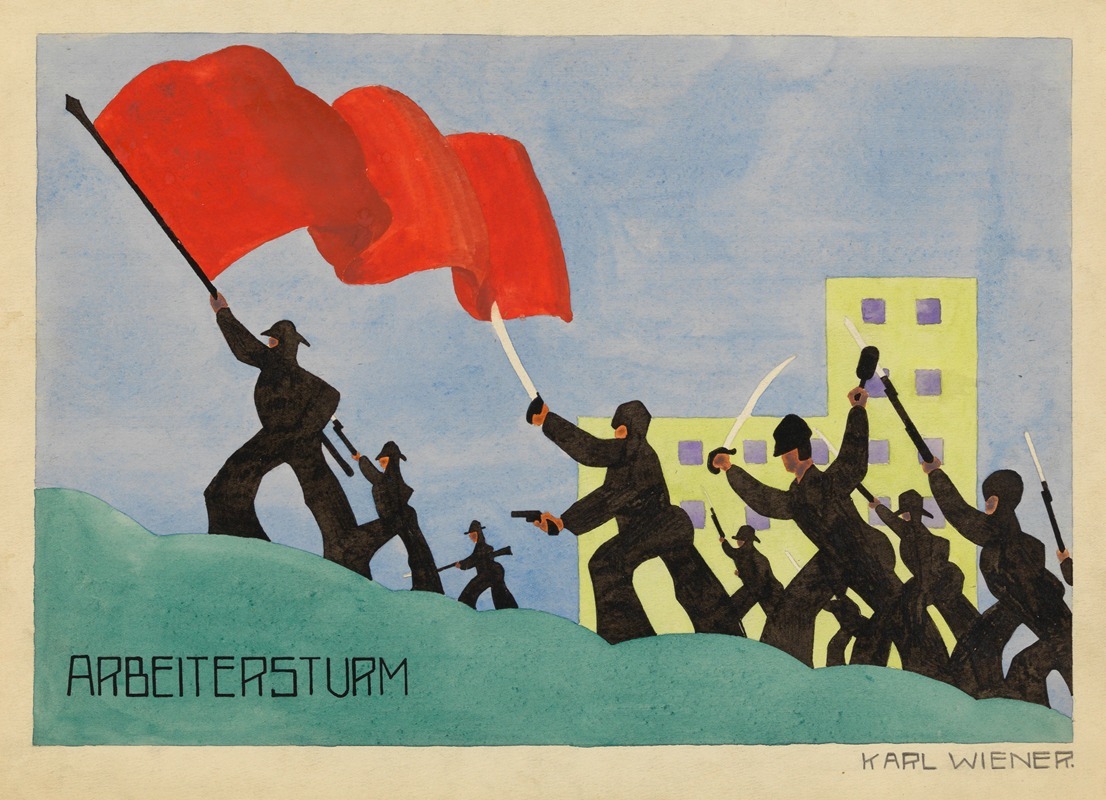
Arbeitersturm (around 1923)
- Dimensions
- ランドスケープ(横長構図)
- Medium
- Graphic ink drawing on paper
- Collection
- Wien Museum
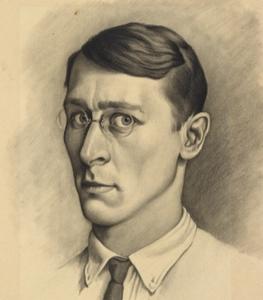
Karl Wiener was an Austrian draftsman , graphic artist and photo montage artist.…
✦ Highlights (technique & color)
Drawing on the tradition of early Viennese Expressionism, the composition is dominated by nervous, ferocious linework. Forms are severely distorted, translating the cries and anguish of the masses into the very roughness of the lines. While addressing a subject aligned with socialist themes, the work diverges from balanced, heroic depictions, deriving its pictorial intensity instead from the manifestation of raw internal passion. Graphic ink on paper powerfully fixes this collective dynamism in place.
✦ The setting of this painting
Rather than depicting a specific, physical location, the scene unfolds in an abstract space of struggle composed of surging diagonal lines and overlapping bodies. The densely packed workers fill the frame, surging forward violently like a tempestuous natural disaster. By stripping the background to its absolute minimum and focusing entirely on the kinetic force of the masses, the work conveys the energy of class struggle not as a localized riot, but as a historical inevitability.
✦ Historical context
In 1923, the Republic of Austria was grappling with astronomical hyperinflation and chronic political instability following the collapse of the Habsburg Empire after World War I. With the looming threat of armed clashes between Social Democratic and Communist forces and far-right paramilitary groups, society was charged with intense class tension. The young Wiener was keenly attuned to this explosive societal energy, capturing the precise moment when collective will erupts.
Packed so tightly they fill the entire frame, workers raise red flags high.
They surge forward like an oncoming tempest.
Undulating diagonal lines intertwine with the violently distorted bodies of the crowd.
Capturing the raw energy of society with rough yet powerful lines, this composition might seem like the work of an artist with advanced academic training.
Yet in 1923, when this piece was created, Karl Wiener was an unknown, self-taught painter who had never once attended art school.
Wiener was born in Graz, Austria, in 1901.
His father, Friedrich, worked as a proofreader for the printing office of the Social Democratic Workers' Party, and Karl grew up in a household with a deep political consciousness rooted in the working class.
However, he did not pursue an artistic career from the start.
In his youth, he earned his living as a bank clerk in Graz and Munich.
The Republic of Austria in 1923.
Following the collapse of the Austro-Hungarian Empire after its defeat in World War I, the nation was reeling under astronomical hyperinflation and chronic political turmoil.
Violent clashes with far-right groups.
Palpable, suffocating class tensions.
Amid such an explosive social climate, Wiener, around twenty-two years old, continued to teach himself to draw while working at a bank.
It was only in the following year, 1924, that he finally knocked on the doors of the Graz State Art School.
In other words, this painting was not born from technique taught by masters.
It was forged purely from his intense sympathy for the socialist struggle and his innate Expressionist sensibility.
About 182 more words
Unlock this story's ending, and every article on MusicStory
- 42
Stories1–2 new every week
An archive of paintings paired with great music, made for a weekend night and a cup of coffee
- 282
Paintings with commentarygrowing daily
From simply looking to truly reading — the brushwork and the obsession of the masters
- 10
Music Librarygrowing daily
Know it first, and what reaches your ear changes — background music becomes art you keep for life
My Notes, unlimited
Every reading adds to a digital art notebook that is yours alone
Already have an account? Log in
Your Note
Write down what this painting made you feel in your art notebook.
Please sign up to write notes.
Sign up for freeRecommended Artworks
Sources & references
More artists
If you find an error in this content, please let us know here
This site is protected by reCAPTCHA, and the Google Privacy Policy and Terms of Service apply.