
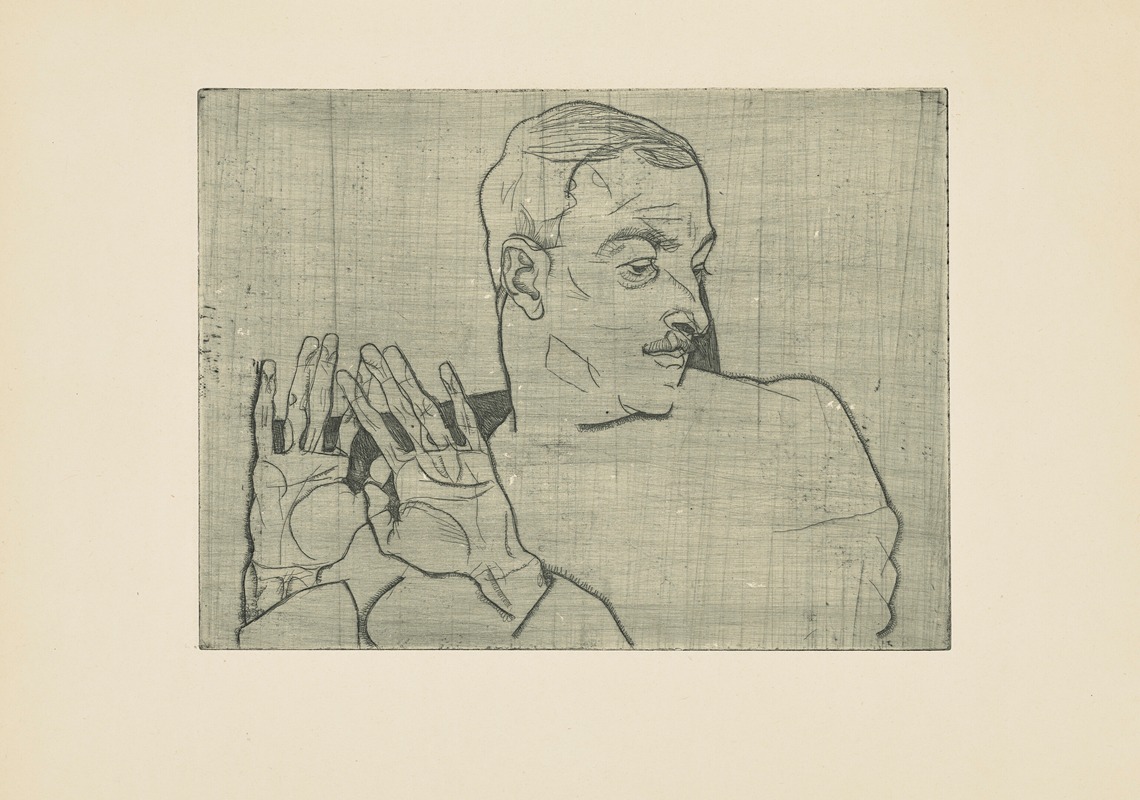
Portrait of Arthur Roessler (Bildnis Arthur Roessler)
1914
- Dimensions
- プレート(版面)サイズ: 23.9 × 31.9 cm
- Medium
- Drypoint on light wove paper
- Collection
- The Museum of Modern Art, New York
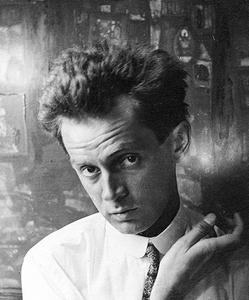
A leading figure of Austrian Expressionism, this early 20th-century painter laid…
✦ Highlights (technique & color)
The drypoint technique involves incising lines directly into a hard copper plate with a steel needle. Ink held by the burr—the displaced metal along the incised lines—creates powerful, velvety, and richly textured lines.
✦ The setting of this painting
Inside Schiele's studio in Vienna. With all interior elements removed from the background, the composition focuses entirely on Roessler's sharp profile and the placement of his hands.
✦ Historical context
In 1914, World War I broke out. Facing increasing material hardship, Schiele sought financial independence and, encouraged by Roessler, began producing works for the German print market.
A space without a background.
A man with a sharp profile gazes into the infinite space beyond the frame.
His unusually distorted hands are intertwined beneath his chin.
Bony fingertips with emphasized joints are positioned as a dramatic focal point.
The subject is art critic Arthur Roessler.
He was the greatest contributor to bringing Egon Schiele's art to the world.
The year 1914.
It was a pivotal year in art history, as World War I erupted and the Austro-Hungarian Empire declared war on Serbia.
Schiele, suffering from a heart condition, was deemed unfit for military service.
However, the devastation of the war and the scarcity of daily necessities were severe.
Roessler extended a helping hand to the young painter, who was seeking financial independence.
He explained the profitability of the German print market.
He then provided metal plates himself and strongly encouraged Schiele to create prints.
“I want you to buy tools and plates immediately.”
On February 19 of the same year.
Schiele pleaded this in a letter addressed to Roessler.
To reciprocate the enthusiastic support, he embarked on his first series of prints.
There were close negotiations between the two.
At one point, a unique bartering took place.
A large spear and several arrows.
In exchange for antique weapons owned by Roessler, Schiele transferred his oil landscape painting, Ruins.
About 123 more words
Read stories of masterpieces for free
Stories featuring this painting
Your Note
Write down what this painting made you feel in your art notebook.
Please sign up to write notes.
Sign up for freeRecommended Artworks
Sources & references
More artists
If you find an error in this content, please let us know here
This site is protected by reCAPTCHA, and the Google Privacy Policy and Terms of Service apply.