
Cloud of Angels
1878
- Dimensions
- 85 × 67.5 cm
- Medium
- Oil on canvas
- Collection
- Alte Nationalgalerie (Berlin)
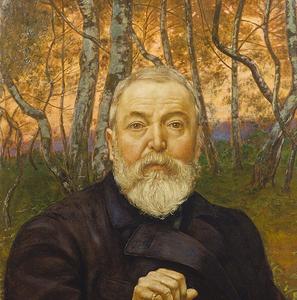
Hans Thoma was a German painter. He was born on 2 October 1839 in Bernau, Grand…
✦ Highlights (technique & color)
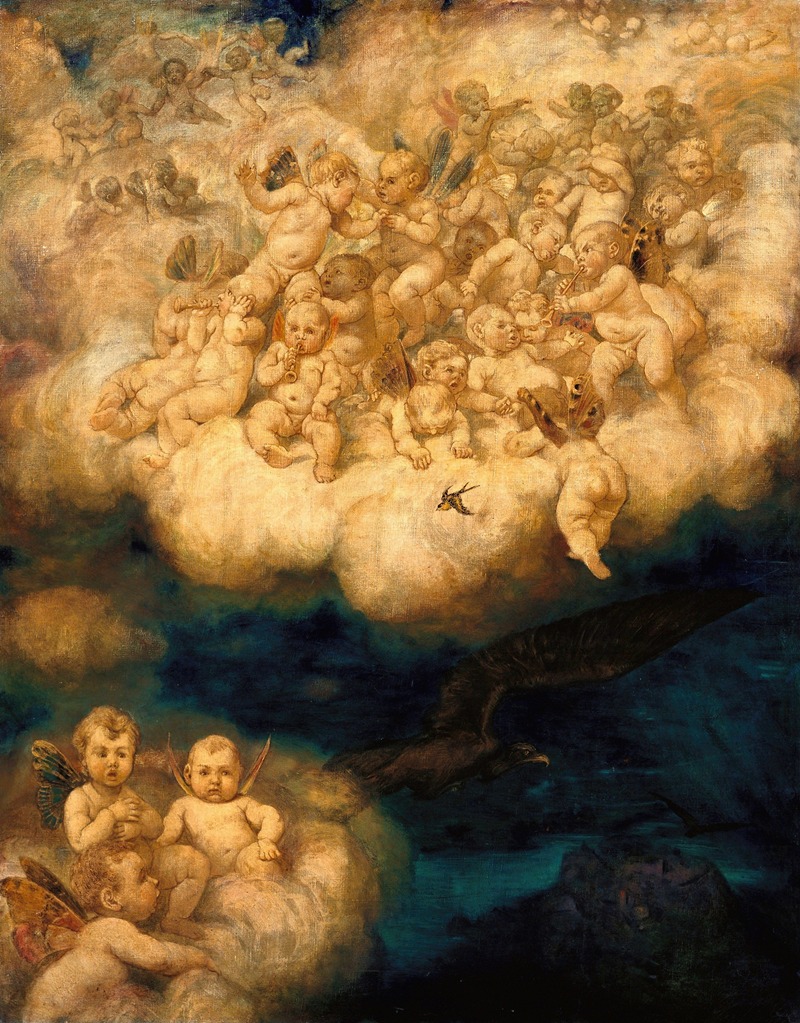
The paint is finished to a porcelain-like, enamel smoothness, enhancing the precious quality of the imagery. Its greatest appeal lies in the rendering of light: rather than emanating from a sun outside the frame, the light gently radiates from within the dense choir of angels itself. A sophisticated palette of translucent blue, pearlescent cream, and golden ochre is harmoniously blended, softly dissolving the boundaries between the angels and the surrounding atmosphere.
✦ The setting of this painting
The setting is no earthly place, but rather the boundless heavenly realm filled with divine light, set amid ethereal clouds. Against a backdrop of crystalline blue sky float soft, creamy and gentle golden clouds. Countless angelic faces and overlapping wings are densely arranged across every corner of the canvas, creating a poetic space that transcends the physical world.
✦ Historical context
In the late 1870s, the German art world was in a period of transition from Realism to Symbolism and Romanticism. Having moved to Frankfurt in 1876, Thoma engaged with avant-garde intellectual circles and began to feel the limitations of his previous realist approach. Painted in 1878, this work marks a crucial turning point in his artistic career, when he decisively shifted from depicting visible reality to visualizing unseen spiritual visions.
Soft clouds float across a crystalline blue sky,
mingling shades of cream and gentle gold.
Look closer, and countless faces of angels emerge.
Their overlapping wings press into every corner of the canvas.
This is no place on physical earth, but an infinite celestial realm.
In 1878, the painter Hans Thoma stood at a major turning point.
Until then, he had pursued realism, striving to depict visible reality just as it was—
an approach shaped by his encounter with Gustave Courbet in Paris.
Yet after moving to Frankfurt, he confronted a profound doubt:
there are truths that an exact reproduction of reality can never convey.
Immersed in an avant-garde intellectual circle in Frankfurt, he reached a decision:
to abandon the description of visible reality.
The path he chose was to give form to the unseen visions of the spirit.
About 133 more words
Read the rest of this commentary —
and step into a secret gallery
opened just for you
An "art letter" delivered to you every Saturday morning
Works, music and words chosen for your sensibility, from your artist-type result and the paintings you love
A library of masterpieces and music you can enjoy "in your own words", not just look at
A "digital art notebook" (unlimited) where your impressions build into your own taste
Unlimited likes and notes
¥980 / month¥0 today
¥980/month (tax incl.) from day 8. Cancel anytime.
Already have an account? Log in
Your Note
Write down what this painting made you feel in your art notebook.
Please sign up to write notes.
Sign up for freeRecommended Artworks
.webp)
Sources & references
More artists
If you find an error in this content, please let us know here
This site is protected by reCAPTCHA, and the Google Privacy Policy and Terms of Service apply.