
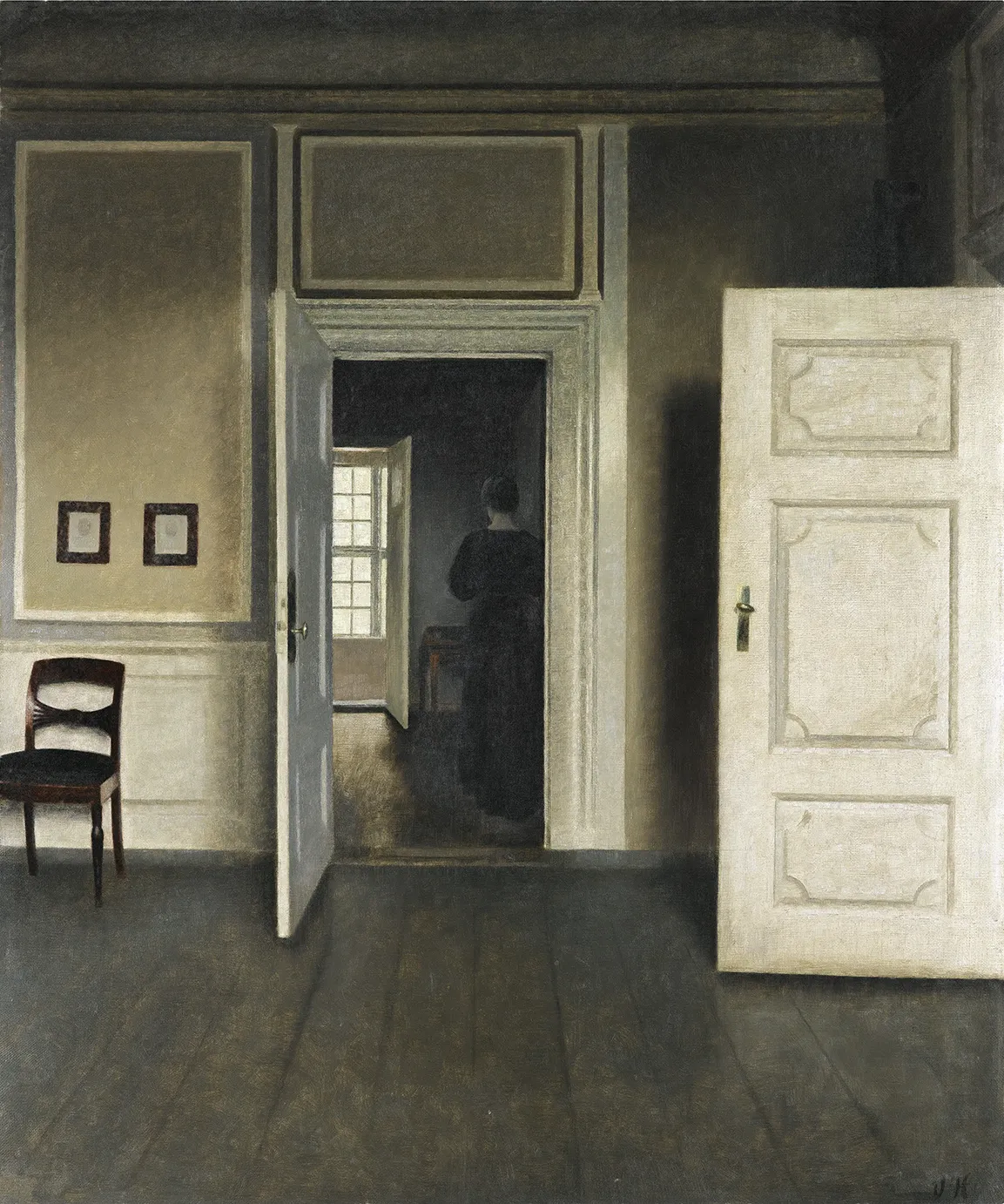
Interior. Strandgade 30
1901
- Dimensions
- 66.0 × 55.0 cm
- Medium
- Oil on canvas
- Collection
- Städel Museum

To explore a pure harmony between architectural lines and light, rather than expressing emotion or narrating a story, thereby creating a distinct visual musicality.
✦ Highlights (technique & color)
The highlight of the work lies in its rigorous architectural geometry and the rendering of light through meticulously calibrated tones of grey. The vertical and horizontal lines of the open doors divide the composition, drawing the viewer's eye toward the back of the artist's wife, Ida, standing in the center of the room beyond. Far from a simple blend of black and white, the greys are built from a complex mixture of blue, yellow, red, and green pigments. Through minute, layered brushstrokes, the artist captured the subtle diffusion and shimmer of ambient light.
✦ The setting of this painting
An apartment at Strandgade 30, located in the Christianshavn district of Copenhagen, Denmark. Originally a 17th-century merchant's residence, the Hammershøis lived here from 1898 to 1909. Stripped of superfluous decoration, it had been renovated into an austere, refined space dominated by subdued tones of grey and white.
✦ Historical context
Around 1900, Europe was caught in the rush of modernization, marked by the Second Industrial Revolution, rapid urbanization, and the advent of electric lighting and photography. Hammershøi, however, retreated from the modern clamor, painting quiet interiors inspired by 17th-century Dutch Golden Age masters such as Vermeer. His work emerged against a historical backdrop where Symbolism and early Modernism intersected.
Beyond an open white door, in the center of a hushed room, stands a woman in a black dress with her back turned to us.
She does not turn around. Nor is she doing anything; she is simply "there."
Neither the room in the foreground nor the one beyond holds anything superfluous.
White doorframes, orderly walls, a small picture frame, and wooden floors reflecting the light. All that exists here is a breathtaking silence and gentle illumination.
Escaping the Din: A Perfect Laboratory
Copenhagen, Denmark, 1901. At the turn of the twentieth century, European cities were rapidly transforming on the crest of the Second Industrial Revolution. Electric lights dispelled the darkness of night, telephones bridged distant voices, and people hurried through life amid the noise and velocity of a new era. Yet the painter Vilhelm Hammershøi was far removed from the clamor of the outside world. What he sought, far from modern tumult, was the deep, lucid tranquility reminiscent of seventeenth-century Dutch painting.
He moved with his wife, Ida, into an old apartment at Strandgade 30 in Copenhagen's Christianshavn district. Taking a set of rooms in this seventeenth-century merchant's mansion, Hammershøi renovated them thoroughly with his own hands. He stripped away all the excessive ornament and lavish furnishings favored by the bourgeoisie of the time, repainting the walls in subdued tones of gray and off-white. Doors and paneling were painted white, while the dark grain of the wooden floors was left bare. Keeping only a minimum of antique furniture, he purged every trace of daily life.
For him, this apartment was far more than a place to relax. It served as his personal "plastic laboratory" and "stage set," where he could observe how light and space intersect and capture them on canvas. Within this home, shifting perspectives, opening and closing doors, and rearranging furniture, he would produce more than sixty interior paintings over the course of some eleven years.
About 599 more words

Sign up free and enter Your Museum
Read the stories behind great paintings and music for free, in Your Museum
Your Note
Write down what this painting made you feel in your art notebook.
Please sign up to write notes.
Sign up for freeRecommended Artworks
.webp)



Sources & references
More artists








If you find an error in this content, please let us know here
This site is protected by reCAPTCHA, and the Google Privacy Policy and Terms of Service apply.