
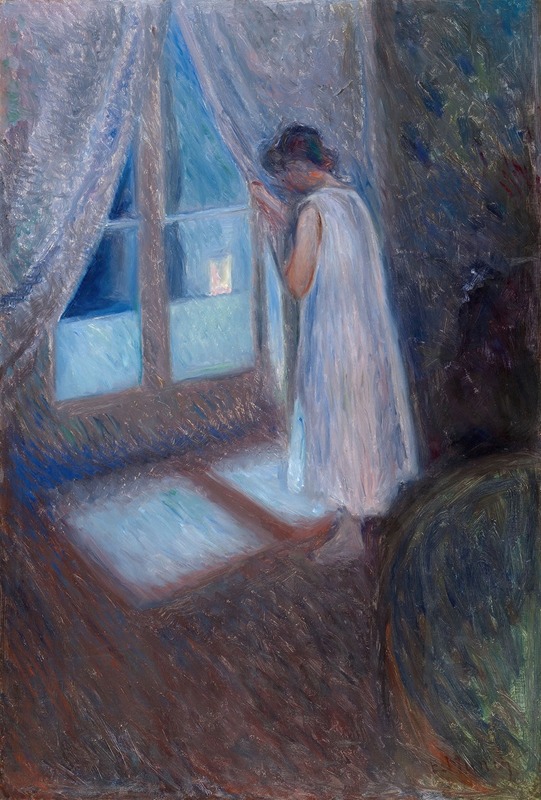
The Girl by the Window
1893
- Dimensions
- 96.5 × 65.4 cm
- Medium
- Oil on canvas
- Collection
- The Art Institute of Chicago

A celebrated Norwegian painter active from the late nineteenth century to the fi…
✦ Highlights (technique & color)
Unified by fluid tones of blue, brown, and violet, the painting evokes the deep melancholy characteristic of the night. Moonlight filtering through the window frame casts two pale, glowing rectangles onto the floor, setting off the girl's white nightgown while leaving her facial expression entirely hidden in silhouette.
✦ The setting of this painting
The setting is presumed to be the riverside town of Saint-Cloud on the outskirts of Paris, or a corner of Christiania (now Oslo). Rather than striving to reproduce a specific location, the work emphasizes a symbolic space that sharply distinguishes the dark interior from the illuminated exterior, with the window functioning as a metaphor dividing the sheltered inside from the unknown outside.
✦ Historical context
Between 1889 and 1893, Munch traveled frequently between Paris and Berlin, encountering the techniques of Impressionism and Symbolism. In late 1889, he issued the Saint-Cloud Manifesto, affirming his resolve to depict living human beings. This work represents a transitional phase in which that manifesto was put into practice.
In a dark room, a girl in a white nightgown gazes out the window.
On the floor, moonlight streaming through the window frame falls as two pale, glowing rectangles.
A quiet, romantic, beautiful night scene.
It appears to be a painting that follows the convention of Nordic Romanticism: a figure standing by an open window.
Anyone might feel that way.
But in fact, an unsettling shadow lurks within this painting.
And at the time of its unveiling, it drew fierce criticism and caused a major scandal.
Late 1889.
Munch, staying in Saint-Cloud, a suburb of Paris, made a certain resolution.
It was a manifesto later known as the 'Saint-Cloud Manifesto'.
'From now on, I will not paint interiors with men reading or women knitting.'
What should be painted are living human beings who breathe, feel, suffer, and love.
He declared this.
This painting is a transitional work where that resolution was put into practice.
The setting is presumed to be Saint-Cloud, or a corner of Christiania after his return home.
The girl's face is a complete silhouette, immersed in darkness.
We cannot tell what her face looks like.
However, look at the lower right of the floor.
A rounded, unsettling shadow is depicted.
This evokes the abstract outline of a man in a top hat, creeping up on the girl.
Psychological unease peculiar to adolescence.
Unknown temptation.
Or, a premonition of violence.
Munch visualized not just a beautiful night, but the fear within the human psyche.
The fluid blue and brown tones evoke a deep melancholy.
About 221 more words
Read stories of masterpieces for free
Your Note
Write down what this painting made you feel in your art notebook.
Please sign up to write notes.
Sign up for freeRecommended Artworks
.webp)

Sources & references
More artists




If you find an error in this content, please let us know here
This site is protected by reCAPTCHA, and the Google Privacy Policy and Terms of Service apply.