
Apollo and Marsyas
1886
- Dimensions
- 45 × 55 cm
- Medium
- Oil on cardboard
- Collection
- Private collection
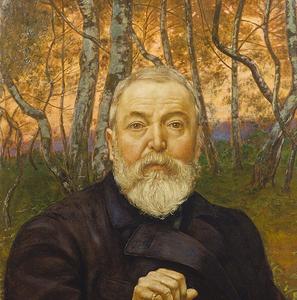
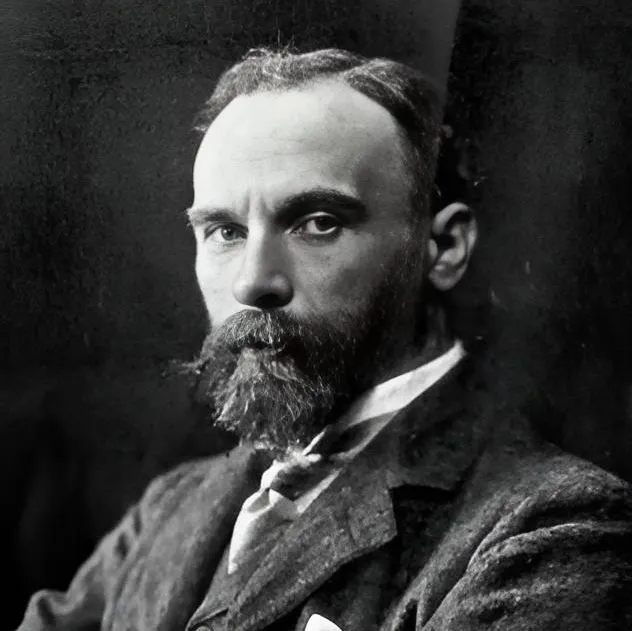
Hans Thoma was a German painter. He was born on 2 October 1839 in Bernau, Grand…
✦ Highlights (technique & color)
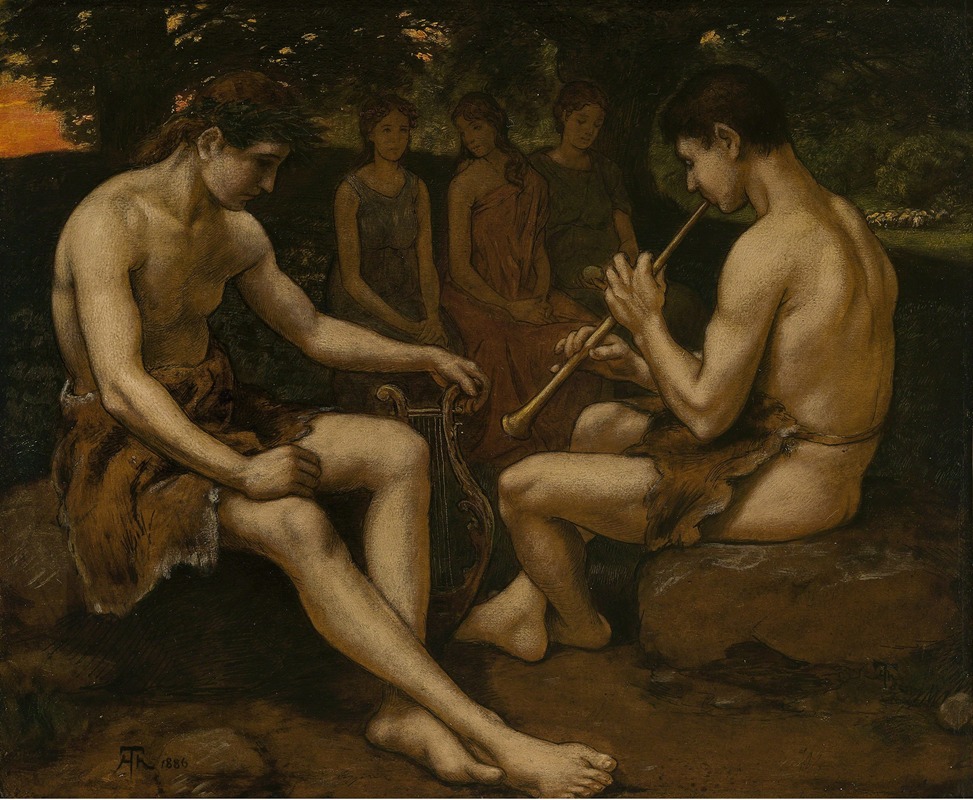
Avoiding a direct portrayal of the gruesome execution, the artist captures the psychological tension of the contest itself. The outcome is made clear from the beginning through the depiction of their physiques. Apollo's body possesses the balanced proportions of idealized Greek sculpture and is painted with radiant, luminous flesh. In stark contrast, Marsyas is submerged in dim shadow, heightening the visual tension between the two figures.
✦ The setting of this painting
Set in the ancient Phrygian forest from Ovid's epic Metamorphoses, this scene depicts the tragic musical contest between Apollo, the god of reason, and the satyr Marsyas. The dark cypress trees looming in the background—symbols of mourning, death, and the underworld in the ancient Roman world—quietly foreshadow the gruesome fate awaiting Marsyas for daring to challenge a deity.
✦ Historical context
In 1886, Hans Thoma was wrestling deeply with his artistic worth, suffering from the neglect of critics and an absence of patrons. In this period just before his triumphant 1890 solo exhibition in Munich, he projected his own painful struggle onto the hubris of Marsyas risking his life against an arrogant god, using this classical subject to express his existential crisis as an artist.
In a dimly lit forest, two figures face each other in silence.
Apollo, the god of reason with radiant skin, and Marsyas, the satyr seated as if sinking into the shadows.
In the background, three Muses are painted discreetly, quietly watching as judges of this cruel musical contest.
In Greek mythology, a gruesome fate awaited Marsyas for daring to challenge a god: to be flayed alive.
The dark cypresses towering in the background are trees that symbolized death and the underworld in ancient Rome.
The very placement of these trees foreshadows the despairing end closing in upon him.
This painting is commonly interpreted as a reflection of the artist Hans Thoma’s own anguish.
In 1886, Thoma was persistently ignored by critics, lacked patrons, and wrestled deeply with doubts about his artistic worth.
He saw himself—engaged in a lonely, unrewarded struggle—mirrored in Marsyas, who risked his life to challenge a proud god.
In the years leading up to his great breakthrough in Munich in 1890, he drew upon classical themes to portray his existential crisis as an artist.
Yet this single painting bears the imprint of another tragedy, one that extends beyond mythical realms and an artist's personal turmoil.
It is the memory of an unreasonable violence that swept across twentieth-century Europe.
At the center of this story is a man who once owned this painting.
His name was Adolf Bensinger.
He was a prominent Jewish chemical industrialist who achieved great success in Mannheim, Germany.
He cherished this serene mythological work, keeping it safely as part of his private collection.
Yet history would strip him of everything.
With the rise of the Nazi regime, the persecution of Jewish people intensified.
Bensinger’s peaceful life crumbled from beneath his feet.
By 1939, he was robbed of all the assets he had built over a lifetime.
And in 1940.
This painting he held so dear was forced into auction as part of the discriminatory property confiscations orchestrated by the Nazis.
About 212 more words
Sign up free and enter Your Museum
Read the stories behind great paintings and music for free, in Your Museum
Your Note
Write down what this painting made you feel in your art notebook.
Please sign up to write notes.
Sign up for freeRecommended Artworks
Sources & references
More artists
If you find an error in this content, please let us know here
This site is protected by reCAPTCHA, and the Google Privacy Policy and Terms of Service apply.