
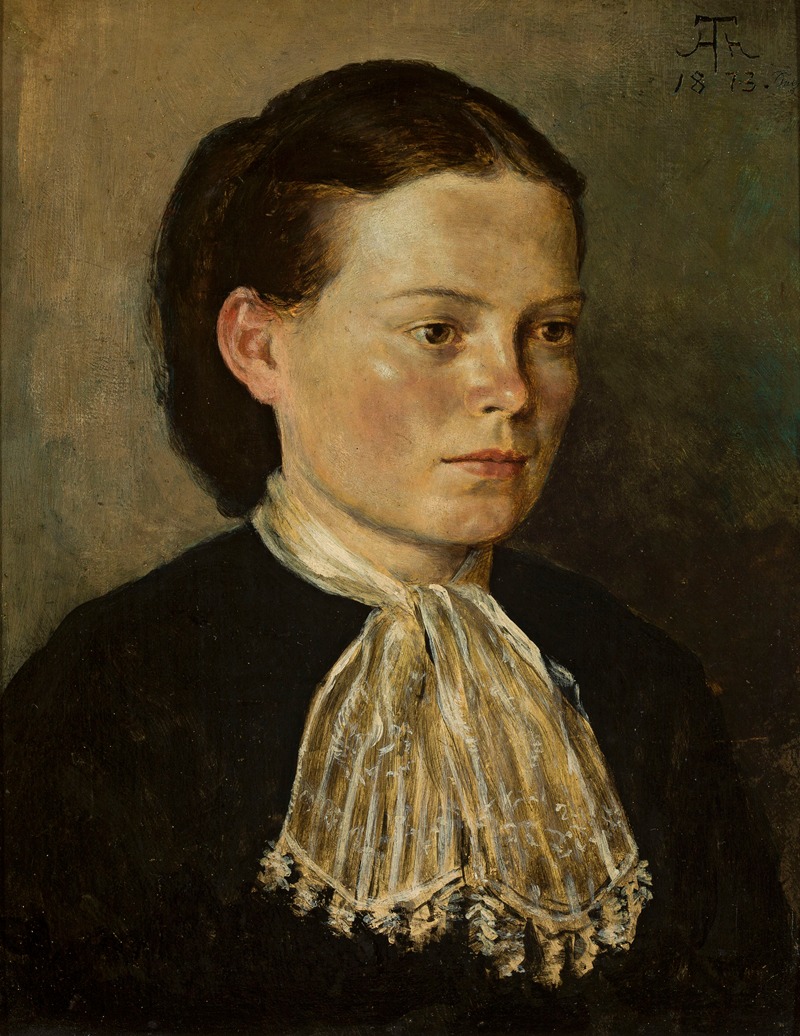
Portrait of Agathe, the Artist's Sister
1873
- Dimensions
- 34.5 × 27.5 cm
- Medium
- Oil on cardboard
- Collection
- National Museum in Warsaw
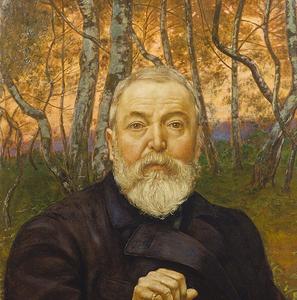
Hans Thoma was a German painter. He was born on 2 October 1839 in Bernau, Grand…
✦ Highlights (technique & color)
The background is rendered in unified, subdued tones devoid of superfluous detail, which accentuates the delicate textures of her skin, hair, and clothing. In addition, the artist employed a distinctive technique—mixing linseed oil with varnish and driers—to achieve a smooth, deep, semi-gloss finish.
✦ The setting of this painting
This work does not depict a specific physical space. Rather, it is a studio portrait presenting a half-length view of Agathe set against an austere, minimalist background. This stripped-down setting was a deliberate choice designed to bring her inner life and presence into sharp focus.
✦ Historical context
The year 1873 was a period of rapid economic development following the end of the Franco-Prussian War and the founding of the German Empire. While grand history paintings and ornate portraits dominated the art academies of the time, Thoma rejected these trends. Influenced by Courbet, whom he had encountered in Paris, he was deepening his own distinct realism, portraying ordinary people with unvarnished honesty.
A woman emerges from the dark background.
Dressed in black with a white collar, she gazes quietly into the distance.
Her name is Agathe Thoma.
She was the younger sister of the artist who painted this work, Hans Thoma.
Painted in 1873, she was twenty-five years old at the time.
In the German art world of the era, dramatic and opulent paintings were in vogue.
Yet Thoma turned his back on this trend.
What he wished to capture was the unadorned, candid presence of a human being.
The spirit of realism he encountered in Paris lived on within him.
Agathe was her brother's most devoted model.
Their path together was by no means an easy one.
Their home was Bernau in the Black Forest region.
In the summer of 1866, her brother was painting in a tiny room of their family home.
A space so confined there was barely room to set up an easel.
There, he painted his mother and Agathe reading the Bible.
It was a time of extreme poverty.
Agathe remained steadfastly by her brother's side through it all.
Together, they fought for his recognition as a painter.
She had also sat for him when she was fifteen years old.
A decade had passed since then.
About 135 more words
Sign up free and enter Your Museum
Read the stories behind great paintings and music for free, in Your Museum
Your Note
Write down what this painting made you feel in your art notebook.
Please sign up to write notes.
Sign up for freeRecommended Artworks
_by_Ilya_Repin_-_%D0%9D%D0%B5%D0%B0%D0%BF%D0%BE%D0%BB%D0%B8%D1%82%D0%B0%D0%BD%D0%BA%D0%B0.webp)
Sources & references
More artists
If you find an error in this content, please let us know here
This site is protected by reCAPTCHA, and the Google Privacy Policy and Terms of Service apply.