
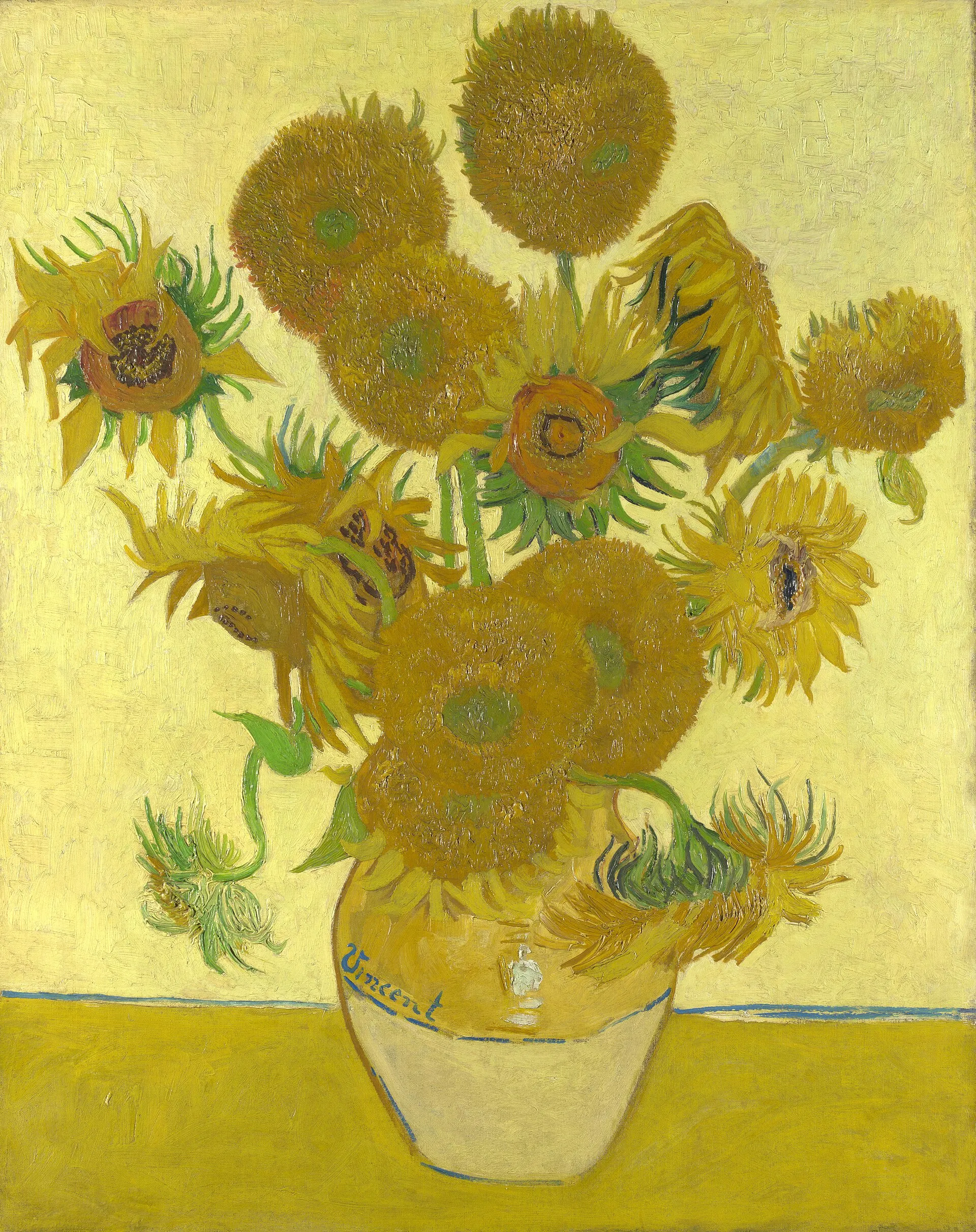
Sunflowers
1888
- Dimensions
- 92.1 × 73.0 cm
- Medium
- Oil on canvas
- Collection
- The National Gallery, London
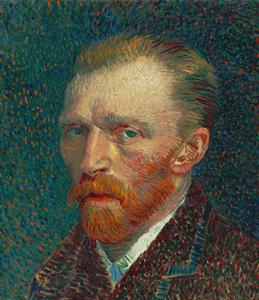
A Post-Impressionist painter who fundamentally revolutionized the visual languag…
A surge of profound joy, embodying solidarity with fellow artists in the Studio of the South and an affirmation of his own existence. Imbuing the space entirely with yellow—the color of friendship and gratitude—this work is an ornament of the soul, etched with his hopes for an ideal artistic community.
✦ Highlights (technique & color)
The defining feature of this work is its nearly monochromatic composition, built almost entirely from varying tones of yellow across the background, vase, table, and petals. Deliberately avoiding complementary color contrasts, Van Gogh achieved volume and harmony solely through subtle shifts in value and saturation. Furthermore, his impasto technique—applying thick, undiluted oil paint directly onto the canvas—imbues the work with a powerful sense of vitality.
✦ The setting of this painting
The Yellow House once stood at 2 Place Lamartine in Arles, in the Provence region of southern France. Van Gogh rented this building in May 1888, intending to make it the hub for his "Studio of the South," a gathering place for avant-garde artists. In late August, amidst the scorching summer heat and the fierce mistral winds, he remained indoors from early dawn, immersing himself in painting as he raced against the shifting natural light and the wilting blossoms.
✦ Historical context
From the mid-19th century onward, advances in the chemical industry enabled the mass production of synthetic new pigments, such as chrome yellow, in paint tubes. Meanwhile, Post-Impressionism emerged, moving beyond Impressionism's fleeting light to express the artist's inner world and subjective vision through intense color. It was an era shaped by the convergence of diverse influences, including the bold outlines of Cloisonnism and the aesthetics of Japanese ukiyo-e woodblock prints.
A two-toned vase set against a yellow wall.
From it, fifteen sunflowers extend their vigorous stems.
From green buds to grand blossoms unfurling in radiant gold,
and even those drooping heavily under the weight of their seeds—
within a single vase, every stage of life thrives together.
When people think of Van Gogh, they often think of madness.
A miraculous masterpiece wildly dashed off by a troubled, solitary genius in the grip of destructive impulses—
that is so often how the story is told.
Yet in truth, when he painted this canvas, he was utterly lucid.
Far from unhinged, he was guided by meticulous calculation, filled with hope and boundless joy.
In 1888.
Exhausted by the grueling pace of life in Paris, Vincent van Gogh arrived in Arles, in the south of France.
At 2 Place Lamartine,
he rented the "Yellow House," its exterior walls washed in vivid yellow.
Here, he nurtured a dream:
to establish the "Studio of the South," a haven where avant-garde artists could live and create together.
In August of that same year.
Amid the scorching heat of Provence and the howling gusts of the mistral,
he shut himself indoors, throwing himself into the creation of this series.
His purpose was to welcome the painter Paul Gauguin, due to arrive in October.
This painting was created to decorate the walls of the guest room prepared for his friend.
For Van Gogh, yellow was a sacred color symbolizing gratitude and friendship.
In letters to his brother Theo and his friend Émile Bernard, he declared:
the sunflower is mine.
To paint them in a single burst before the morning-plucked sunflowers could wilt.
To compose the entire picture using only subtle variations of the same hue, powered by the new synthetic pigment chrome yellow.
This was not madness, but an exceptionally calm and revolutionary artistic endeavor.
About 248 more words
Read stories of masterpieces for free
Your Note
Write down what this painting made you feel in your art notebook.
Please sign up to write notes.
Sign up for freeRecommended Artworks
Sources & references
More artists




If you find an error in this content, please let us know here
This site is protected by reCAPTCHA, and the Google Privacy Policy and Terms of Service apply.