
The Lacemaker
1670
- Dimensions
- 縦 24.5 cm × 横 21.0 cm
- Medium
- Oil on canvas mounted on oak panel
- Collection
- Musée du Louvre
Based in Delft during the 17th-century Dutch Republic, he was a master of genre…
✦ Highlights (technique & color)
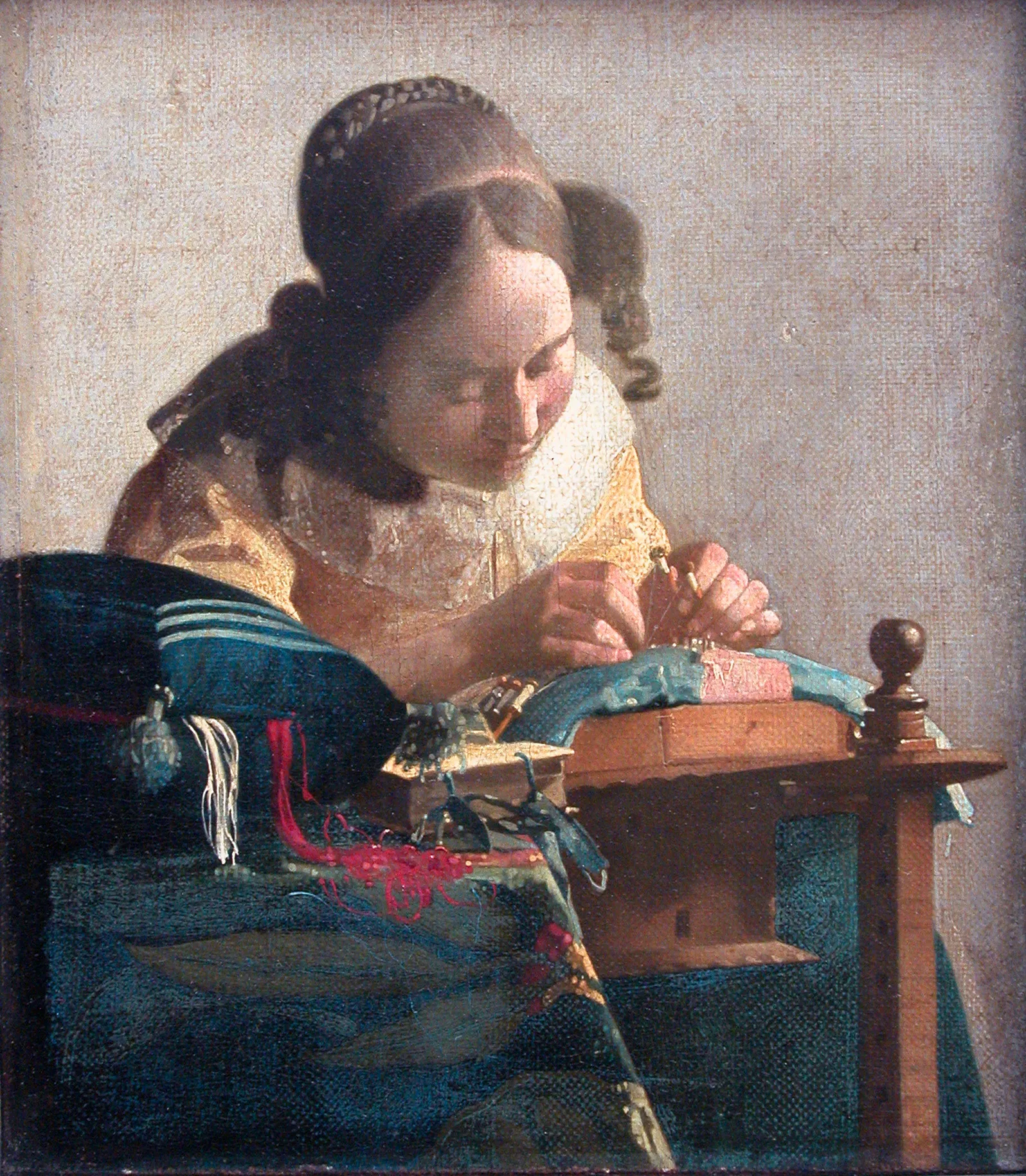
The red and white silk threads spilling from the blue sewing cushion in the immediate foreground are painted with soft, diffused brushstrokes lacking distinct contours. As the eye moves further back, the woman's fingers, pins, bobbins, and taut threads are depicted with sharp precision, brilliantly capturing in oil paint the effect of depth of field that occurs when the human eye focuses on a specific distance. Notice also the carefully calculated visual flow, in which the tilt of her head and the angles of her hands converge seamlessly upon the single point where the needle and thread meet.
✦ The setting of this painting
The domestic interior of the affluent petty bourgeoisie in mid-17th-century Delft. It presents an idealized, intimate, and enclosed space arranged within Vermeer's own home and studio.
✦ Historical context
The Dutch Golden Age in the late 17th century. In Delft, bobbin lacemaking was revered as a domestic craft that symbolized feminine delicacy and refined sensibility. It was also a period of rapid advancement in optics and scientific inquiry, during which artists actively experimented with visual expression using the camera obscura.
In a room embraced by silence, a young woman focuses every ounce of her attention on the work in her hands.
Her head is bowed deeply, her gaze acutely fixed upon the minute point where the bobbins and pins intersect.
Light filtering in from the upper left illuminates her forehead and busy fingers, softly casting its glow over the small universe she creates.
Prayer and Silence Woven into the Thread
She wears a bodice of vibrant lemon-yellow satin, paired with a sheer white lace collar.
The sheen of these fine garments and her refined appearance clearly indicate that she is not an impoverished laborer toiling for her daily bread. Rather, she is a woman from a well-to-do household in mid-seventeenth-century Delft, devoting herself to this delicate needlework as a graceful, enriching pastime.
Her hair is drawn back tightly into a compact bun, presenting a neat appearance. Yet, on either side of her face, finely curled tendrils escape to spill over her shoulders. Even this slight disarray reveals how deeply immersed she is in the task before her, heedless of her own appearance. Before her sits a decoratively carved wooden lacemaking desk, upon whose angular frame her hands rest securely. Her entire body leans toward this modest desk, funneling all her energy into the tips of her fingers.
About 612 more words
Sign up free and enter Your Museum
Read the stories behind great paintings and music for free, in Your Museum
Your Note
Write down what this painting made you feel in your art notebook.
Please sign up to write notes.
Sign up for freeRecommended Artworks
.webp)
Sources & references
- Understanding The Lacemaker by Johannes Vermeer
- THE LACEMAKER by Johannes Vermeer
- Le musée du Louvre-Lens accueille La Dentellière de Johannes Vermeer, chef-d'œuvre emblématique du musée du Louvre
- La Dentellière - Louvre site des collections
- Vermeer transfigure dans ses toiles la vie silencieuse des êtres et des choses
- The Lacemaker by Johannes Vermeer
- Vermeer's Paintings in their Frames: The Lacemaker
- How Much Is The Embroiderer Worth? | $200–450M - Painting Meanings
- Engraving The Lacemaker - Vermeer - Librairie-Boutique du Louvre
- Johannes Vermeer (1632-1675) - Page 1 · Louvre Shop
- THE GUITAR PLAYER by Johannes Vermeer
- Fine Art: Vermeer's Lacemaker copied by Salvador Dali - LaceNews
- When Salvador Dalí tried to get a rhino to attack a Vermeer painting - Mashable
- Wish we could have been at the zoo for this moment. Surrealist painter Salvador Dali setting up easel to paint a picture of a rhinoceros at the Vincennes Zoo; May 05, 1955 in Paris, France - Facebook
- Related Artworks: The Lacemaker - Essential Vermeer
- Vermeer's The Lacemaker - Lines and Colors
- Hersilie séparant Romulus et Tatius - Louvre site des collections
More artists

If you find an error in this content, please let us know here
This site is protected by reCAPTCHA, and the Google Privacy Policy and Terms of Service apply.