
A Young Woman Seated at the Virginals
- Dimensions
- 51.5 × 45.5 cm
- Medium
- Oil on canvas
- Collection
- The National Gallery, London

Based in Delft during the 17th-century Dutch Republic, he was a master of genre…
✦ Highlights (technique & color)
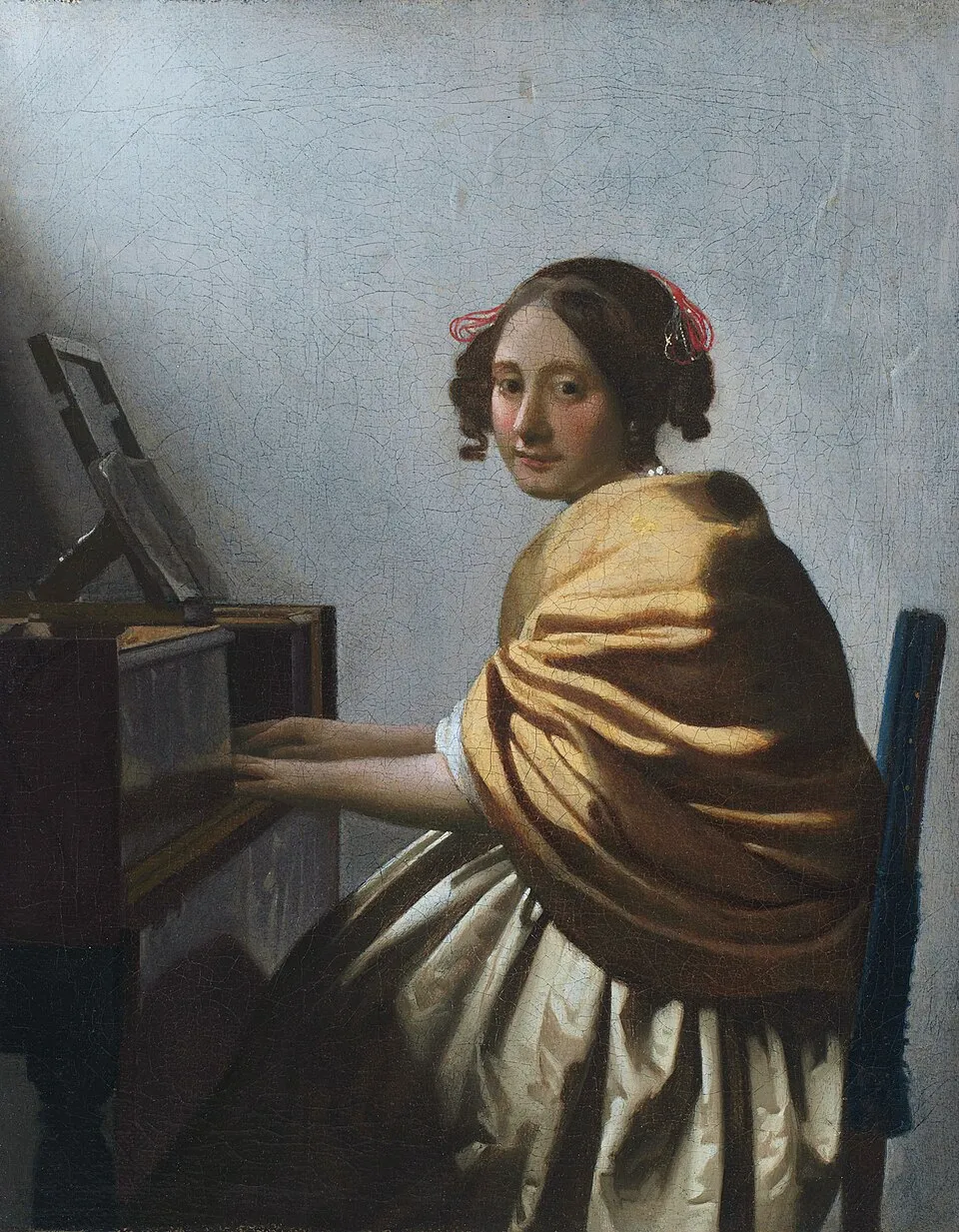
Scientific analysis has illuminated techniques characteristic of Vermeer's final years. Natural ultramarine, a costly pigment, is used lavishly, lending a cool, luminous clarity to the entire composition. Additionally, the folds of the woman's skirt are rendered with linear, angular, and geometric facets. The presence of a pinhole at the vanishing point also confirms that he inserted a needle and attached strings to map out his linear perspective with precision.
✦ The setting of this painting
The interior depicted is not a direct study of an actual room in a specific building. Instead, it is an imagined space that Vermeer geometrically reconstructed by arranging furnishings and items from his own home. Unlike many Dutch genre paintings bathed in bright daylight, the scene is infused with a tranquil light evocative of dusk or evening. Nighttime music-making served as a dramatic device to convey more personal, reflective, or private romantic sentiments.
✦ Historical context
During the seventeenth-century Dutch Golden Age, Delft boasted a refined urban culture and a flourishing civic class. In wealthy households, owning and playing the virginal was a mark of high education, virtue, and social standing for daughters of good families. Furthermore, music frequently appeared in literature as an allegory for human relationships—particularly the harmony between men and women—and playing a keyboard instrument was often depicted with a dual nature, representing both the preservation of virtue and sensual temptation.
A young woman seated at a virginal rests her hands on the keys as she looks out at us. Red ribbons are woven through her tightly curled hair, and the folds of her skirt are rendered with straight lines, forming angular, geometric planes.
At first glance, it appears to be a tranquil moment of music captured in silence—a meticulously calculated, flawless space so characteristic of Vermeer.
Yet this painting conceals a violent past, having once been brutally slashed with a blade.
The incident occurred in 1968 in an exhibition room of the National Gallery in London. An assailant armed with a razor carved a large circular cut across the woman's face. The deep slash ran across her nose and extended to the right side of her head—a catastrophic wound that could have easily destroyed the painting.
To prevent copycat attacks, however, the gallery never released photographs of the damage to the public, keeping the affair entirely under wraps. Behind closed doors, conservators undertook an exquisite restoration, flawlessly reviving both the canvas's structure and its paint layers.
Today, behind thick protective glass, she smiles with not a trace of those horrific scars visible on her face.
About 346 more words

Unlock this story's ending, and every article on MusicStory
- 42
Stories1–2 new every week
An archive of paintings paired with great music, made for a weekend night and a cup of coffee
- 282
Paintings with commentarygrowing daily
From simply looking to truly reading — the brushwork and the obsession of the masters
- 10
Music Librarygrowing daily
Know it first, and what reaches your ear changes — background music becomes art you keep for life
My Notes, unlimited
Every reading adds to a digital art notebook that is yours alone
Already have an account? Log in
Your Note
Write down what this painting made you feel in your art notebook.
Please sign up to write notes.
Sign up for freeRecommended Artworks





Sources & references
More artists








If you find an error in this content, please let us know here
This site is protected by reCAPTCHA, and the Google Privacy Policy and Terms of Service apply.