
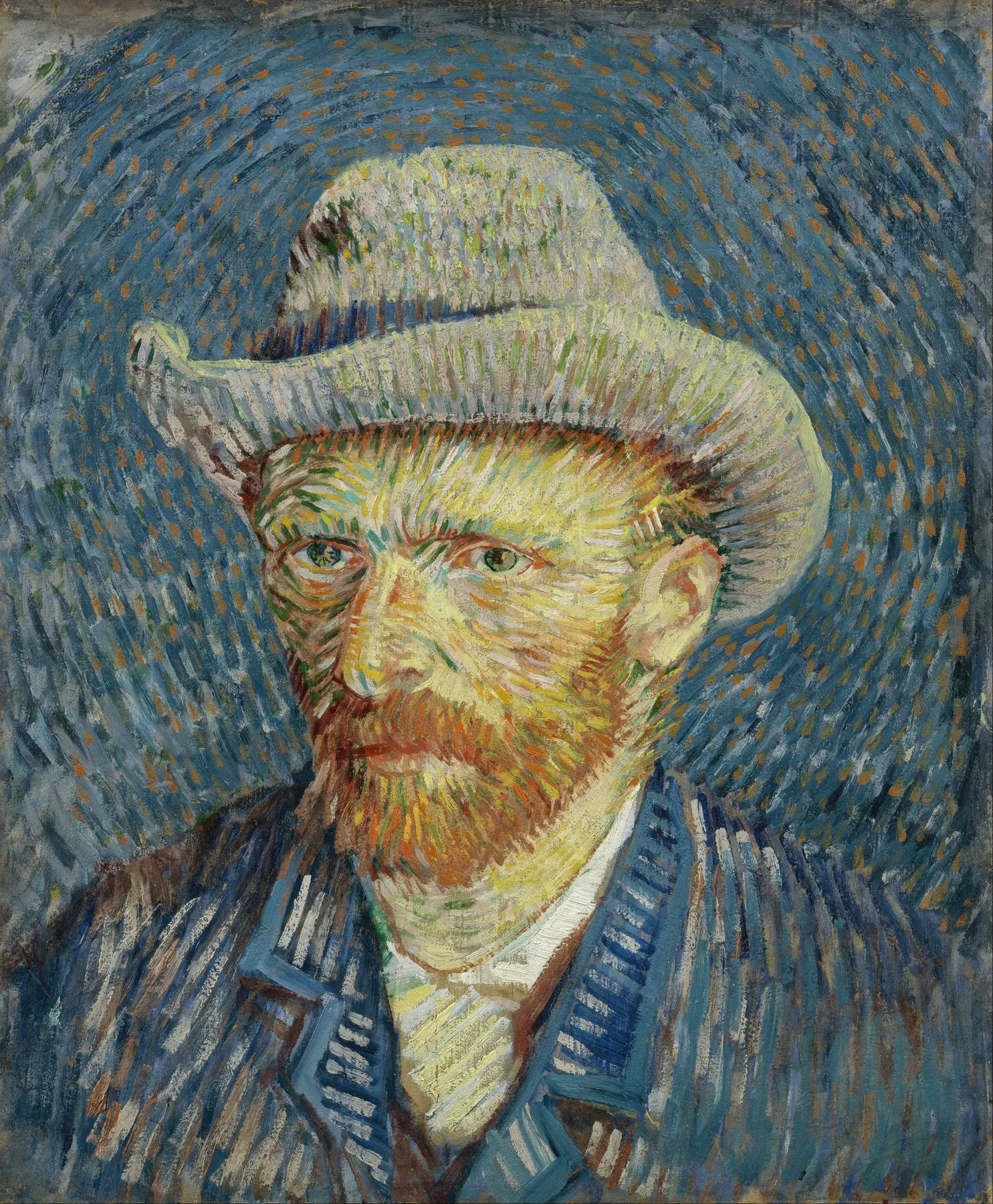
Self-Portrait with Grey Felt Hat
1887
- Dimensions
- 44.5 cm × 37.2 cm
- Medium
- 油彩、綿布
- Collection
- ファン・ゴッホ美術館
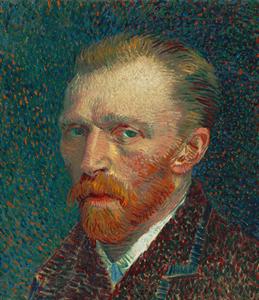
A Post-Impressionist painter who fundamentally revolutionized the visual languag…
人物画の技術を高めるため、自分の顔の色彩を正しく捉える訓練として描いた。暗い農民画家から近代都市パリの現代芸術家へと脱却しようとする強い意志が込められている。
✦ Highlights (technique & color)
顔面では鼻筋、頬の骨格、髭の生え方に沿って筆を走らせることで体積感を表現し、背景では頭部の輪郭線を包み込むようにストロークを弧状に展開して動的な視線誘導を行っています。また、髭や目元には赤色と緑色の補色同士を隣接させて配置し、視覚的な躍動感を生み出しています。
✦ The setting of this painting
フランス・パリのモンマルトル地区、ルピック街54番地にあるアパートメントの室内。ゴッホが弟テオと同居していた部屋の一角に設けた小さな作業スペース。
✦ Historical context
19世紀後半、科学的知見の発展に伴い光の波動説や色彩理論が美術界に影響を与え、化学工業の発達で鮮やかな新開発の合成顔料が容易に入手可能になった時代。パリでは新印象派の分割主義が旋風を巻き起こしていました。
In the corner of a modest apartment where the cold Parisian air creeps in, a man gazes intently into a hand mirror. His eyes are piercing, examining his own features reflected in the glass as though observing an unfamiliar landscape for the very first time. A reddish-brown beard, angular bone structure, and greenish-blue eyes. Mixing paints on his palette, he applies short, forceful strokes to the canvas. What he sought to depict was not merely his own face; it was the light and color of a new era, and his very own future.
An Aura of Madness, or a Calculated Experiment?
When viewing this self-portrait by Vincent van Gogh, many find their eyes immediately drawn to the distinctive, swirling brushwork in the background. The collection of short strokes radiating outward from the center of his face creates the optical illusion that the entire canvas is vibrating.
Certain traditions and popular myths have long claimed that these radiating background strokes were modeled after the halos seen in portraits of Christian saints. Other theories suggest they were a direct depiction of the painter's psychological breakdown or a spiritual aura emanating from within. To those familiar with his turbulent life, it may indeed be tempting to interpret this swirling background as a manifestation of the madness and anguish churning within his soul.
In truth, however, that was not the case. Far from being the product of insanity or subconscious impulse, these brushstrokes were the outcome of a remarkably calm and intellectual inquiry. While staying in Paris, Van Gogh was profoundly struck by Divisionism, a cutting-edge technique championed by Neo-Impressionist painters such as Georges Seurat and Paul Signac. He studied their theories rigorously, interpreting them not as mere mechanical dots, but as directional linear strokes capable of expressing emotion and three-dimensional structure.
The radiating brushwork in the background was a meticulously calculated technical device designed to accentuate the volume of his head and impart an optical rhythm to the entire composition. Rather than surrendering to madness, he was a dedicated researcher immersed in experiments to forge a new visual language.
Why Did He Paint His Own Face So Often?
During his time in Paris, Van Gogh produced no fewer than twenty-five self-portraits. His relentless focus on his own face has sometimes been attributed to extreme narcissism or an obsessive self-fixation born of an awareness of his deteriorating mental state. Yet the real reason he kept peering into the hand mirror was far more pragmatic and pressing.
At the time, he depended entirely on the financial support of his brother Theo, who worked as an art dealer. Unable to sell a single painting, he was living day to day in profound financial hardship. To refine his skills as a portraitist, practicing from living human subjects was essential. However, he could not afford to pay the fees required to hire professional models.
The least expensive alternative he arrived at was to use his own reflection as a model. In letters to his sister Willemien and his brother Theo, Van Gogh stated explicitly that his self-portraits were technical exercises in figure painting, writing that if he could correctly capture the colors of his own face, he would be able to paint the heads of other men and women as well.
For him, painting self-portraits was not a sentimental act of introspection, but a gritty, determined discipline aimed at achieving the freedom to paint people. The hours spent confronting himself in the mirror were a solitary battleground where he honed his craft while contending with the stark reality of poverty.
What the Canvas and Attire Reveal About His Finances
A closer look at this work reveals just how meager his circumstances were, written directly into the materials he used. Typically, oil paintings are executed on primed linen canvas. This work, however, was painted directly onto cheap, unprimed cotton fabric rather than standard linen.
To save on material costs wherever possible, he turned to readily available, inexpensive cotton cloth, economizing even on the expense and effort of applying a primer. It was a hand-to-mouth existence where he struggled even to secure a proper support for his paints. Yet in striking contrast to these impoverished circumstances, his appearance in the painting is surprisingly sophisticated.
He wears a brimmed grey felt hat pulled low over his head, a tailored jacket fit for an urban gentleman, a collared shirt, and a neatly tied cravat. Nothing remains of the dark, somber peasant painter of his Dutch period.
This attire reflects his resolute determination. It clearly expresses his conscious effort to cast off the persona of an obscure provincial artist and reinvent himself as a modern painter embracing the atmosphere of Paris and pioneering the vanguard of art. The refined gentleman depicted on humble cotton fabric bears witness to his unwavering pride, refusing to bow before the poverty of his daily life.
In Front of an Apartment Mirror, Not on the Streets of Paris
Given the sophisticated felt hat and tailored jacket, some popular accounts have suggested that this painting depicts the artist sketching on the vibrant streets of Paris or at an outdoor café. It is easy to see the appeal in imagining him standing on a bustling Parisian corner, brush in hand, watching the passersby amid the energy of a modernizing metropolis.
In reality, however, this work was painted indoors, within an apartment at 54 Rue Lepic in Montmartre. In a small working space set up in a corner of the rooms he shared with Theo, he sat observing his own reflection in a hand mirror.
The background does not represent an accurate depiction of the room's actual walls. All specific furniture and interior details have been stripped away, creating a painterly space reconstructed through geometry and color as he faced the mirror in his studio.
Rather than venturing out into the glittering world, he spent solitary hours before a hand mirror in a cramped room. Yet within that modest space, a boundless realm of light and color unfolded in his mind. By dissolving the physical walls and summoning a background of dancing particles of light, he sought to leap from the corner of that apartment into uncharted artistic horizons.
The True Colors That Have Vanished
When we stand before this painting in a museum today, the background appears as a tranquil blue, harmonizing beautifully with the yellows and oranges of his face. The cool, subdued contrast between blue and yellow seems to accentuate the painter's composed gaze.
Remarkably, however, the colors we see today are not those he originally laid down. Scientific analyses have uncovered a startling truth about the palette of this painting: when first created, the background was not blue, but a brilliant purple.
Using eosin, a newly developed red organic pigment, he mixed red with blue to create an intense violet. Originally, the canvas was charged with the fiery energy of a stark complementary contrast between purple and yellow, as though sparking with light. Over the decades, however, this red pigment, vulnerable to sunlight and ultraviolet rays, suffered severe fading. With the red completely lost, only the remaining blue has endured on the surface today.
What he truly intended to express was not a quiet harmony, but an intense collision of light that would scorch the retina. When we imagine those lost original hues, we are reminded once more of the extraordinary passion and energy he poured onto this modest piece of cotton fabric.
About 573 more words
Read the rest of this commentary —
and step into a secret gallery
opened just for you
An "art letter" delivered to you every Saturday morning
Works, music and words chosen for your sensibility, from your artist-type result and the paintings you love
A library of masterpieces and music you can enjoy "in your own words", not just look at
A "digital art notebook" (unlimited) where your impressions build into your own taste
Unlimited likes and notes
¥980 / month¥0 today
¥980/month (tax incl.) from day 8. Cancel anytime.
Already have an account? Log in
Your Note
Write down what this painting made you feel in your art notebook.
Please sign up to write notes.
Sign up for freeRecommended Artworks
Sources & references
- Vincent van Gogh - Self-Portrait with Grey Felt Hat
- Self-Portrait with Grey Felt Hat by GOGH, Vincent van - Web Gallery of Art
- The Paintings (Self-Portrait with Grey Felt Hat) - The Vincent van Gogh Gallery
- Van Gogh Paintings: Antwerp & Paris | PDF - Scribd
- The Self-Portraits | Vincent van Gogh
- Image Processing for Artist Identification - Computerized Analysis of Vincent van Gogh's Painting Brushstrokes - Stanford InfoLab
- Self-Portrait with Grey Felt Hat - VanGoYourself
- Van Gogh's Self-Portraits
- Self Portrait With Grey Felt Hat | Revealed - YouTube
- Portraits of Vincent van Gogh - Wikipedia
- Vincent van Gogh - Wikipedia
- Self-Portrait With Grey Felt Hat (EN) - MyWoWo
- Van Gogh Self-portrait Art Shirt: Men's Cotton Button Down - Etsy Israel
- Fiber art interpretation of Van Gogh's self-portrait - Facebook
- (PDF) Image processing for artist identification - ResearchGate
More artists
If you find an error in this content, please let us know here
This site is protected by reCAPTCHA, and the Google Privacy Policy and Terms of Service apply.