
Friedlich
1930
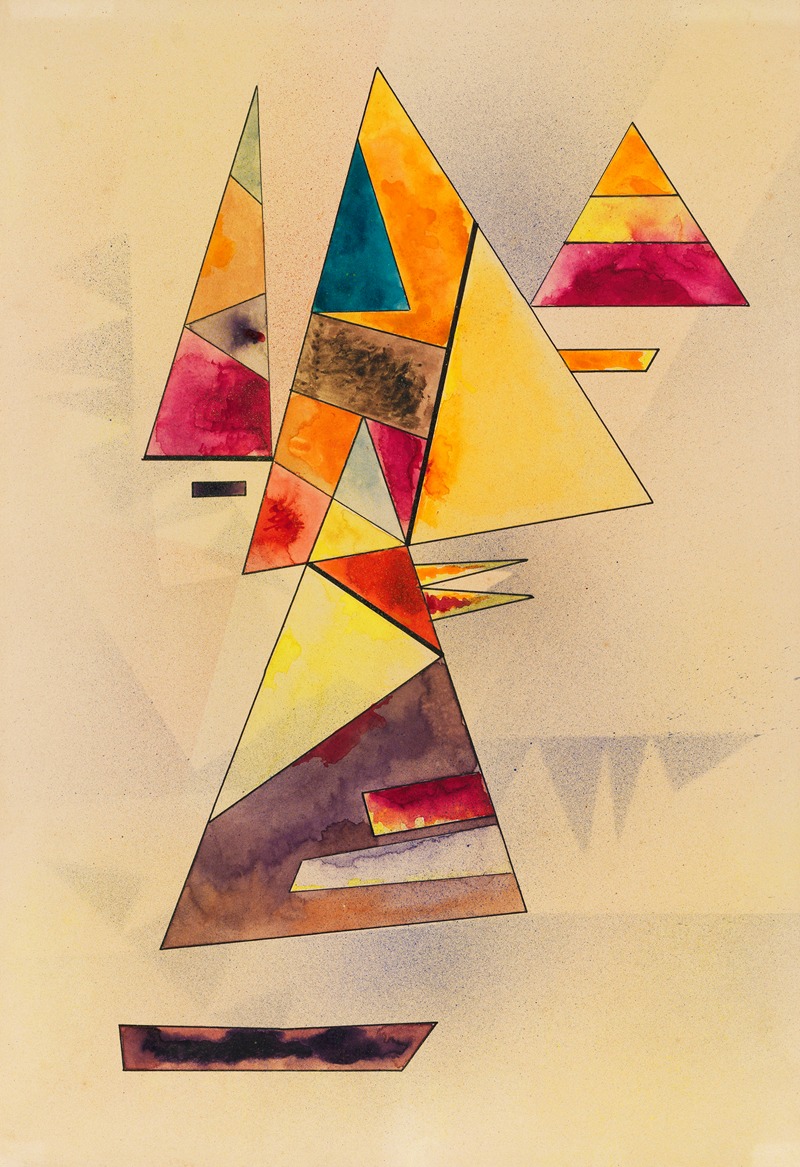
- Dimensions
- 47.5 x 33.0 cm
- Medium
- Watercolor and ink on paper
- Collection
- Private collection
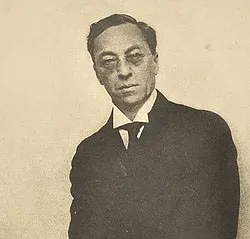
Wassily Wassilyevich Kandinsky was a Russian painter and art theorist. Kandinsky…
✦ Highlights (technique & color)
A key highlight is the structural parallelism with Klee's work. Forms rise from a flat horizontal line and fan out toward the top, translating the plumage and wings in Klee's piece into geometric triangles. Kandinsky also adopted Klee's pioneering spray technique to produce an airy, delicate blue background, upon which black ink figures float to evoke a sense of infinite space.
✦ The setting of this painting
Rather than depicting a concrete external landscape, the scene is conceived as an exceptionally rich "abstract and pictorial dialogue" with the structural composition of "Tripelmarionette" (Triple Marionette), a pivotal 1927 watercolor by his close ally Paul Klee, who worked in the adjacent room. In this space, the contours drawn by Klee are carefully referenced and reconfigured into pure geometric energy.
✦ Historical context
In 1930, Kandinsky and Klee were teaching at the Bauhaus in Dessau, living side by side in the Masters' Houses. While they were warm neighbors who enjoyed afternoon tea together, they also maintained a deeply intellectual and professional rivalry. This harmonious period of cohabitation came to an abrupt end with Klee's departure in 1931 and the subsequent forced closure of the Bauhaus by the Nazi regime.
Within a pale yellow space, vibrant triangles overlap.
From a horizontal line below, geometric forms fan outward and upward.
Fine particles, like a blue mist, drift softly across the background.
Dessau, Germany, 1930.
Kandinsky and Paul Klee were both teaching at the Bauhaus in Dessau, living next door to each other in residences designed for the faculty.
They were close neighbors who enjoyed afternoon tea together on the terrace.
At the same time, they were intellectual and professional rivals of the highest order.
Between the two of them, there was a quiet tradition.
Ever since the formation of Der Blaue Reiter in 1911, they had exchanged their own works as gifts on each other's birthdays.
Each winter, they shared these offerings through their art.
December 4, 1931.
On Kandinsky's 65th birthday, Klee gave him a masterpiece of his own:
a 1927 work titled Tripelmarionette.
Kandinsky was profoundly moved.
Then arrived December 18.
On Klee's birthday, Kandinsky presented him with this painting—
a watercolor he had completed in his studio the previous September.
In the center of the mount, he had written a special dedication in his own hand:
"To my old, dear friend."
About 132 more words
Read stories of masterpieces for free
Your Note
Write down what this painting made you feel in your art notebook.
Please sign up to write notes.
Sign up for freeRecommended Artworks
_by_Ilya_Repin_-_%D0%9D%D0%B5%D0%B0%D0%BF%D0%BE%D0%BB%D0%B8%D1%82%D0%B0%D0%BD%D0%BA%D0%B0.webp)
Sources & references
More artists
If you find an error in this content, please let us know here
This site is protected by reCAPTCHA, and the Google Privacy Policy and Terms of Service apply.