
Apples and Oranges
1899
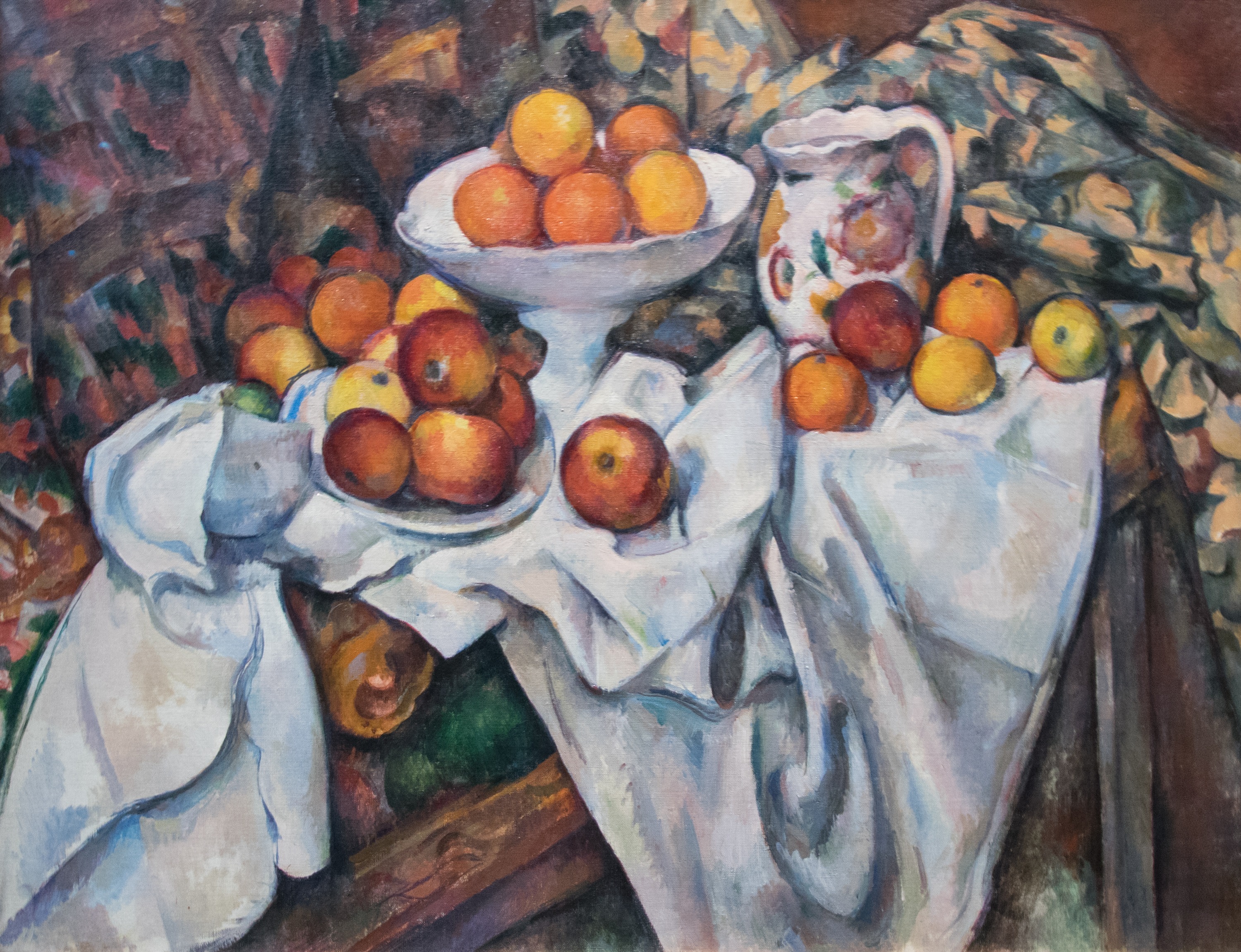
Image: Wikimedia Commons / Public Domain
- Dimensions
- 74.0 × 93.0 cm
- Medium
- Oil on canvas
- Collection
- Musée d'Orsay
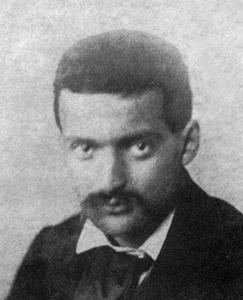
Paul Cézanne was a French artist and Post-Impressionist painter whose work laid…
To reclaim the solidity and permanence of form that Impressionism had dissolved, and to construct a new spatial architecture that synthesizes the natural movement of human vision onto a single canvas.
✦ Highlights (technique & color)
In the folds of the white cloth at the lower left, Cézanne deliberately left areas of the white canvas ground untouched to create a sense of luminosity. Rather than relying on dark shadows, the volume of the fruit is rendered through modulation—subtle chromatic shifts from red to yellow. The misalignment of the table's edges on either side illustrates the integration of multiple shifting viewpoints.
✦ The setting of this painting
Cézanne's studio on Rue Hégésippe-Moreau in the 18th arrondissement of Paris. The geometric-patterned tapestry, the floral pitcher, and the majolica plate depicted in the composition were props he personally owned.
✦ Historical context
The late 1890s saw the role of painting shift—spurred by the spread of photography—from a faithful imitation of the external world toward the construction of the deep structures underlying human visual perception. It was also an era when new concepts of space, such as non-Euclidean geometry, were entering intellectual discourse.
In a studio set slightly apart from the bustle of Paris, an aging painter sat facing fruit in quiet contemplation. Before him, an opulent, rumpled white tablecloth swelled across the surface, laden with a mound of apples and oranges alongside a floral-patterned pitcher. No one else was in the room. In a space ruled by silence, brush in hand, he continued his wordless dialogue with the inanimate objects before him.
Gazing upon the Constant in the Wake of Loss
In 1899, Paul Cézanne was submerged in profound solitude. Although an inheritance from his father had freed him from financial hardship, his soul remained unfulfilled. A few years earlier, he had lost his beloved mother, his emotional pillar. That same year brought another drastic upheaval: the Jas de Bouffan, his cherished family estate in his native Aix-en-Provence, was sold by his family. Both the landscapes of his homeland that had anchored his spirit and the warmth of family bonds slipped through his fingers. Worsening diabetes only compounded his struggle, leaving his psyche tormented by isolation.
Amid this profound sense of loss, Cézanne shut himself away in his studio on Rue Hégésippe-Moreau in the 18th arrondissement of Paris. The only world that offered him comfort, and the only one he could control, was the space upon the canvas. He hung a tapestry featuring a geometric pattern in dark blue-green tones on the studio wall and arranged apples and oranges on white majolica dishes. Unlike humans, these fruits and vessels never complained or betrayed him; they simply existed. Rearranging them and carefully controlling the natural light, he observed them intently.
This work was not commissioned by anyone; it was undertaken as a purely formal inquiry of his own. Using the same props, he focused during this period on producing a series of six large-scale still lifes. Among them, this painting was the largest, representing the zenith of his passion in the density of its composition and the brilliance of its color.
About 561 more words
- ・Subverting Conventional Perspective: Experiments with Multiple Viewpoints
- ・Memories Entrusted to Apples and Color Expression Free of Shadows
- ・The Trajectory of an Artistic Quest Passed on to Picasso and Later Masters
Read the rest of this commentary —
and step into a secret gallery
opened just for you
An "art letter" delivered to you every Saturday morning
Works, music and words chosen for your sensibility, from your artist-type result and the paintings you love
A library of masterpieces and music you can enjoy "in your own words", not just look at
A "digital art notebook" (unlimited) where your impressions build into your own taste
Unlimited likes and notes
¥980 / month¥0 today
¥980/month (tax incl.) from day 8. Cancel anytime.
Already have an account? Log in
Your Note
Write down what this painting made you feel in your art notebook.
Please sign up to write notes.
Sign up for freeRecommended Artworks
_1893.webp)
Sources & references
More artists
If you find an error in this content, please let us know here
This site is protected by reCAPTCHA, and the Google Privacy Policy and Terms of Service apply.