
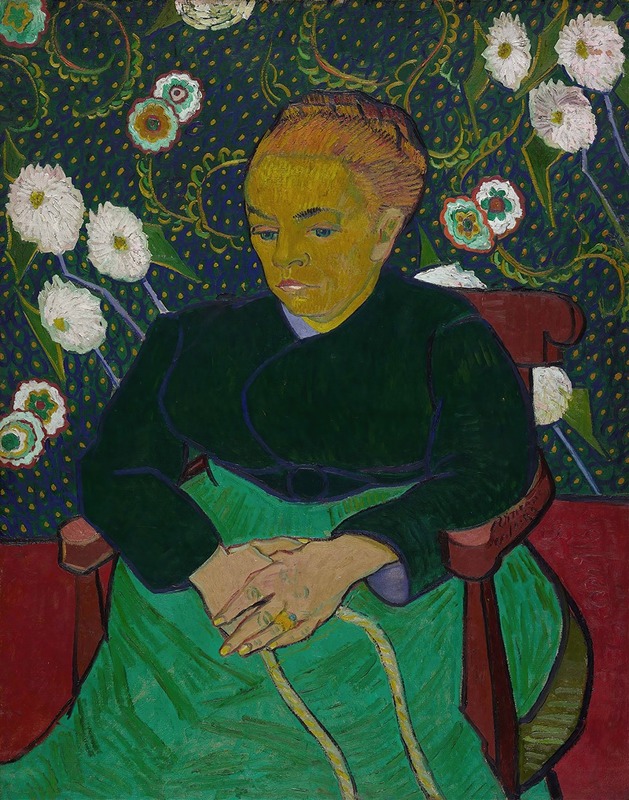
Madame Roulin Rocking the Cradle (La Berceuse)
1889
- Dimensions
- 92.0 × 73.0 cm
- Medium
- 油彩・カンヴァス
- Collection
- クレラー・ミュラー美術館、メトロポリタン美術館、シカゴ美術館、ボストン美術館、ステデリック美術館
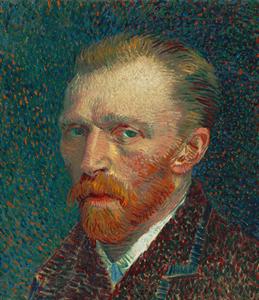
A Post-Impressionist painter who fundamentally revolutionized the visual languag…
過酷な海で命がけの漁をする漁師たちの孤独を慰めるため、彼らが揺りかごに揺られているような安らぎを感じられる「視覚的な子守唄」を描きたかった。
✦ Highlights (technique & color)
ルーラン夫人の服の力強い緑色と、顔や肌の赤・桃色による強烈な補色対比が見どころ。また、顔や衣装には斜線や曲線を交差させる網目状のハッチング筆致が用いられ、色の混合と立体の質感を同時に表現している。背景の花柄格子線と衣服のラインが、中央で重ねられた手と紐へ視線を誘導する構図になっている。
✦ The setting of this painting
フランス南部プロヴァンス地方の街アルルにある、通称「黄色の家」のアトリエ。女性が座っているのは、かつてゴッホと同居していた画家ポール・ゴーギャンが愛用していた木製の肘掛け椅子である。
✦ Historical context
19世紀末のフランスは急速な工業化と都市化が進み、伝統的なコミュニティが解体されて都市労働者の孤独や疎外感が社会問題化していた。キリスト教の信仰が揺らぐ中、人々は宗教に代わる精神的救済や永遠の母性を求めていた。
Winter in Arles, in the south of France. Amid the bitter howling winds, Vincent van Gogh stood before a canvas in his studio. Seated quietly in front of him, resting upon a wooden armchair, was a plump woman draped in a vibrant green dress. Behind her, a tapestry-like wallpaper abloom with magnificent blossoms resembling dahlias and peonies unfurled, gracing the space like a celebratory halo. Her hands were gently clasped in her lap, holding a thick, coarse rope. Her gaze was cast downward as though lost in distant contemplation, her lips firmly set. With each brushstroke, Van Gogh inscribed upon the canvas the fathomless warmth and embrace dwelling within her tranquil presence. It was no mere portrait, but a form of solace desperately sought by an artist tormented by profound loneliness and anxiety.
The Invisible Infant and the Cradle String
Turning one's gaze to the hands of the woman seated resolutely in the center of the canvas, one notices that she firmly clasps a thick cord. Yet what should lie at the other end of that cord is nowhere to be seen in the picture. She holds the rope because, by design, it extends beyond the frame to rock the unseen cradle of a baby.
Why did Van Gogh choose not to depict the infant, choosing instead to fill the canvas entirely with the mother? Art historians such as Bradley Collins have pointed out that a profound intention lies behind this composition. Van Gogh, who had once aspired to enter the ministry, sought to strip away the figures of Christ and the angels typical of traditional Catholic religious paintings, fashioning this ordinary, working-class mother into a modern Virgin Mary.
By removing the infant from the frame, the viewer is invited to recall the warmth of their own childhood cradle and envision their own mother. She became both the mother of someone in particular and a universal symbol of motherhood embracing all humankind. Van Gogh sought to transcend the framework of religion, establishing upon the canvas a flesh-and-blood sacred presence to which people living in modern times could turn for genuine solace.
A Friend in the Departed Companion's Chair
The model for this painting was Augustine Roulin, the wife of Joseph Roulin, who worked as a postman in Arles. Having arrived in an unfamiliar land and often finding himself isolated due to his fiery temperament, Van Gogh found the Roulin family to be among his few understanding companions, offering him invaluable and warm support as a family.
Van Gogh had Augustine, his benefactor, sit in a very particular chair. The wooden armchair she occupied was the very one favored by Paul Gauguin, the painter who had briefly lived with Van Gogh in the Yellow House.
Having welcomed Gauguin with the dream of founding an artist's community, their shared life dissolved in bitter clash, and Gauguin departed. In that chair, left suddenly vacant by its former occupant, Van Gogh seated his dear friend's wife. As though seeking to mend the pain of a severed bond, or perhaps striving to reclaim the idealized domestic sanctuary that had shattered, he may have been desperately trying, through Augustine's presence, to fill the vast void in his own heart.
Five Canvases Painted in the Wake of the Severed Ear
In December 1888, following the definitive rupture with Gauguin, Van Gogh reached his psychological limit and committed the tragic act of severing his own ear. Suffering from an acute psychotic episode, he was immediately admitted to the municipal hospital in Arles.
After the turn of the year, having been discharged and returning to the Yellow House, Van Gogh resumed work on this portrait of Augustine as a form of therapy to soothe his mind, all while battling the terror that another attack might occur.
A common myth suggests this painting was executed in a singular rush of emotion during his confinement in the hospital or amidst the confusion of his seizures. Yet that is far from the truth. In reality, Van Gogh executed five distinct versions of the exact same composition within a short period, guided by a meticulously deliberate plan grounded in color theory. Even while grappling with his madness, he retained his lucid artistic vision and refined technique, replicating variations of this lullaby until he was fully satisfied. It was an arduous, prayer-like process—a desperate attempt to tether his unraveling psyche through the act of holding a brush.
A Lullaby for Fishermen on Tempestuous Seas
The sentiment Van Gogh poured into this work took on an even deeper dimension through a novel he had been reading. At the time, he was profoundly moved by An Iceland Fisherman, written by the French novelist Pierre Loti.
In letters addressed to his brother Theo and to Gauguin, Van Gogh wrote of the solitude and homesickness endured by the Icelandic fishermen risking their lives in the harsh waters of the North Sea. Hardened sailors yearning for a distant home as they contended with the constant fear of perishing upon the frigid waves—it was for such souls that Van Gogh wished to paint this piece.
He envisioned how this painting might look hung within the dim cabin of a fishing boat tossed upon raging seas. He dreamed that when these weary men, exhausted from grueling labor, looked up at this image, they would recall the lullabies their mothers sang in their childhood, finding a comforting peace as though rocked in a cradle themselves. Van Gogh's empathy reached across the distance, extending from his studio in Arles all the way to the nameless individuals trembling in isolation upon the cold and distant ocean.
About 542 more words
Read the rest of this commentary —
and step into a secret gallery
opened just for you
An "art letter" delivered to you every Saturday morning
Works, music and words chosen for your sensibility, from your artist-type result and the paintings you love
A library of masterpieces and music you can enjoy "in your own words", not just look at
A "digital art notebook" (unlimited) where your impressions build into your own taste
Unlimited likes and notes
¥980 / month¥0 today
¥980/month (tax incl.) from day 8. Cancel anytime.
Already have an account? Log in
Your Note
Write down what this painting made you feel in your art notebook.
Please sign up to write notes.
Sign up for freeRecommended Artworks
Sources & references
More artists
If you find an error in this content, please let us know here
This site is protected by reCAPTCHA, and the Google Privacy Policy and Terms of Service apply.