
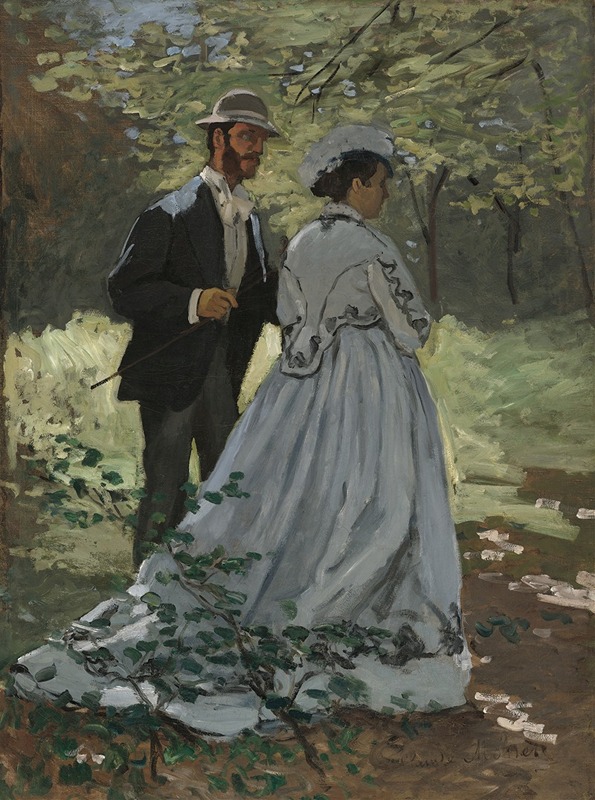
Bazille and Camille (Study for Déjeuner sur l’Herbe )
1865
- Dimensions
- 93 × 68.9 cm
- Medium
- Oil on canvas
- Collection
- National Gallery of Art, Washington
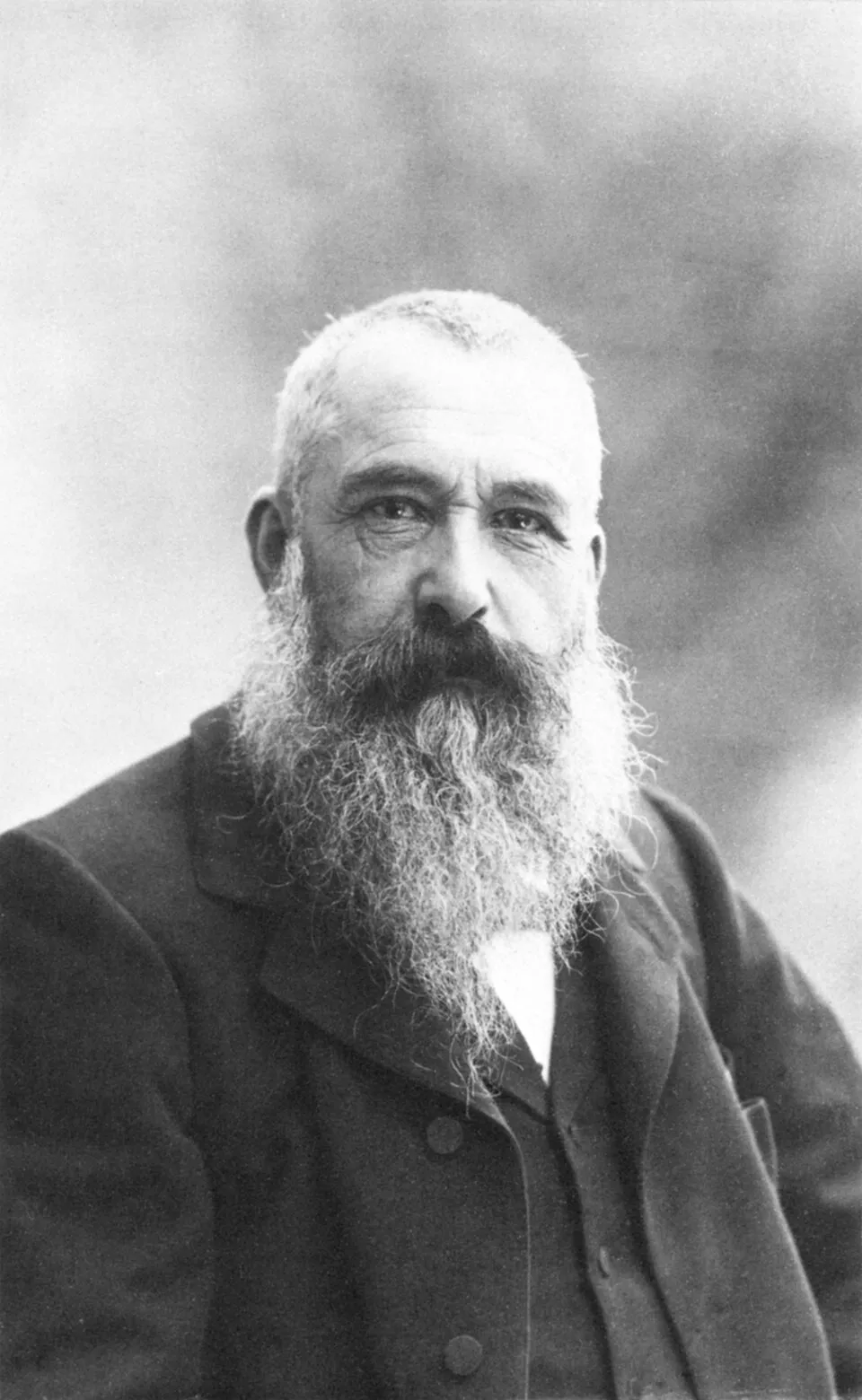
Celebrated as a founding figure of Impressionism, he is one of France’s most ren…
✦ Highlights (technique & color)
As a preparatory study for a monumental work, it is filled with energetic and spontaneous brushwork that rivals the finished canvas itself. Paint was applied swiftly with palette knives and broad brushes, with the canopy of trees captured simply in shades of celery and sage green. The dappled sunlight falling across the garments and the ground is directly rendered through bold strokes of white and pale cream.
✦ The setting of this painting
The scene is set around Chailly-en-Bière, near the edge of the Forest of Fontainebleau. This area, which served as a base for plein-air painting by the Barbizon School artists, was also a vital training ground for the young Monet to observe natural light firsthand. Here, he explored the interplay between the figures and the dappled sunlight filtering through the trees above.
✦ Historical context
In 1865, when mythological and historical subjects still dominated the Salon, Monet and his peers aspired to depict modern life as it unfolded around them. Amid the scandal sparked by Manet's Luncheon on the Grass, Monet sought to modernize painting by vividly capturing the contemporary dress of the bourgeoisie and making wholesome outdoor leisure his primary subject.
A couple stands on a forest path.
Sunlight filters through the trees, falling on the woman's slate-gray gown.
It was the summer of 1865.
Young Claude Monet was in the Forest of Fontainebleau,
near the village of Chailly-en-Bière.
He was planning an ambitious masterpiece.
A monumental painting, measuring four meters high and six meters wide, titled Déjeuner sur l’Herbe.
It was a massive work, intended to challenge Manet's painting of the same name.
This particular piece is a study to test the figures to be placed in that large-scale work.
Monet sought to individually record the light filtering through the trees overhead.
The models were Camille, who would later become his wife,
and Frédéric Bazille, his irreplaceable best friend.
Bazille was born into a wealthy family in the South of France and moved to Paris to study medicine, but his passion for painting was too strong to suppress, leading him to join Monet and his circle.
He generously allowed the extremely poor Monet to live in his studio and provided him with unwavering support.
That summer, too, he came to Chailly at Monet's request.
He posed repeatedly until Monet was satisfied.
However, an unexpected incident occurred.
Monet injured his leg while working outdoors.
He became immobile at a local inn.
Bazille, a medical student, took action.
He assembled an improvised traction device using pulleys and weights on the inn's bed.
And he devotedly nursed Monet.
Bazille captured the scene of his care in a painting titled An Improvised Field Hospital.
About 95 more words
Read stories of masterpieces for free
Your Note
Write down what this painting made you feel in your art notebook.
Please sign up to write notes.
Sign up for freeRecommended Artworks
Sources & references
More artists
If you find an error in this content, please let us know here
This site is protected by reCAPTCHA, and the Google Privacy Policy and Terms of Service apply.