
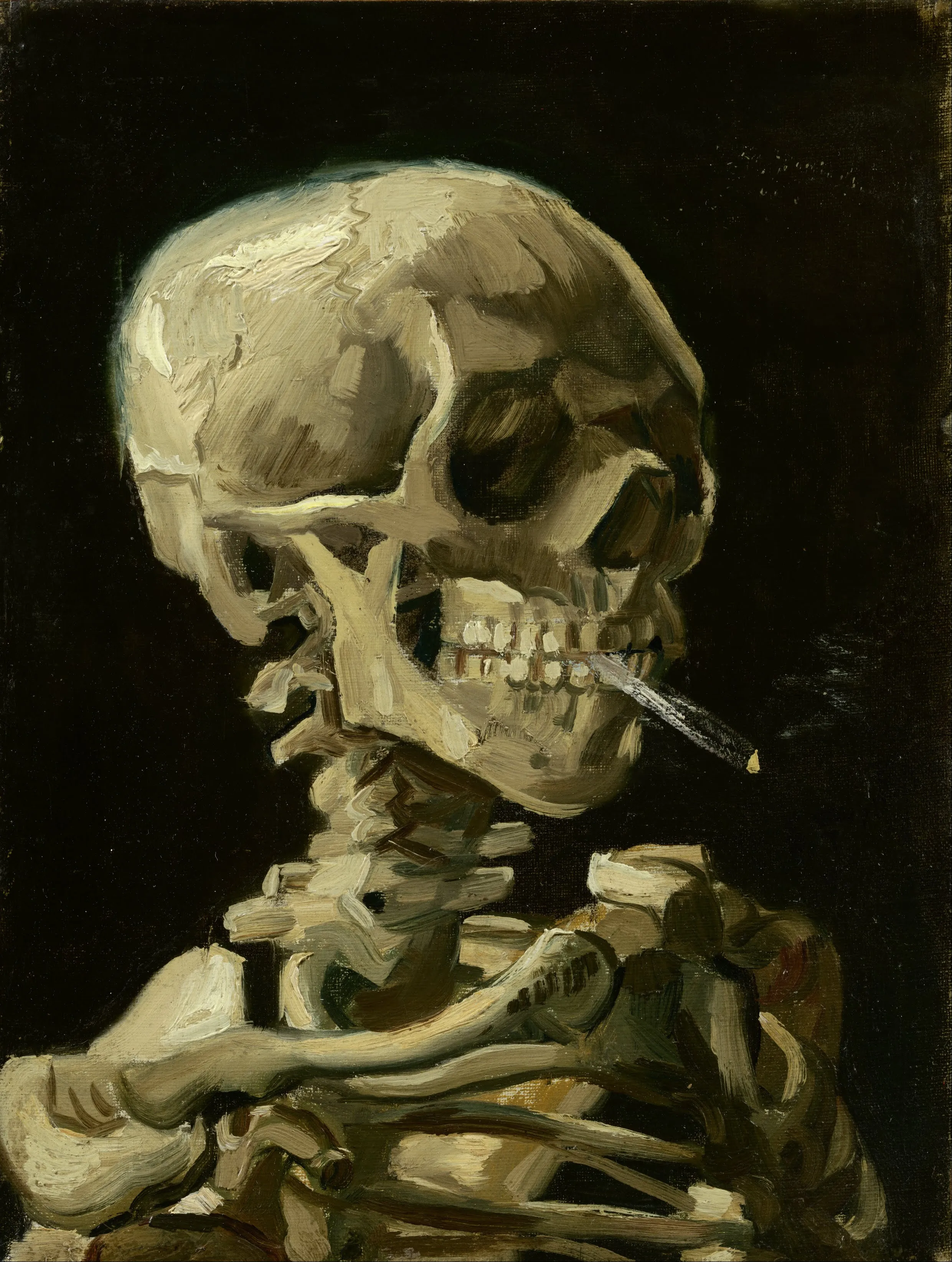
- Dimensions
- 32.3 cm × 24.8 cm
- Medium
- 油彩・カンヴァス
- Collection
- ファン・ゴッホ美術館
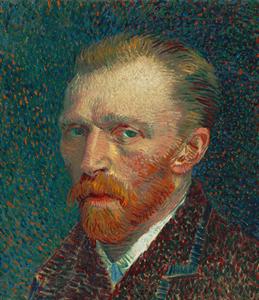
A Post-Impressionist painter who fundamentally revolutionized the visual languag…
伝統主義的で息の詰まるアカデミーの解剖学授業に対する、学生らしいユーモラスな反逆と揶揄。
✦ Highlights (technique & color)
画面左上から射し込む光が、頭蓋の滑らかな曲線や骨の粗い質感を強烈な明暗のコントラストで浮かび上がらせている。全体的に絵具は薄く平滑に塗られているが、煙草の先端の火種にのみ鮮やかなオレンジから朱色の絵具が厚く塗られ、視線を一点に集中させている。
✦ The setting of this painting
ベルギーのアントウェルペン。王立芸術アカデミーの教室、あるいはゴッホが借りていた個人のアトリエ。明確な室内の奥行きや調度品を一切排除した抽象的な暗闇の中に、解剖学研究用の骨格標本が浮かび上がっている。
✦ Historical context
19世紀後半のヨーロッパの芸術アカデミーでは、徹底した実体写生と古典古代の美の規範の習得が課されており、個人的な感情やユーモアを混入させることは冒涜とみなされていた。一方で、紙巻煙草は都市のボヘミアンや反体制的な若者文化のシンボルとして広まりつつあった。
A flat, depthless darkness shifting from dark green to near-black. From this void-like space, a human skull tinted in pale yellow and olive-gray looms eerily. Light streams in from the upper left, unforgivingly illuminating the rough texture and smooth contours of the bone, creating a stark contrast of light and shadow. Yet, what arrests our gaze is not merely this meticulous rendering of bone. Jutting out from between the bared teeth is a single, lit cigarette. A skull—the quintessential symbol of death—holds a cigarette like a living being, glowing with an ember of orange in the dark. This peculiar, somewhat comical, and utterly striking painting was created by the Dutch artist who would later become a worldwide master: Vincent van Gogh. Why on earth did he paint such an enigmatic picture?
A Bizarre Painting of a Smoking Skeleton
At first glance, this work by Van Gogh might seem like an eerie horror scene or a piece of dark humor. Set against a dark background is a human skull, with a lit cigarette protruding from between its teeth. The skeleton portrayed preserves precise anatomical accuracy, from the frontal bone and eye sockets to the cheekbones, mandible, and upper cervical vertebrae. Even the contours of the bone and the cranial sutures are vividly captured through layered, short brushstrokes, revealing the artist's profound grasp of human anatomy and his keen eye for observation.
Yet there is a jarring dissonance in seeing a skull—an object of solemn, scientific study—clamping down on an everyday luxury like a cigarette. This sight, as though the dead were casually enjoying a smoke, disconcerts viewers while exerting an uncanny, magnetic pull. Standing out as an exceptional oddity in Van Gogh’s entire oeuvre, this oil painting also serves as a mirror reflecting the turbulent emotions swirling within him and the harsh reality of his life at the time.
A Premonition of Death, or an Anti-Smoking Poster?
Such an unusual motif has prompted posterity to offer a variety of interpretations. Widely known among them are tragic narratives claiming it to be a kind of self-portrait foreshadowing his own death, or didactic readings viewing it as an early precursor to anti-smoking posters warning society of tobacco's harms. Given that the artist would later take his own life and was himself an inveterate heavy smoker, such interpretations certainly possess a dramatic and appealing ring.
However, these are nothing more than unfounded popular myths. Modern research by the Van Gogh Museum and scholars such as Louis van Tilborgh clearly defines this painting as a piece of art-student mischief—a joke. Rather than conveying a profound religious message, a dread of mortality, or a social warning, it was an expression of humor born of personal and youthful defiance. What, then, was the target of Van Gogh's prank?
Rebellion Against a Stifling Academy
The answer lies in the circumstances surrounding Van Gogh when he painted it. In January 1886, at the age of thirty-two, Van Gogh enrolled in the Royal Academy of Fine Arts in Antwerp, Belgium. For someone who had been largely self-taught, subjecting himself to traditional academic art instruction was a formidable challenge. In the academy’s evening drawing class, students were required to make meticulous sketches of skeleton models kept in the classroom to master human anatomy.
For Van Gogh, however, classes at the academy brought a succession of disappointments and friction rather than the enlightenment he had hoped for. He grew deeply frustrated with the lifeless, conventional copying techniques prescribed by the professors. In letters to his brother Theo, he fiercely criticized his fellow students' drawings as hopelessly bad and fundamentally flawed in their grasp of form. In his eyes, the other students merely traced surfaces, making no attempt to capture the true vitality and structure of the subject.
Moreover, oil painting was not permitted in these classes; only drawing was allowed. Van Gogh therefore took it upon himself to create this oil painting in his own time, either in his room or studio. Demonstrating his flawless skill in anatomical drawing while contaminating it with something as vulgar as a cigarette, it was his own stinging parody directed at the sanctity of rigid academicism—an overt act of defiance against a suffocating institution.
Decaying Teeth and the Skeleton
Alongside his clash with the academy, Van Gogh was pushed to his physical and mental limits during this period. Dependent on allowances sent by Theo, he poured almost all that money into model fees and art supplies, leaving barely enough for food. His diet consisted almost entirely of bread, coffee, and copious amounts of tobacco. Sunk into extreme malnutrition, Van Gogh suffered from severe pyorrhea and dental decay, losing or requiring treatment for more than ten teeth.
Letters to Theo recount in detail the hefty sums he paid to a local dentist. Caught in intense pain and despair as his own teeth rotted away and fell out one after another, he sat staring intently at a bared-toothed skull, rendering it upon the canvas. Placing a cigarette between the skeleton's teeth carries an eerie resonance with his own bodily torment, going well beyond a mere prank on the academy. In the skull’s insolent grin, one can sense both a self-mocking nod to his deteriorating body and an unwavering obsession to keep painting regardless.
About 652 more words
Read the rest of this commentary —
and step into a secret gallery
opened just for you
An "art letter" delivered to you every Saturday morning
Works, music and words chosen for your sensibility, from your artist-type result and the paintings you love
A library of masterpieces and music you can enjoy "in your own words", not just look at
A "digital art notebook" (unlimited) where your impressions build into your own taste
Unlimited likes and notes
¥980 / month¥0 today
¥980/month (tax incl.) from day 8. Cancel anytime.
Already have an account? Log in
Your Note
Write down what this painting made you feel in your art notebook.
Please sign up to write notes.
Sign up for freeRecommended Artworks
Sources & references
More art movements
Pre-Baroque
1 artworks
Victorian era
8 artworks
Impressionism
47 artworks
Late Pre-Raphaelite
10 artworks
Baroque
2 artworks
American Impressionism
5 artworks
Realism
4 artworks
Pre-Raphaelite
3 artworks
Barbizon School
5 artworks
Academic art
5 artworks
Luminism
3 artworks
Rococo
2 artworks
Symbolism
22 artworks
Neo-Impressionism
3 artworks
Ukiyo-e
1 artworks
Japonism
4 artworks
Edo period
1 artworks
Fauvism
1 artworks
Naturalism
8 artworks
Russian Realism
1 artworks
Post-Impressionism
13 artworks
Genre painting
8 artworks
Neoclassicism
3 artworks
ウィーン分離派
7 artworks
未来派
1 artworks
More artists
If you find an error in this content, please let us know here
This site is protected by reCAPTCHA, and the Google Privacy Policy and Terms of Service apply.