
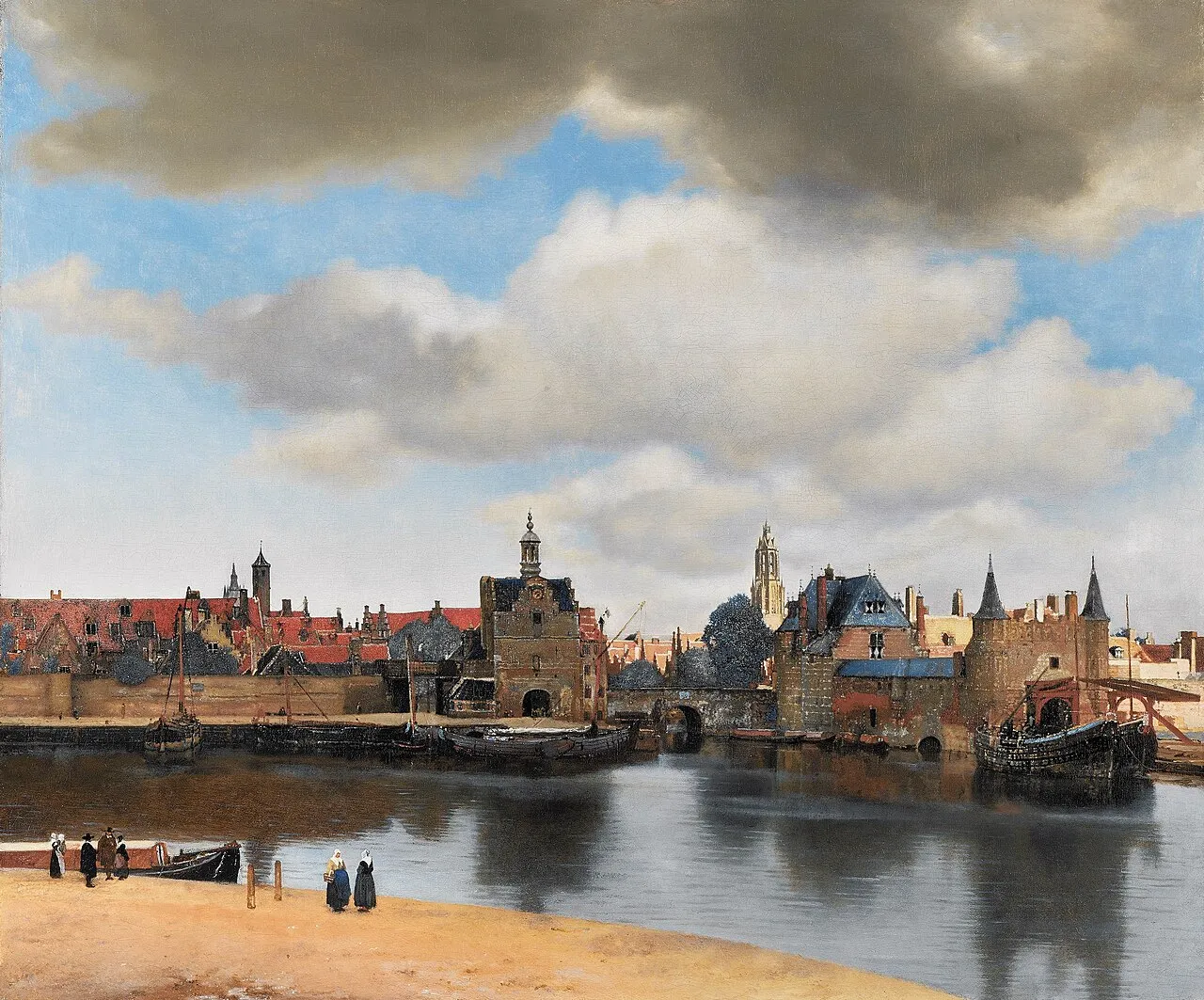
View of Delft
- Dimensions
- 96.5 × 115.7 cm
- Medium
- Oil on canvas
- Collection
- Mauritshuis, The Hague

Based in Delft during the 17th-century Dutch Republic, he was a master of genre…
A quiet defiance of mere topographical documentation—the artist's pride, deconstructing the actual landscape and reconstructing it with his own hands into a space of perfect harmony and stillness.
✦ Highlights (technique & color)
To evoke the coarse texture of the stone buildings, sand was deliberately mixed into the underlayer of paint. The reflections of light on the water are delicately rendered with tiny dabs of white and yellow. Near the center of the canvas, a small pinhole can be found, used by the artist to set lines of perspective.
✦ The setting of this painting
The setting is the Kolk, a triangular harbor basin at the southern edge of Delft in South Holland, along the mouth of the Schie river. At the time, it served as a bustling commercial hub for the transport of goods and passenger barges. The angle of the sunlight indicates early morning, while the lush foliage on the trees suggests late spring or summer.
✦ Historical context
In the 17th-century Dutch art market, cityscapes enjoyed great popularity, driven by civic pride. Between the spring of 1660 and the autumn of 1661, a new carillon was being installed in the tower of the Nieuwe Kerk. The empty belfry depicted in the painting aligns precisely with this historical fact.
A vast sky and drifting clouds occupy more than a third of the canvas.
Stretching beneath them is the city of Delft, casting its reflection upon the water.
A tranquil glimpse of seventeenth-century Holland.
At first glance, one might easily mistake it for a cityscape captured with photographic precision.
Indeed, it was long believed that Vermeer used an optical device called a camera obscura,
simply tracing the projected view directly onto his canvas.
In truth, however, this painting is not a literal depiction of reality.
Vermeer deliberately made bold alterations to the scene before his eyes.
The year is 1660.
In his late twenties, Johannes Vermeer was steadily building his reputation as a painter in his native Delft.
Living with his wife, Catharina, in the home of his affluent mother-in-law, it was a time of stability for the artist.
He observed this view from the upper floor of a building on the south bank of the River Schie.
The season was late spring or summer,
with the morning sun illuminating the town from the east.
In the distance, the tower of the Nieuwe Kerk is depicted without bells.
Historical records reveal that work to install a new carillon took place between the spring of 1660 and the autumn of the following year.
It was during this exact period that Vermeer looked out upon that empty belfry.
Yet he did not merely copy what he saw onto the canvas.
Compared to the actual topography, the tower of the Nieuwe Kerk has been shifted closer to the center.
The Rotterdam Gate on the right was made lower and flatter.
The drawbridge connecting the two gates was lengthened and straightened.
About 226 more words
Read stories of masterpieces for free
Your Note
Write down what this painting made you feel in your art notebook.
Please sign up to write notes.
Sign up for freeRecommended Artworks
Sources & references
More artists


If you find an error in this content, please let us know here
This site is protected by reCAPTCHA, and the Google Privacy Policy and Terms of Service apply.