
The Art of Painting
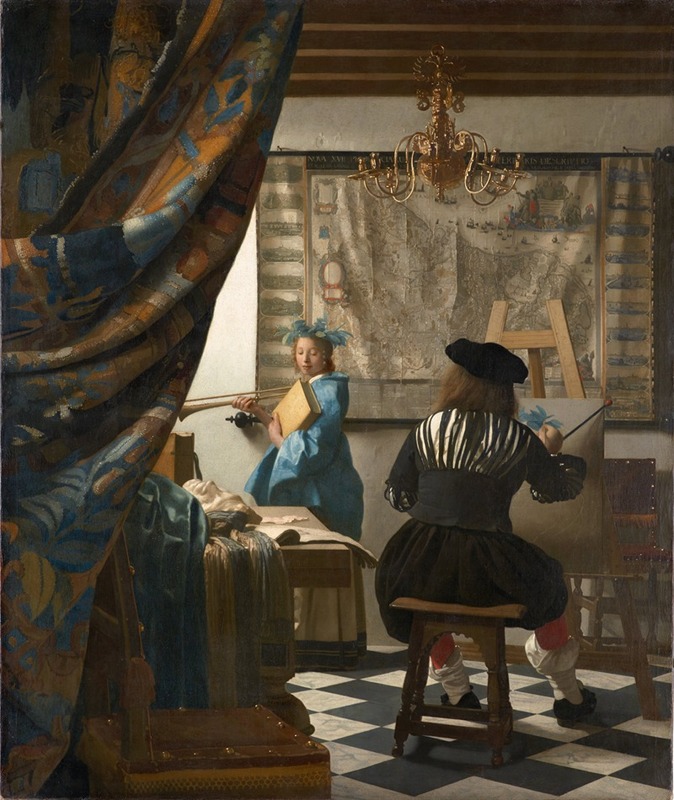
- Dimensions
- 120.0 × 100.0 cm
- Medium
- Oil on canvas
- Collection
- Kunsthistorisches Museum, Vienna
Based in Delft during the 17th-century Dutch Republic, he was a master of genre…
A fierce pride in elevating painting—so often relegated to a mere craft—to a noble art alongside poetry and philosophy. It marks the culmination of the artist's unyielding pride and aesthetic ideals, which he never relinquished even on the brink of financial ruin and death.
✦ Highlights (technique & color)
Costly natural ultramarine was generously applied to the model's blue dress and the shadows of the foreground curtain, imbuing the entire composition with a cool, luminous clarity. A small pinhole placed at the vanishing point, just to the right of the center, allowed the artist to stretch strings to plot precise perspective orthogonals. Furthermore, techniques using small dots of oil paint were masterfully employed to evoke the shimmering glint of light on surfaces such as the chandelier.
✦ The setting of this painting
Drawing upon elements of the studio in the Delft residence of his mother-in-law, Maria Thins, where Vermeer lived, this represents an idealized and imaginary studio space perfected through compositional mastery. The checkered black-and-white marble floor is geometrically configured to establish a spatial grid for one-point linear perspective. A gentle light pouring from an unseen window on the left softly illuminates the entire room.
✦ Historical context
The wall map hanging in the background was published in 1636. By the late 1660s, when this painting was created, the Netherlands had already been divided into the Northern and Southern regions. Presenting this politically obsolete map of the unified Seventeen Provinces within the studio suggests a profound nostalgia for the past glory of the entire Low Countries, which once shared a common culture, language, and splendid artistic heritage.
Beyond the drawn-back, heavy tapestry lies a sunlit studio.
A painter dressed in black and white sits upon a stool.
He has just begun capturing a woman in a blue dress onto the canvas.
This painter with his back turned is often said to be Vermeer himself.
The model is also sometimes thought to be his wife, Catharina.
It was long widely believed to depict a scene of private, everyday life.
Yet, because the face is entirely concealed, it cannot be confirmed as a self-portrait.
When it was created in the late 1660s, his wife was in her mid-thirties and had borne many children.
Her appearance would not have matched that of the young woman in the painting.
This was not a work capturing the everyday moments of any specific person.
At the time, Vermeer served as a dean of the Guild of Saint Luke in Delft.
Acknowledged as the finest painter in the region, he was the head of a large family raising eleven children.
With the financial support of his mother-in-law, he painted while also dealing in art.
This grand work was not commissioned by any patron.
Instead, it remained in his studio as an independent creation born purely of the artist's own ambition.
Wealthy patrons came to visit his studio.
This was a singular masterpiece meant to showcase the pinnacle of his skill and erudition to them.
The figure depicted is a woman personifying Clio, the muse of history.
She holds a trumpet heralding fame and a book that records history.
Here, Vermeer presents himself not as a mere craftsman, but as a noble artist depicting history.
The work carried a powerful conviction: that painting is the supreme art.
In 1672, the French invasion brought the "Year of Disaster."
The Dutch economy collapsed, and the art market disintegrated entirely.
Vermeer sank into immense debt and faced ruin.
His family was plunged into severe hardship.
Those around him may well have urged him to sell it.
Yet, until his sudden death in 1675 at the age of forty-three, he never parted with this painting.
About 223 more words
Unlock this story's ending, and every article on MusicStory
- 42
Stories1–2 new every week
An archive of paintings paired with great music, made for a weekend night and a cup of coffee
- 319
Paintings with commentarygrowing daily
From simply looking to truly reading — the brushwork and the obsession of the masters
- 10
Music Librarygrowing daily
Know it first, and what reaches your ear changes — background music becomes art you keep for life
My Notes, unlimited
Every reading adds to a digital art notebook that is yours alone
Already have an account? Log in
Your Note
Write down what this painting made you feel in your art notebook.
Please sign up to write notes.
Sign up for freeRecommended Artworks
Sources & references
More artists





If you find an error in this content, please let us know here
This site is protected by reCAPTCHA, and the Google Privacy Policy and Terms of Service apply.