
The Street Enters the House
1911
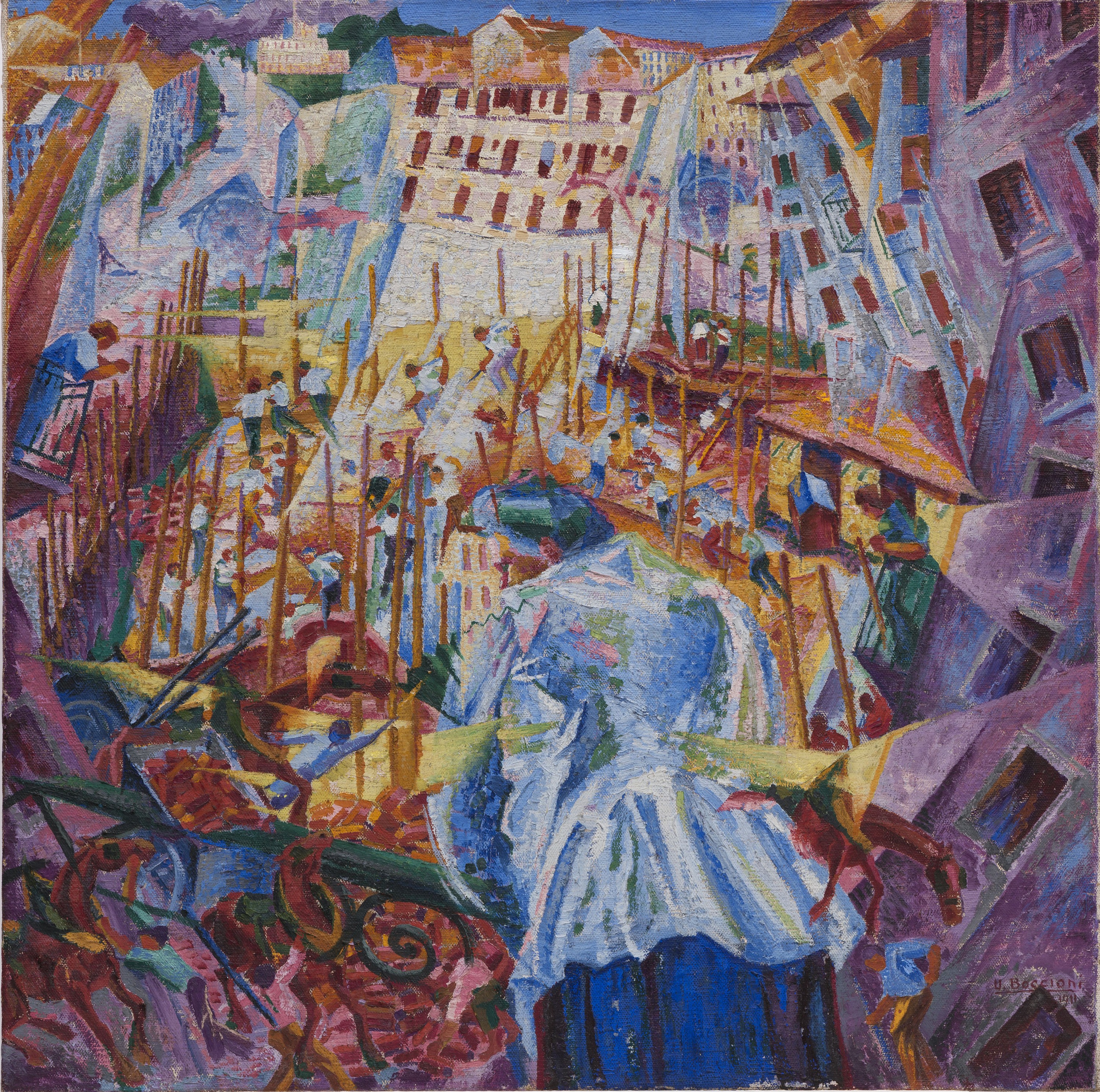
Image: Wikimedia Commons / Public Domain
- Dimensions
- 100.0 cm × 100.6 cm
- Medium
- Oil on canvas
- Collection
- Sprengel Museum
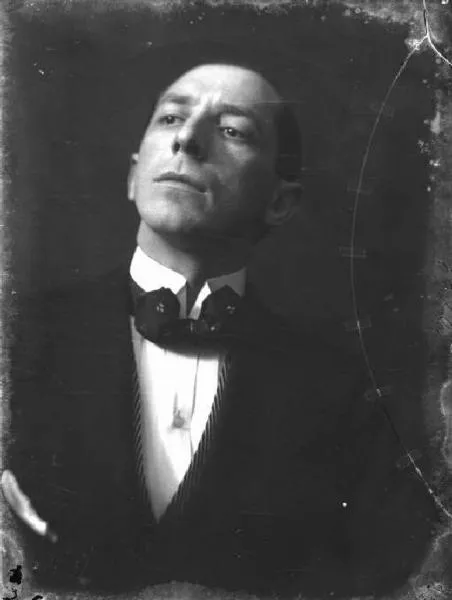
A central figure in Italian Futurism, he unified the movement's theories of pain…
I wanted to shatter the stillness of conventional art and capture the dynamism of a living moment—where the clamor, vibrations, and rays of light of the modern city collide fiercely and merge with the human body and mind.
✦ Highlights (technique & color)
In the foreground, the back of a woman in blue—the artist’s mother—serves as a repoussoir, drawing the viewer directly into the picture plane. Surrounding buildings appear to tilt and cascade toward her head, dissolving traditional single-point perspective. Moreover, fragments of buildings and small horses are painted translucently through her back and shoulders, visually rendering the Futurist concept of “interpenetration”—the sensation of exterior noise and light invading the interior and the human consciousness. The contrast between the cool tones within and the warm hues outside synesthetically evokes unseen acoustic vibrations.
✦ The setting of this painting
The view from the top-floor balcony of Umberto Boccioni’s apartment at 23 Via Adige, situated in the southeastern district of Milan, Italy. Below lies the street stretching toward Piazza Trento, surrounded by the bustling construction of the Bezozzi-Marzoli factory and the foundation work for modern apartment buildings. Set around midday between late summer and autumn under intense sunlight, the scene captures a sensory collision of steam, noise, and rising dust.
✦ Historical context
In the early 20th century, northern Italy was undergoing rapid industrialization and a second wave of urbanization. Milan, in particular, was hailed as the “Manchester of Italy,” experiencing a boom in steel-frame construction and the rapid expansion of a municipal tram network. In the art world, the Futurists, led by figures like Boccioni, launched an avant-garde movement that rejected past traditions in favor of celebrating the dynamism, speed, machinery, and clamor of the modern metropolis.
On an early afternoon beneath the blazing summer sun, flinging open the balcony window unleashed a rush of dust and deafening clamor into the room. Before his eyes lay no tranquil scene of daily life: piles of red brick, deeply excavated earth, countless wooden poles driven vertically and obliquely for scaffolding, and the bustling energy of laborers steering horses laden with supplies. From the top floor of his Milan apartment, Umberto Boccioni looked down upon the pulse of a modern city transforming as if it were a living creature. Deep within him swirled a fervent desire, almost bordering on restlessness, to somehow cast this overwhelming energy onto canvas.
What Rushes In the Moment the Window Opens
The painting's title refers to the experience of throwing open a window, when the city's sounds, light, movement, and scents surge simultaneously into both human consciousness and interior space. What Boccioni wished to depict was far more than a mere cityscape. In the Technical Manifesto of Futurist Painting, published in 1910 by the avant-garde group to which he belonged, it was proclaimed that the moment a window is opened, the entire life of the street, its noises and its rays of light, rush into the room all at once. He sought to capture the very sensation expressed in these words within a single painting.
When a person resting in a quiet room throws open the window and collides violently with the outside world, what occurs within the human mind? It is not merely a visual experience; the clamor reaching the ears, the vibrations felt against the skin, and the pungent odors all merge into one colossal torrent. Boccioni sought to dissolve the physical boundary of the window frame, capturing the moment when the outer world merges with human interiority. For him, it was a daring quest to open the door to a completely new form of art.
The Changing City and the Balcony as a Laboratory
According to research by art historian Laura Mattioli Rossi, the painting depicts the construction of a factory underway along Via Adige in Milan. At the time, Milan stood at the forefront of a rapid transformation from a historic city into a modern industrial metropolis. Looking down day and night from the balcony of his apartment at the city's ceaseless construction, Boccioni drew upon these visual and acoustic shocks to create many of his masterworks.
Day after day, he stood on his balcony, intently watching the laborers move below and the frameworks of buildings rise into the sky. It is even rumored that his neighbors regarded him as an eccentric, so fervently did he lean out over the railing. Yet he was not merely captivated by excitement. Treating the balcony—the boundary between interior and exterior—as a theoretical laboratory, he calmly observed how the energy of the metropolis acted upon human senses. To him, this balcony served as a frontline observatory linking the world with himself.
A Passion Kindled in Poverty
At the time of this work's creation, Boccioni was in severe financial distress. Though he struggled even to afford daily necessities, an unquenchable flame burned within him. As a central figure of the Futurist movement, he was relentlessly active, staking everything on overthrowing past conventions to forge an expression worthy of a new era.
This painting was not created on commission. Boccioni took up his brush entirely of his own accord, driven to demonstrate the new Futurist theories to the world. In November 1911, he visited Paris, where he encountered the latest avant-garde currents. Profoundly stimulated by the revolutionary spatial expressions being explored by his contemporaries there, he returned to Milan. Eager to synthesize the inspiration he had absorbed in Paris with his own ideas, he executed this painting in a burst of creative fervor shortly after his return. As if defying the crushing weight of poverty, he poured his unrelenting passion onto the canvas.
The Figure at the Center of the Canvas
At the center of the composition, a woman is seen from behind, leaning out from the balcony. The model for this figure was Boccioni's own mother, Cecilia. While some commentaries have described her as an anonymous resident startled by the city's din, art historical research has revealed that Boccioni's domestic sphere and his mother's presence formed the very foundation of his Futurist urban vision.
He loved his mother deeply and featured her as a model in numerous works. Here, too, her back is far more than an incidental detail of the scenery. According to Boccioni's own explanation, the woman's head was conceived not merely as a pair of eyes taking in a view, but as a sensory receptor upon which the city's noise, vibrations, and rays of light converge. Through his mother's body, the vast energy of the metropolis flows into the domestic interior. His mother, the figure closest to him and a symbol of domestic solace, confronts the turbulence of a changing outer world. Perhaps this poignant contrast was precisely the authentic human sensation he sought to evoke.
About 513 more words
Read the rest of this commentary —
and step into a secret gallery
opened just for you
An "art letter" delivered to you every Saturday morning
Works, music and words chosen for your sensibility, from your artist-type result and the paintings you love
A library of masterpieces and music you can enjoy "in your own words", not just look at
A "digital art notebook" (unlimited) where your impressions build into your own taste
Unlimited likes and notes
¥980 / month¥0 today
¥980/month (tax incl.) from day 8. Cancel anytime.
Already have an account? Log in
Your Note
Write down what this painting made you feel in your art notebook.
Please sign up to write notes.
Sign up for freeRecommended Artworks
Sources & references
More artists
If you find an error in this content, please let us know here
This site is protected by reCAPTCHA, and the Google Privacy Policy and Terms of Service apply.