
 日本語 (JA)
 English (EN)
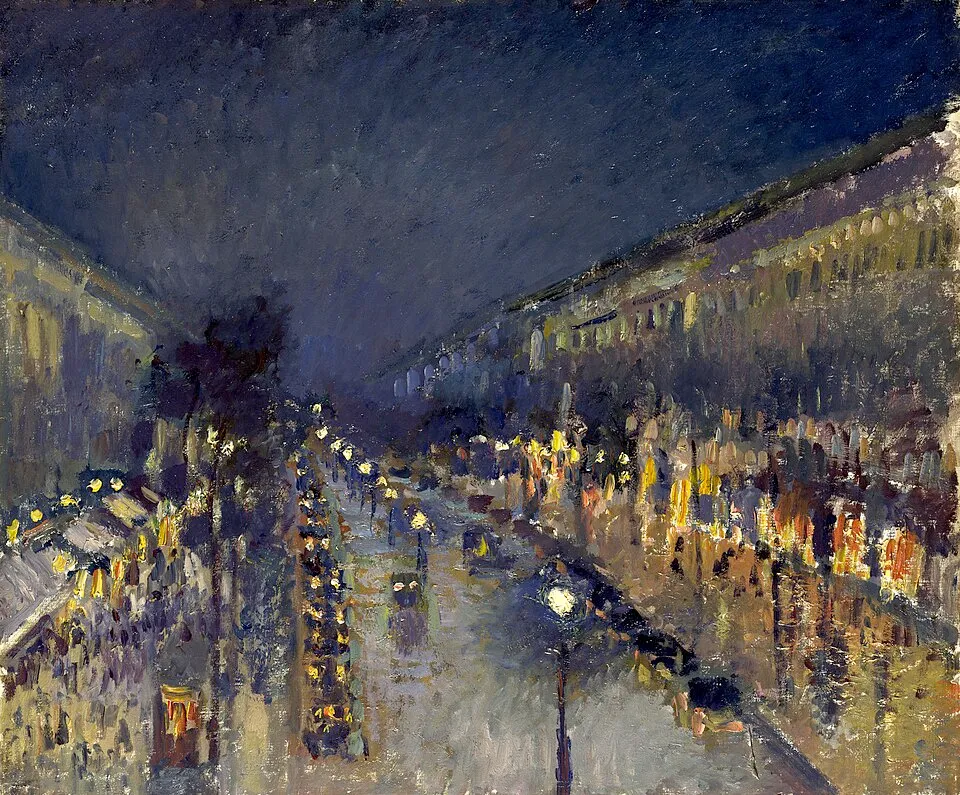
The Boulevard Montmartre at Night
- Dimensions
- 53.3 × 64.8 cm
- Medium
- 油彩、カンヴァス
- Collection
- ロンドン・ナショナル・ギャラリー
フランス印象派を代表する画家。 仲間内で最年長であり、その面倒見の良さから「印象派の父」として多くの画家に慕われた。
眼の病気で外に出られない制約の中、売却目的ではなく、人工照明が作り出す新しい光の表現と都市のエネルギーを純粋に探求するため。
✦ Highlights (technique & color)
画面中央の車道に並ぶ電気アーク灯の白青く冷たい光と、両脇の店舗から漏れるガス灯の暖かみのある黄色やオレンジ色の光の対比に注目してください。また、雨に濡れた路面が光を反射する様子や、夜空を描く際に屋根のラインから上に向かって扇状に筆を動かした特殊なタッチも見どころです。
✦ The setting of this painting
フランス・パリのモンマルトル大通り。イタリエンヌ大通りとドゥルーオ通りの交差点にあったグランド・ホテル・ドゥ・リュシーの客室の窓から、南東方向(サン=ドニ門方面)を見下ろした景観。1897年冬から早春にかけての、雨上がりの夜の情景です。
✦ Historical context
1890年代末のパリは、ジョルジュ・オースマン男爵による大規模な都市改造計画が定着し、近代都市インフラが完成していた時期です。また、都市照明が従来のガス灯から最新の電気アーク灯へと移行する過渡期であり、二つの技術が混在していました。
The cold rain has cleared, and the wet asphalt begins to reflect the city lights like a mirror. Late nineteenth-century Paris, on the Boulevard Montmartre. The lamps of passing carriages and the warm glow spilling from cafés bathe the darkness of night in vivid color. High above the bustle, from a window in an upper-floor hotel room, an elderly painter gazed steadily down at the street below. His name was Camille Pissarro. Revered by many younger artists as the patriarch of Impressionism, he was nevertheless grappling with a profound anguish that threatened his very life as a painter.
The Only Nocturne Painted by the Impressionist Master
Among the countless works Pissarro left behind, this painting holds a unique place. It is the only nocturnal scene among the series of fourteen Boulevard Montmartre paintings produced in 1897, and remarkably, the only nighttime cityscape in oil of his entire career. Out of more than a thousand oil paintings he created, this remains the sole piece in which he depicted a city at night.
Even more curiously, nowhere on the canvas did the artist leave a signature or date; it remains unsigned. This quiet absence suggests that he painted it not for public display, but to confront something deep within himself. Why did this Impressionist master paint the city at night just once in his life? And why did he leave the work without his name?
Paris After the Rain, Seen from an Upper Room
Then in his late sixties, Pissarro suffered from a chronic eye condition. His doctor strictly forbade him from exposing his eyes to cold winds, airborne dust, and intense glare, making painting outdoors—the very lifeblood of an Impressionist—nearly impossible. Setting up his easel out in nature and capturing landscapes bathed in sunlight had once been his everyday reality. Deprived of it, he may well have stood on the brink of deep despair.
Yet Pissarro never set down his brushes. If he could not go outside, he would look out from within. He rented an upper-floor hotel room and hit upon the idea of painting the city through its windows.
What unfolded beyond his window was not the tranquil countryside he had long depicted, but a burgeoning metropolis teeming with modernization. In a letter to his son Lucien, he expressed his deep admiration for the view: "It is a wonderful prospect, allowing me to take in the full sweep of the boulevard, looking almost bird's-eye down upon the carriages, omnibuses, people, great trees, and tall rows of houses." The room that might have been a confinement forced upon him by illness became, for Pissarro, a magical vantage point from which to peer into a whole new world.
A Record of an Era Where Old and New Light Intersect
Below Pissarro lay the nocturnal panorama of a Paris in the midst of transformation. Running straight down the center of the canvas is the cool, white light of electric arc lamps, a cutting-edge innovation introduced at the time. Meanwhile, from the shop windows and cafés lining both sides of the street, the warm orange glow of traditional gas lamps spills into the evening air.
The painting vividly captures a transitional moment in history, where two distinct forms of light coexisted in a single space. Modern art historians, including Richard R. Brettell, have found profound meaning in this contrast of illumination. According to their interpretation, the evenly spaced electric lights symbolize the "administrative order" imposed by municipal authorities, while the gaslights glowing freely along the street corners represent the "private commercial desires" of individuals.
The cold light of technology meets the warm radiance imbued with human vitality and desire. The rain-soaked street acts as a vast mirror, reflecting these lights and making the entire city gleam like a living creature. Pissarro did not merely transcribe a view; he sought to imprint upon the canvas the drama of light and shadow brought forth by a new age.
About 559 more words
Sign up free and enter Your Museum
Read the stories behind great paintings and music for free, in Your Museum
Stories featuring this painting
Your Note
Write down what this painting made you feel in your art notebook.
Please sign up to write notes.
Sign up for freeRecommended Artworks
Sources & references
More art movements
Pre-Baroque
1 artworks
Victorian era
10 artworks
Impressionism
48 artworks
Late Pre-Raphaelite
10 artworks
Baroque
2 artworks
American Impressionism
5 artworks
Realism
4 artworks
Pre-Raphaelite
3 artworks
Barbizon School
5 artworks
Academic art
5 artworks
Luminism
3 artworks
Rococo
2 artworks
Symbolism
22 artworks
Neo-Impressionism
3 artworks
Ukiyo-e
1 artworks
Japonism
4 artworks
Edo period
1 artworks
Fauvism
1 artworks
Naturalism
9 artworks
Russian Realism
1 artworks
Post-Impressionism
13 artworks
Genre painting
9 artworks
Neoclassicism
3 artworks
ウィーン分離派
7 artworks
自然主義
1 artworks
ナショナル・ロマンティシズム
1 artworks
未来派
1 artworks
More artists
If you find an error in this content, please let us know here
This site is protected by reCAPTCHA, and the Google Privacy Policy and Terms of Service apply.