A 17th-century Dutch painter who captured the subtle play of light through delicate pointillé, elevating everyday bourgeois scenes into realms of serene stillness through geometric composition and precious blue pigment.
LifeLife and works
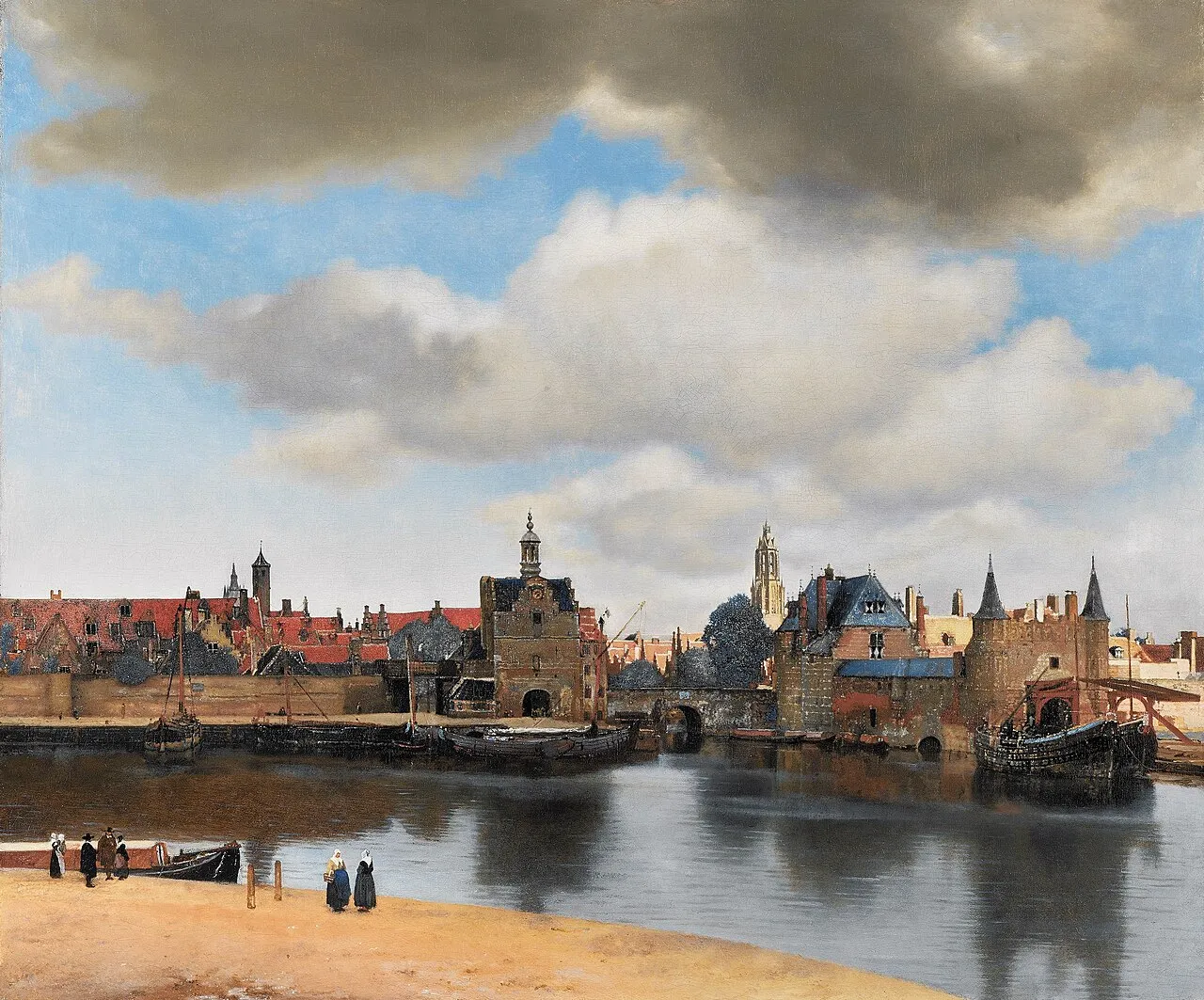
Johannes Vermeer was born in 1632 in the Dutch city of Delft. His father ran an inn facing the Markt while also dealing in art, allowing the young Vermeer to cultivate an eye for painting amid a constant flow of diverse patrons and pictures. Following his father's death when he was twenty, he took over the art dealership, and the following year registered as a master in the local Guild of Saint Luke. In his early years, influenced by the dramatic chiaroscuro of the Utrecht Caravaggisti, he produced large-scale history paintings on religious and mythological themes.
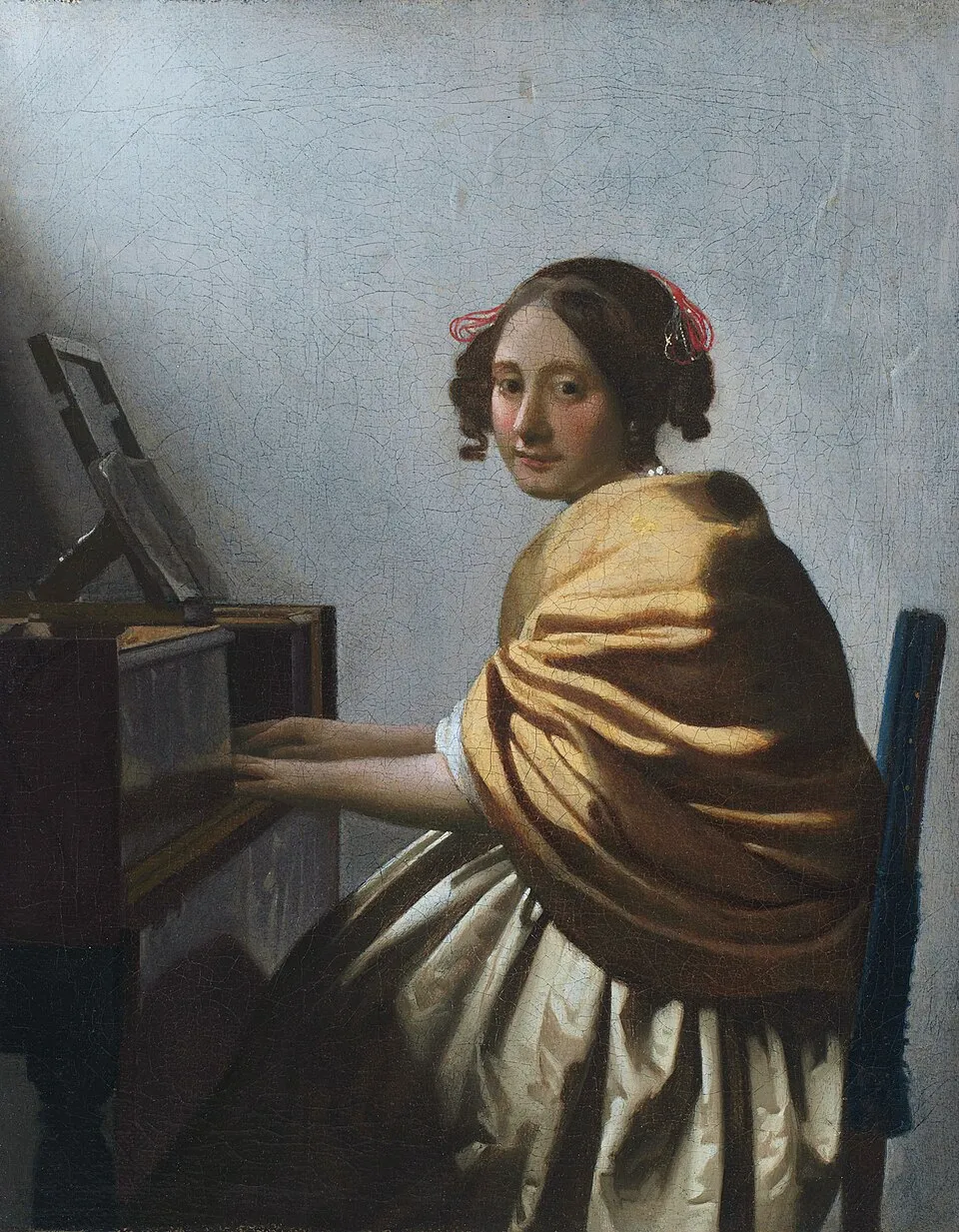
In the mid-1650s, his creative direction shifted dramatically. Absorbing the spatial techniques of interior scenes pioneered by contemporaries such as Pieter de Hooch, Vermeer narrowed his focus to figures absorbed in their private living spaces. Stripping all theatrical drama from everyday moments—such as a woman reading a letter or musicians tuning their instruments—he began to concentrate entirely on harmonizing the behavior of light within rigorously measured interiors.
It was during this period that he established his approach to rendering light as pure optical phenomena. Conducting visual experiments with devices such as the camera obscura, which projected external views into a darkened box, he reproduced the unfocused halos of light observed through them onto canvas using minute dabs of paint known as pointillé. He also attached strings to pins placed at vanishing points to construct precise perspective grids. Pieter Teding van Berckhout, an aristocrat who visited his studio in 1669, noted in his journal that this mastery of perspective was the most extraordinary aspect of the painter's work.
His artistic output was sustained by his affluent mother-in-law, Maria Thins, and a local patron, Pieter Claesz van Ruijven, who had the right of first refusal for his works. Around 1660, Vermeer moved into his mother-in-law's spacious home in the Catholic quarter, setting up his studio in a second-floor room facing northwest. Bathed in the steady northern light from the windows, the room's marble floor tiles, fine musical instruments, and his mother-in-law's art collection were incorporated directly into his paintings as recurring motifs. Producing at an exceptionally slow pace of only two or three works a year, he nevertheless maintained a comfortable livelihood thanks to the substantial sums paid by his patron.
Yet this stability unraveled in 1672 when the French army invaded the Dutch Republic. In defense, dikes were breached to flood the land, cutting off the income from his mother-in-law's tenant farms, and the art market collapsed entirely. Unable to sell the works of other artists he had acquired as a dealer, Vermeer sank into heavy debt. Tormented by the distress of financial ruin, he died suddenly in December 1675 at the age of forty-three. In a subsequent notarized document, his widow, Catharina, testified that within only a day or a day and a half, he had declined from good health to death.
After his death, Vermeer's name faded rapidly from art history, and for a long period, his works were traded under the forged signatures of other painters. He remained largely forgotten for nearly two centuries until his rediscovery in the mid-19th century by the French critic Théophile Thoré-Bürger. Today, his surviving works, held in collections such as the Rijksmuseum, are subject to non-destructive scientific analysis. Examination of "The Milkmaid" revealed a vigorous, rapidly executed underdrawing, showing that a fire basket and a jug rack initially included in the background were painted over in the final composition. These deliberate adjustments, preserved beneath layers of paint, reveal his painstaking process of paring down space to achieve ultimate harmony.