
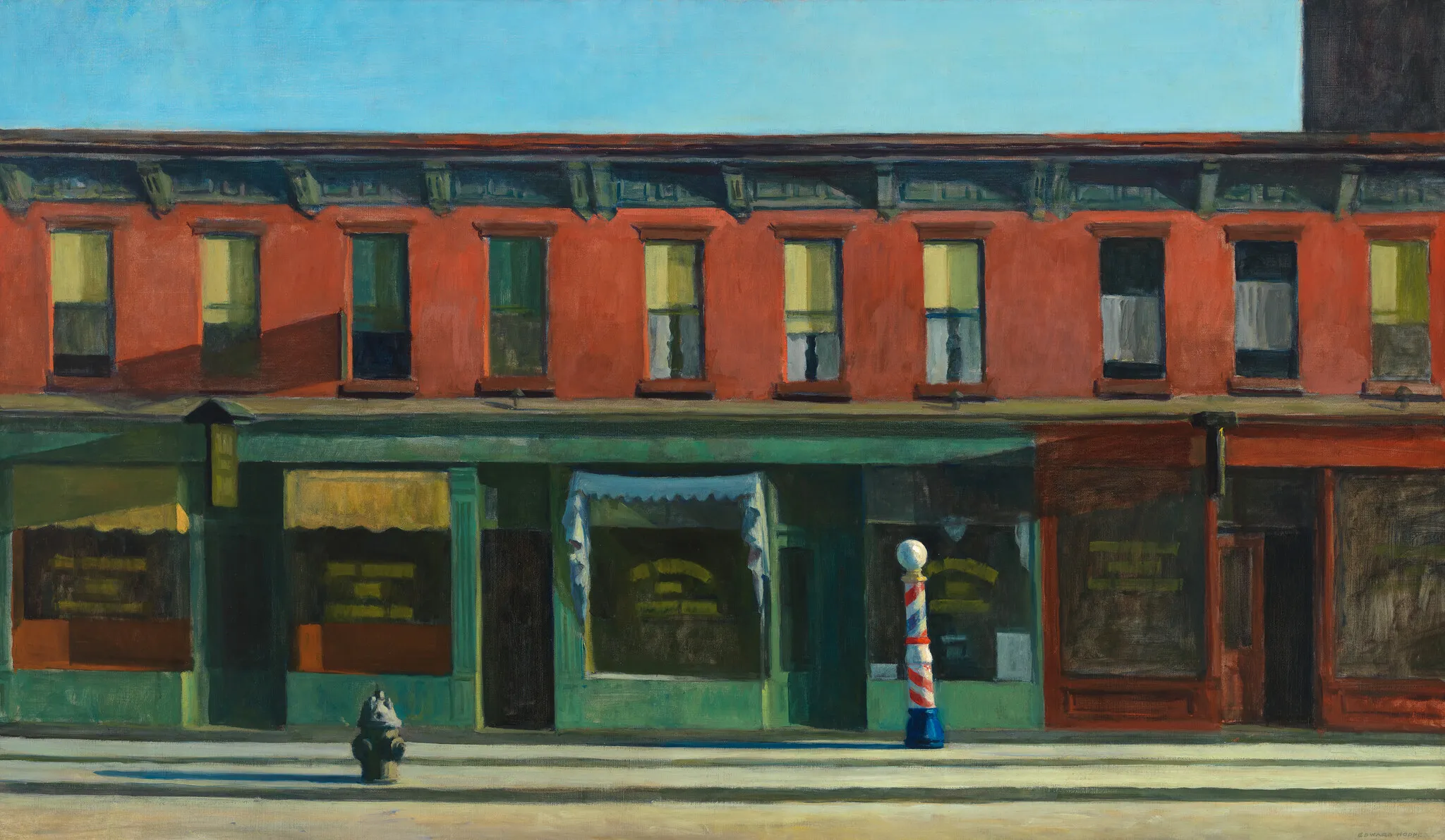
Early Sunday Morning
1930
- Dimensions
- 89.4 × 153.0 cm
- Medium
- Oil on canvas
- Collection
- Whitney Museum of American Art
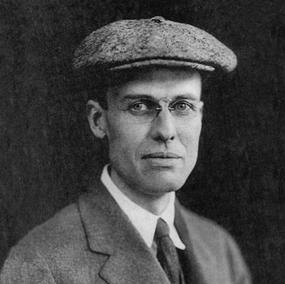
A defining figurative painter of twentieth-century American art, he captured urb…
A quiet rebellion against treating painting as a mere copy of landscape. To accentuate the loneliness and stillness of the city, the artist deliberately excluded human figures and cast impossible shadows, constructing an evocative theatrical space.
✦ Highlights (technique & color)
The extreme horizontal format creates a panoramic effect that guides the viewer's gaze across the composition. Its most striking feature is the cast shadows, which fall in a physically impossible direction. If sunlight from the east were to strike a north-south street, the shadows would recede into the background; instead, the painter artificially introduced dramatic lateral illumination reminiscent of theatrical stage lighting.
✦ The setting of this painting
New York in 1930. This fictional cityscape is an amalgamation of memories, incorporating actual buildings along Seventh Avenue and Bleecker Street, as well as scenes from the artist's hometown of Nyack. It depicts a quiet moment just after sunrise, before the day's commercial bustle begins.
✦ Historical context
Shortly after the onset of the Great Depression triggered by the 1929 stock market crash. The deserted streetscape, appearing as if the city's commercial life has ground to a halt, evokes the economic stagnation of the era. It was also a period of urban renewal, during which 19th-century low-rise red-brick neighborhoods were giving way to modern high-rises.
Reddish-brown brick buildings stretch across the horizontal canvas.
A shop with its green awning drawn down.
A storefront with a red facade.
A fire hydrant and a barber's pole standing solitary on the sidewalk.
A quiet scene of an early Sunday morning.
A realistic painting faithfully capturing a New York street corner during the Great Depression.
This is how the work is often described.
Even the title is Early Sunday Morning.
Anyone would assume that it is simply a slice of real-life scenery.
Yet in truth, this painting conceals major fabrications.
One is the erased presence of a human figure.
Another is the impossible direction of the shadows.
And even the title was not chosen by the artist himself.
New York, 1930.
The forty-eight-year-old Edward Hopper was in his studio on Washington Square.
The stock market had crashed the previous year.
The dark shadow of the Great Depression was beginning to fall over the city.
It was born from the despair of an artist impoverished by the Great Depression—
or so it is sometimes said, but that is not the case.
Hopper's paintings were selling, and he was financially very secure.
Together with his wife, Jo, he lived a well-ordered, disciplined life.
An independent project, undertaken without commission.
What he sought to paint was the familiar sight of Seventh Avenue,
or perhaps the old brick buildings of Bleecker Street,
or the streetscapes of his hometown, Nyack.
These were the historic sights that were being torn down, one after another, in the wake of urban redevelopment.
Hopper did not simply sketch a real street from life.
He combined memories of several places to construct a single scene.
Partway through the process,
he had painted a figure in one of the second-story windows.
Perhaps the model was his wife, Jo.
The silhouette of someone standing by the window.
Yet just before completion,
Hopper painted over the figure entirely.
A deserted street.
He banished every trace of living presence from the canvas.
Furthermore, he bent the laws of light.
If the morning sun shines from the east onto a north-south avenue,
the shadows should fall back toward the buildings.
A fabricated shadow.
About 184 more words
Read stories of masterpieces for free
Your Note
Write down what this painting made you feel in your art notebook.
Please sign up to write notes.
Sign up for freeRecommended Artworks
.webp)

Sources & references
More artists
If you find an error in this content, please let us know here
This site is protected by reCAPTCHA, and the Google Privacy Policy and Terms of Service apply.