
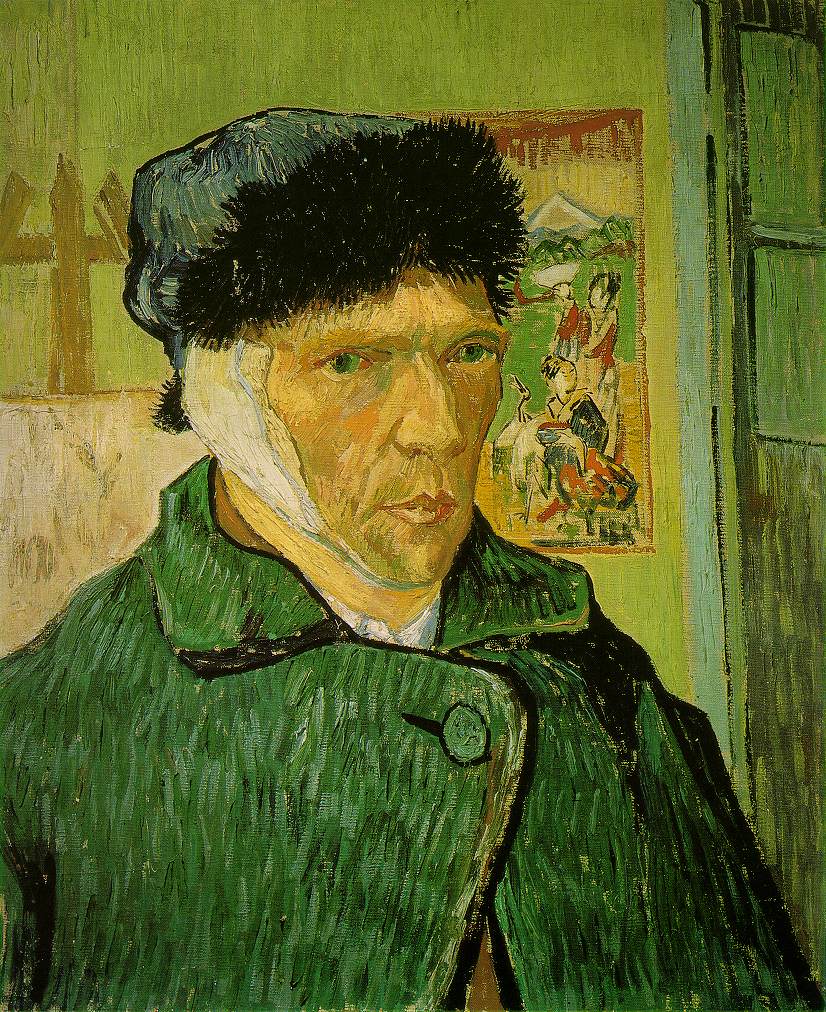
Self-Portrait with Bandaged Ear
1889
- Dimensions
- 60.5 cm × 50.0 cm
- Medium
- Oil on canvas
- Collection
- The Courtauld Gallery
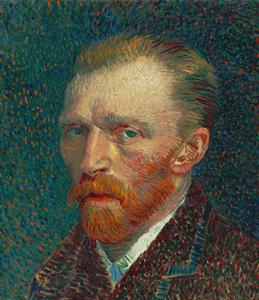
A Post-Impressionist painter who fundamentally revolutionized the visual languag…
A quiet yet fierce defiance against despair and the label of madness. Painted at the very site where his dream of a brotherhood had collapsed, this work is an indomitable testament to his sanity and his resolve to survive as a painter.
✦ Highlights (technique & color)
The work makes powerful use of impasto, laying thick coats of oil paint onto the canvas. The visible traces of palette knives and stiff bristles infuse the surface with raw energy. In addition, carefully calculated complementary contrasts—such as the red and orange background paired with the green coat, and the yellow wall set against the blue cap—enhance one another, generating profound psychological tension.
✦ The setting of this painting
The setting is the second-floor studio of the Yellow House in Arles, in the South of France. It was January 1889, a bitter winter swept by the fierce, biting winds of the mistral. Inside the poorly heated room, Van Gogh painted while bundled in a heavy overcoat and winter cap. This was the sanctuary where he had envisioned an artists' collective—and the tragic scene of its unraveling.
✦ Historical context
In the late 1880s, the French art world witnessed the flowering of Post-Impressionism, which sought to convey the artist's inner emotional state and symbolic meaning. A vital driving force behind this movement was Japonisme. The clear contours and bold, flat colors of ukiyo-e woodblock prints liberated painters from traditional Western conventions, and Van Gogh was among those profoundly influenced by them.
A man clad in a heavy green coat and a winter cap trimmed with black fur.
A thick white bandage is wound painfully from the right side of his head to beneath his chin.
His gaze reaches beyond the frame, staring directly at us.
His expression is rigid, held in profound silence.
December 1888, Arles in the south of France.
Van Gogh clashed with Gauguin and severed his own ear.
This painting was created in the immediate aftermath.
For that reason, it is often thought to have been painted impulsively, in the grip of madness.
Or so one might assume.
Yet the truth is quite different.
This is not a record of a deranged mind.
It is an indomitable declaration, conceived with remarkable calm and calculation.
On the night of the incident,
overcome by frenzy following a fierce argument, he cut off his own ear.
Wrapping the severed ear in paper, he went to a brothel.
There, he handed it to Gabrielle Berlatier, a young woman working as a cleaner.
The next morning, he was found unconscious from severe blood loss.
He was rushed to the hospital in Arles,
where he was treated by Dr. Félix Rey, a young intern, and his colleagues.
For many years, it was said that he had merely sliced off a small piece of his earlobe.
In 2016, however,
a sketch drawn by Dr. Rey was discovered.
It revealed a devastating reality, showing that only a tiny fragment of the earlobe had been spared.
Nearly the entirety of his left ear had been sliced away.
A catastrophic wound.
Gauguin left, and the dream of their communal life collapsed.
His livelihood depended entirely on allowances sent by his brother Theo from Paris.
He was profoundly broken, both in body and spirit.
Yet on January 7, 1889, he was discharged.
He returned to his studio in the "Yellow House," the very setting of the tragedy.
In January, Arles is whipped by the cold, fierce winds of the mistral.
Inside his poorly heated room,
he wrapped himself in a heavy green coat.
Holding the heavy dressing firmly in place with a blue cap,
he stood before the mirror.
Because he painted his own reflection, the bandage appears on the right side of the canvas.
In reality, it was his left ear that he had severed.
- This work is part of “6 works for you” for The Mad Genius → See
About 166 more words
Unlock this story's ending, and every article on MusicStory
- 42
Stories1–2 new every week
An archive of paintings paired with great music, made for a weekend night and a cup of coffee
- 319
Paintings with commentarygrowing daily
From simply looking to truly reading — the brushwork and the obsession of the masters
- 10
Music Librarygrowing daily
Know it first, and what reaches your ear changes — background music becomes art you keep for life
My Notes, unlimited
Every reading adds to a digital art notebook that is yours alone
Already have an account? Log in
Your Note
Write down what this painting made you feel in your art notebook.
Please sign up to write notes.
Sign up for freeRecommended Artworks

Sources & references
More artists






If you find an error in this content, please let us know here
This site is protected by reCAPTCHA, and the Google Privacy Policy and Terms of Service apply.