
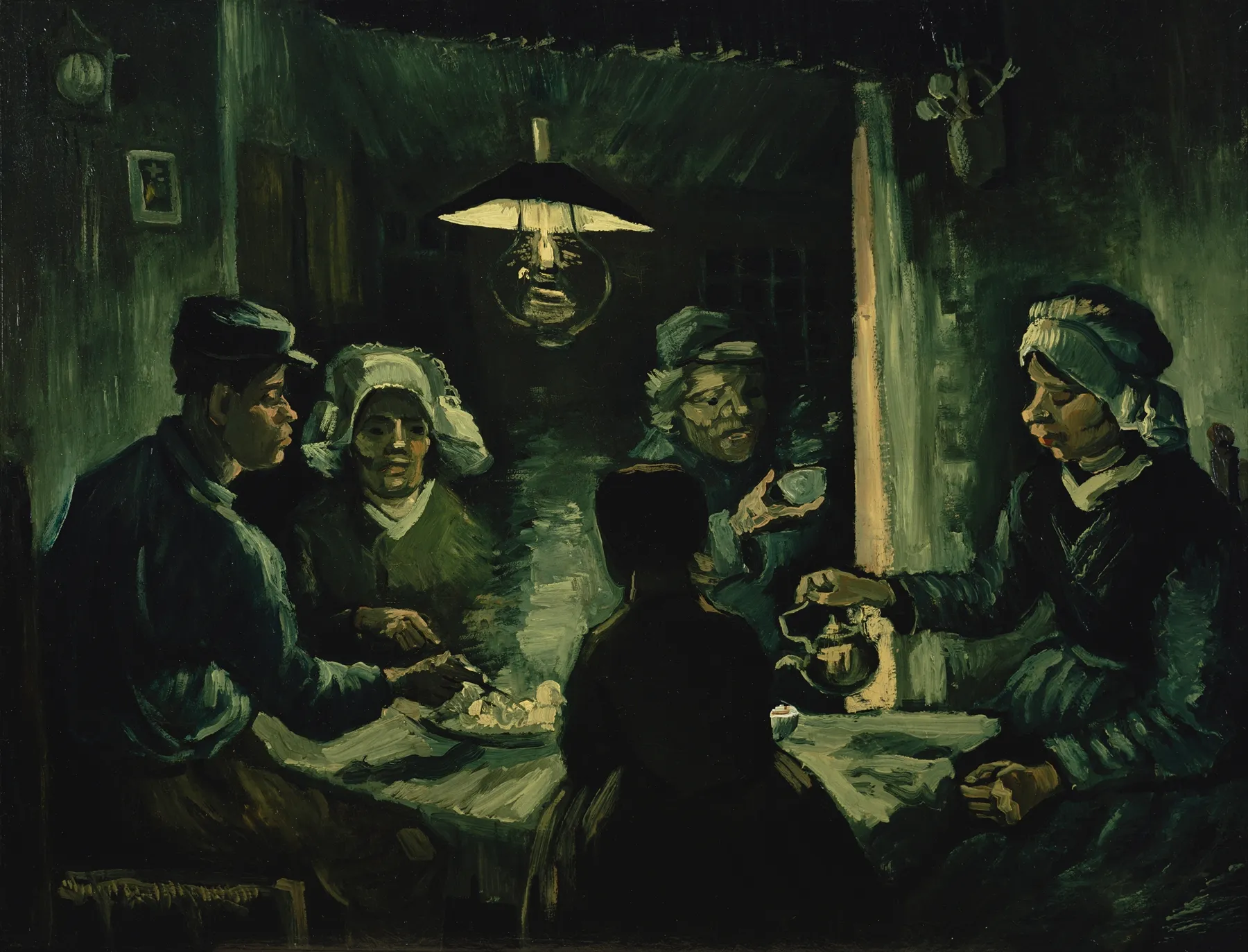
The Potato Eaters
1885
- Dimensions
- 82.0 × 114.0 cm
- Medium
- Oil on canvas
- Collection
- Van Gogh Museum (Amsterdam, Netherlands)
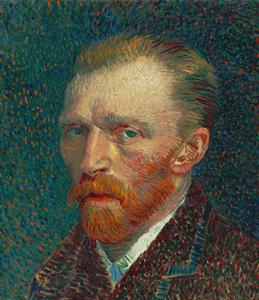
A Post-Impressionist painter who fundamentally revolutionized the visual languag…
A fierce rebellion against an art world that demanded pretty pictures. A cry from the soul, etched with profound respect for peasants who worked the earth with their own hands and lived with honest dignity, as well as the pride of an artist coming into his own.
✦ Highlights (technique & color)
The impasto technique is employed throughout, building up paint in exceptionally thick layers. Frequently working wet-on-wet before the underlayers dried, the artist also wiped away contours with a dry brush or cloth, allowing the figures to meld into the background. Rather than relying on simple blacks and browns, the palette blends dark blues, greens, and ochres into a complex mix, achieving a dusty, earthy tone reminiscent of an unpeeled, muddy potato.
✦ The setting of this painting
The scene is set in the village of Gerwen, near Nuenen in North Brabant, the Netherlands, inside the combined living and dining quarters of the de Groot family, who were actual tenant farmers. It was a typical cottage with a low thatched roof and an earthen floor. The time is seven in the evening. After toiling in the marshy fields from dawn to dusk, the family gathers at the end of the day to share a humble supper of home-grown potatoes and weak grain coffee.
✦ Historical context
In late 19th-century Europe, as the Industrial Revolution and urbanization gathered pace, severe poverty among tenant farmers in traditional rural areas remained a grave social issue. The peasantry of North Brabant owned no land of their own, relying on cheap, calorie-rich potatoes as their lifeline. Moreover, oil lamps had begun spreading to rural households in the mid-19th century, introducing stark contrasts of light and shadow into domestic interiors.
In a dimly lit room, a dining table is illuminated by lamplight.
Peasants gather together, reaching for steaming potatoes.
Heavily distorted faces.
Knobby, awkward hands.
Looking at these crude, rough brushstrokes, one might assume
that it was dashed off on a whim right beside their table,
or perhaps that the artist simply lacked the skill to render them correctly.
Yet in truth, that could not be further from the case.
This painting was the culmination of over a hundred studies produced across a single winter.
Born of meticulous planning, it was his very first major work.
The year was 1885.
Vincent van Gogh was living in Nuenen, in the Netherlands.
At 32 years of age, five years had passed since he decided to teach himself how to paint.
With no means of earning an income of his own,
he relied entirely on remittances sent by his younger brother Theo, an art dealer in Paris.
To afford painting supplies, he went so far as to cut back on his own food.
Neglect and poor nutrition had ruined his teeth and wrecked his health.
In March, his father Theodorus died suddenly.
Amid family friction and grief,
his isolation deepened, yet he resolved to prove his true worth:
by creating an ambitious multi-figure composition that could hold its own in the Parisian art market.
The setting was the nearby village of Gerwen,
the cottage of an actual tenant farming family, the De Groots.
From dawn until dusk, they toiled in harsh wetland fields.
Their staple diet consisted of nothing more than homegrown potatoes and weak grain coffee.
Day after day, Van Gogh frequented this modest cottage.
Gordina de Groot, the young woman seated at the back right of the composition—
he produced more than forty studies of her head alone.
Day in, day out, he tirelessly observed the faces and hands of these laborers.
Then, in late April,
he secluded himself in his studio to complete the final canvas, weaving together memory and imagination.
It was proof that he had matured into an accomplished figure painter—
a work in which he took absolute pride.
Seeking their appraisal, he sent the canvas to Theo in Paris,
and dispatched a lithograph to his close friend, the painter Anthon van Rappard.
- This work is part of “6 works for you” for The Poet of Sorrow → See
About 231 more words
Unlock this story's ending, and every article on MusicStory
- 42
Stories1–2 new every week
An archive of paintings paired with great music, made for a weekend night and a cup of coffee
- 319
Paintings with commentarygrowing daily
From simply looking to truly reading — the brushwork and the obsession of the masters
- 10
Music Librarygrowing daily
Know it first, and what reaches your ear changes — background music becomes art you keep for life
My Notes, unlimited
Every reading adds to a digital art notebook that is yours alone
Already have an account? Log in
Your Note
Write down what this painting made you feel in your art notebook.
Please sign up to write notes.
Sign up for freeRecommended Artworks
Sources & references
More artists
If you find an error in this content, please let us know here
This site is protected by reCAPTCHA, and the Google Privacy Policy and Terms of Service apply.