
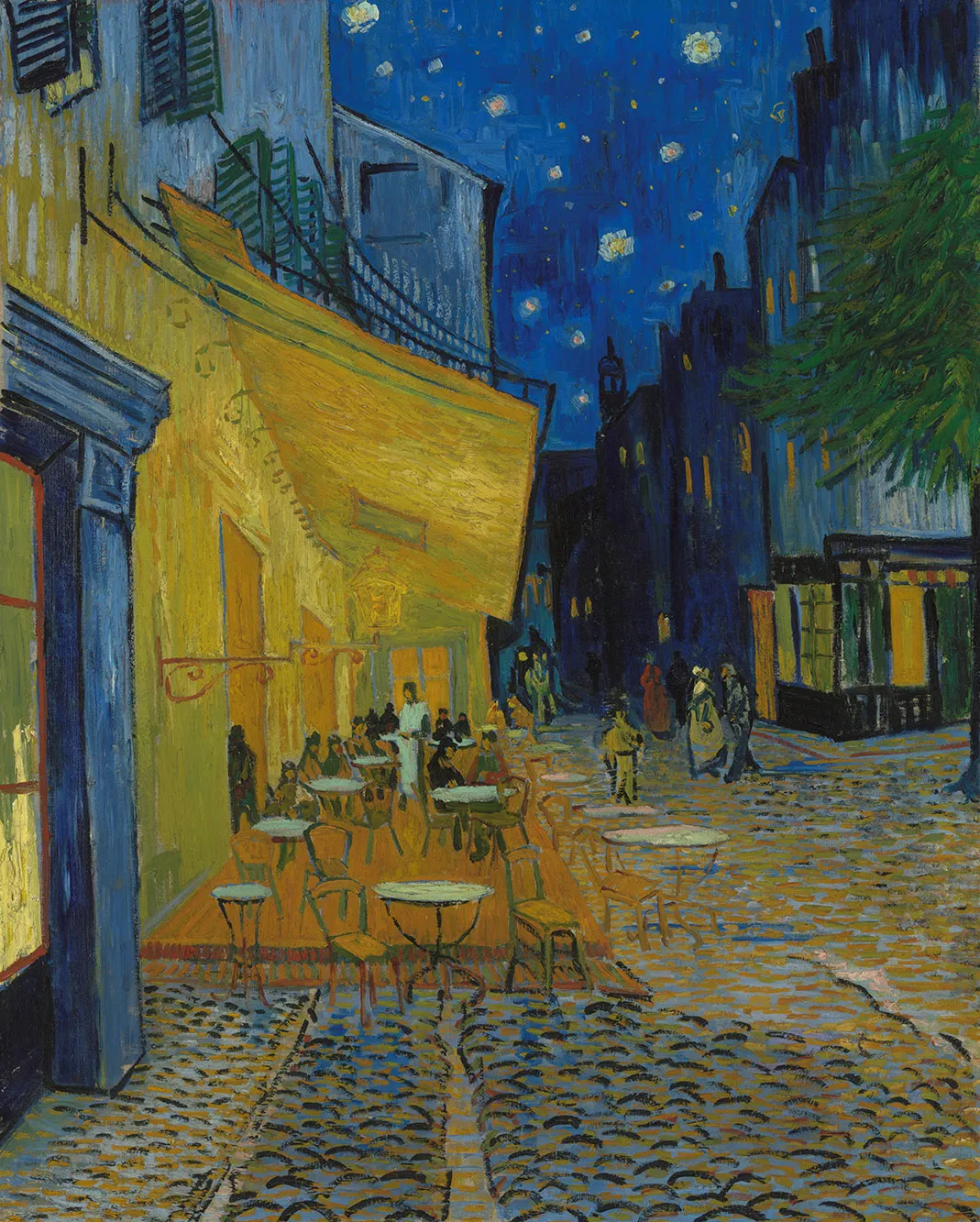
Café Terrace at Night
1888
- Dimensions
- 80.7 cm × 65.3 cm
- Medium
- Oil on canvas
- Collection
- Kröller-Müller Museum (Otterlo, Netherlands)
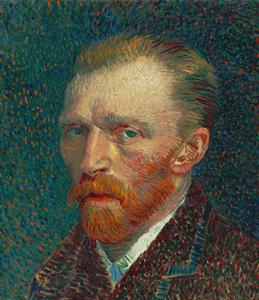
A Post-Impressionist painter who fundamentally revolutionized the visual languag…
A vibrant rebellion in color against the conventional darkness of traditional night scenes. A testament to joy, capturing both the hopeful light of waiting for a cherished companion and the fierce vitality of modern city nightlife.
✦ Highlights (technique & color)
The most remarkable aspect of this work is that, despite being a nocturnal scene, Van Gogh used no black paint at all. The darkness and shadows are rendered through combinations and layered applications of blue, green, and violet. Moreover, by placing complementary colors side by side—the warm yellows and oranges of the terrace against the cool blues and violets of the night sky—the artist intensifies each hue, creating the illusion that the entire canvas is glowing. The thick impasto technique also lends a tactile presence and dimension to the light and stars.
✦ The setting of this painting
This scene looks down the Rue du Palais from the northeastern corner of the Place du Forum in the Cité district of Arles, Provence, in southern France. In the late 19th century, the growing adoption of gas lighting as urban infrastructure transformed the square into a bustling leisure spot for citizens in the evening. Known at the time as the Café La Terrasse, the establishment continues to operate today as the Café Van Gogh.
✦ Historical context
In late 19th-century Europe, the rapid expansion of gas lighting in urban centers gave rise to an outdoor nightlife culture. With city streets and cafés brightly illuminated after dark, artists gained the means to capture the modern urban nightscape. Van Gogh was also deeply influenced by the crisp color planes of Japanese ukiyo-e woodblock prints and the Cloisonnism practiced by contemporaries like Louis Anquetin, a technique of bounding areas of flat color with dark outlines.
A café terrace sheltered beneath a vibrant yellow awning.
Above, a large gas lantern bathes the round tables and chairs in a warm, golden glow.
Silhouettes of patrons gather in the gentle illumination.
Looking up, large stars shine brilliantly in the deep ultramarine sky framed between the buildings.
A warm scene emerges from the darkness of the night.
Today, the Café Van Gogh, with its yellow facade, still welcomes visitors in Arles.
It seems as though it has preserved its appearance from that very era.
When painting a nocturnal scene, black paint is typically used to convey the darkness.
Yet in truth,
back in 1888, the exterior walls of this café were not yellow at all.
And there is another even more surprising fact:
Van Gogh did not use a single stroke of black paint to depict this night scene.
In February 1888,
Van Gogh moved from Paris to the town of Arles in the Provence region of southern France.
In September of that year, he rented the Yellow House, his heart brimming with excitement for a new project:
establishing the Studio of the South, a shared haven and workshop with fellow painter Paul Gauguin.
During this period, as he eagerly awaited Gauguin's arrival the following October,
Van Gogh's creative drive reached an extraordinary peak.
Though he was in financial straits, relying on funds sent by his brother Theo for living expenses and art supplies,
he was emotionally serene, completely absorbed in his pure artistic pursuits.
It was around this time that Van Gogh strolled through the nocturnal streets of Arles.
And then,
he came upon a café on the Place du Forum in the city center.
In the late nineteenth century, gas lamps had only recently begun to spread across urban spaces.
It was a striking new sight, brightly illuminating the darkness of the night.
He had been engrossed in Guy de Maupassant's novel Bel-Ami,
captivated by its description of a brightly lit café terrace and a starry sky along the boulevard.
He resolved to express that very atmosphere in his own painting.
He brought his canvas directly to the location at night—
a revolutionary method for the time, painting outdoors directly under the glow of the gas lamps.
In a letter to his sister Wil, he recorded this spontaneous surge of passion:
"Normally one makes drawings and sketches beforehand, but I decided to make a painting of it straight away."
About 222 more words
Unlock this story's ending, and every article on MusicStory
- 42
Stories1–2 new every week
An archive of paintings paired with great music, made for a weekend night and a cup of coffee
- 282
Paintings with commentarygrowing daily
From simply looking to truly reading — the brushwork and the obsession of the masters
- 10
Music Librarygrowing daily
Know it first, and what reaches your ear changes — background music becomes art you keep for life
My Notes, unlimited
Every reading adds to a digital art notebook that is yours alone
Already have an account? Log in
Stories featuring this painting
Your Note
Write down what this painting made you feel in your art notebook.
Please sign up to write notes.
Sign up for freeRecommended Artworks
Sources & references
More artists
If you find an error in this content, please let us know here
This site is protected by reCAPTCHA, and the Google Privacy Policy and Terms of Service apply.