
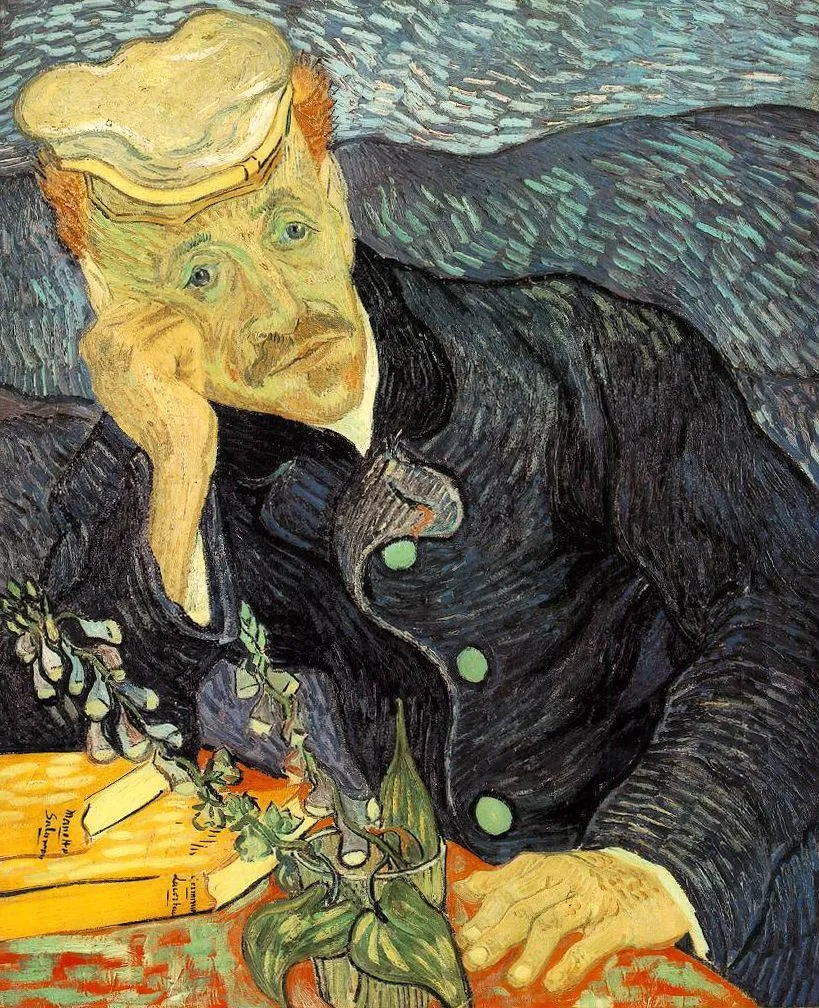
Portrait of Doctor Gachet
1890
- Dimensions
- 67.0 cm × 56.0 cm
- Medium
- Oil on canvas
- Collection
- Private collection
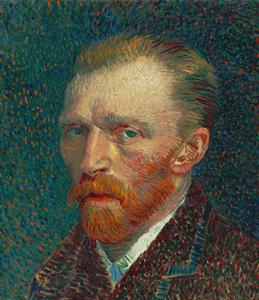
A Post-Impressionist painter who fundamentally revolutionized the visual languag…
Rejecting mere superficial likeness, this work resonates deeply with the spiritual sorrow of modern humanity. A pinnacle of modern portraiture, it imprints a singular pathos and passion upon the somber face of a friend who shared the artist's own isolation.
✦ Highlights (technique & color)
On rough canvas, the artist applied a fierce impasto, brushing paint straight from the tube across the surface in a single, unhesitating burst without preparatory sketches. The dark blue jacket and the red table in the foreground create a sharp complementary contrast that dramatically accentuates Dr. Gachet's pale skin and melancholic expression. His precariously tilted posture visually underscores his inner psychological turmoil.
✦ The setting of this painting
The setting is the residence of Dr. Gachet in Auvers-sur-Oise, a rural village northwest of Paris. In the late 19th century, the opening of the railway transformed it into an artistic haven frequented by many painters. The Gachet estate was an imposing stone house built into the hillside, surrounded by an expansive garden planted with a rich variety of alpine flora and medicinal herbs. The natural early summer light filtering onto the outdoor terrace profoundly influenced the palette of this painting.
✦ Historical context
The years around 1890 marked a transition from Impressionism to Post-Impressionism. It was also an era when rapid industrialization and urbanization made 'neurasthenia' and 'melancholy' widespread social concerns. Years later, the painting would be caught in the turbulent tides of history, targeted in 1937 by Nazi Germany's suppression of 'degenerate art' and forcibly confiscated from a museum.
A man rests his elbow on a red table, propping his right cheek with his hand. Clad in a blue jacket, his gaze wanders into the distance.
His name is Paul-Ferdinand Gachet, the physician who cared for Van Gogh in the final months of his life. All too often, he has been portrayed as a cold-hearted quack whose inadequate care drove the artist to take his own life.
Yet the reality was quite different.
For Van Gogh, he was an essential pillar of emotional support—an irreplaceable confidant bound by a deep friendship.
In May 1890, having ended his solitary confinement at the asylum in Saint-Rémy, Van Gogh journeyed to Auvers-sur-Oise, on the outskirts of Paris. It was in this lush, tranquil village that he met the sixty-two-year-old Dr. Gachet.
At first, there was apprehension. "He is as sick as I am, or perhaps even more so," Van Gogh wrote in a letter to his brother Theo.
Yet within a few weeks, the two men had formed a close bond. Gachet was far more than a country doctor; well-read in contemporary literature, he possessed a profound understanding of an artist's inner torment. He was an amateur printmaker himself and an ardent lover of the arts.
Van Gogh visited Gachet's home regularly, sharing meals with the family and painting in the garden of medicinal herbs. Gachet even guided him in the craft of etching.
Van Gogh's creative drive reached its zenith. Over roughly seventy days, he painted at an astonishing pace, completing more than eighty works.
One day, Gachet saw one of Van Gogh's self-portraits—the one set against a swirling blue background. Deeply moved, he asked the artist to paint his portrait in that exact style.
Van Gogh turned to his canvas. It was not a paid commission; he took up his brush entirely of his own accord.
In the deep weariness and melancholy etched into Gachet's face, Van Gogh recognized the sorrow and ardent passion of the modern soul.
In the foreground rests a sprig of purple foxglove, a remedy for heart conditions that was also used to treat mental distress. Beside it lie yellow-covered books: novels by the Goncourt brothers that portray the suffering of artists.
The portrait was a testament to his deep trust in Gachet. Two wounded souls were quietly resonating with one another.
About 214 more words
Read stories of masterpieces for free
Stories featuring this painting
Your Note
Write down what this painting made you feel in your art notebook.
Please sign up to write notes.
Sign up for freeRecommended Artworks
Sources & references
More artists
If you find an error in this content, please let us know here
This site is protected by reCAPTCHA, and the Google Privacy Policy and Terms of Service apply.