
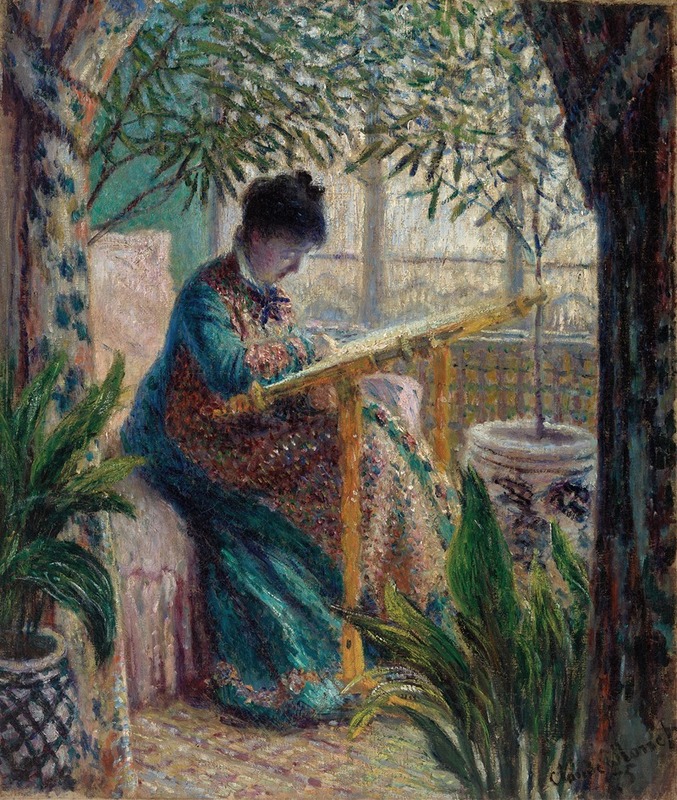
Madame Monet Embroidering (Camille au métier)
1875
- Collection
- Barnes Foundation

Celebrated as a founding figure of Impressionism, he is one of France’s most ren…
✦ Highlights (technique & color)
An experiment in allowing the light from the window to bring out the autonomy of texture. The way fabric and skin reflect light is captured with exquisite precision, complemented by remarkably free and expressive brushwork.
✦ The setting of this painting
An enclosed interior setting where soft light pours through the window, gently illuminating Camille's hands and clothing.
✦ Historical context
A transitional period in which Monet dismantled traditional academic conventions to establish his own Impressionist style, methodically devising strategies to reconstruct the physical phenomenon of light on canvas.
A woman at the window, engrossed in her embroidery.
Dressed in a beautiful blue and red patterned gown, she gazes quietly at her work.
Green plants are arranged around her, and bright light streams in through the window.
She is Camille, the beloved wife of the painter Claude Monet.
In 1875, Monet undertook an experiment within the confines of this indoor space.
He sought to capture precisely how the soft light streaming through the window illuminated her hands and clothing.
He aimed to capture that scene with meticulous detail.
For Monet, his family was not merely an object of affection.
They were muses for his most rigorous visual experiments.
Camille, with her light-reflecting clothes and skin texture, was the perfect model.
When painting portraits of external patrons, Monet faced social constraints.
He had an obligation to preserve the model's identity.
However, when painting his wife, his brushwork gained an astonishing degree of freedom.
The intimate relationship with his family provided a safe experimental ground where he could try new techniques without fear of failure.
That was the intimate relationship of family.
About 107 more words
Unlock this story's ending, and every article on MusicStory
- 42
Stories1–2 new every week
An archive of paintings paired with great music, made for a weekend night and a cup of coffee
- 282
Paintings with commentarygrowing daily
From simply looking to truly reading — the brushwork and the obsession of the masters
- 10
Music Librarygrowing daily
Know it first, and what reaches your ear changes — background music becomes art you keep for life
My Notes, unlimited
Every reading adds to a digital art notebook that is yours alone
Already have an account? Log in
Your Note
Write down what this painting made you feel in your art notebook.
Please sign up to write notes.
Sign up for freeRecommended Artworks
Sources & references
More artists






If you find an error in this content, please let us know here
This site is protected by reCAPTCHA, and the Google Privacy Policy and Terms of Service apply.